A wifi smart hose timer for raised bed drip irrigation usually costs 60 to 90 dollars more than a basic battery timer, and for a one- or two-bed vegetable garden, that premium rarely pays for itself. The wifi connection earns its place when you travel often during the growing season, run several beds with different crops on separate valves, or already manage other smart home watering gear and want one app for everything. Outside of those cases, a battery timer with a manual rain delay button covers most of the same need for a fraction of the cost. This guide walks through exactly when the upgrade makes sense and when it does not.
The Real Cost Gap Between a Battery Timer and a Wifi Timer
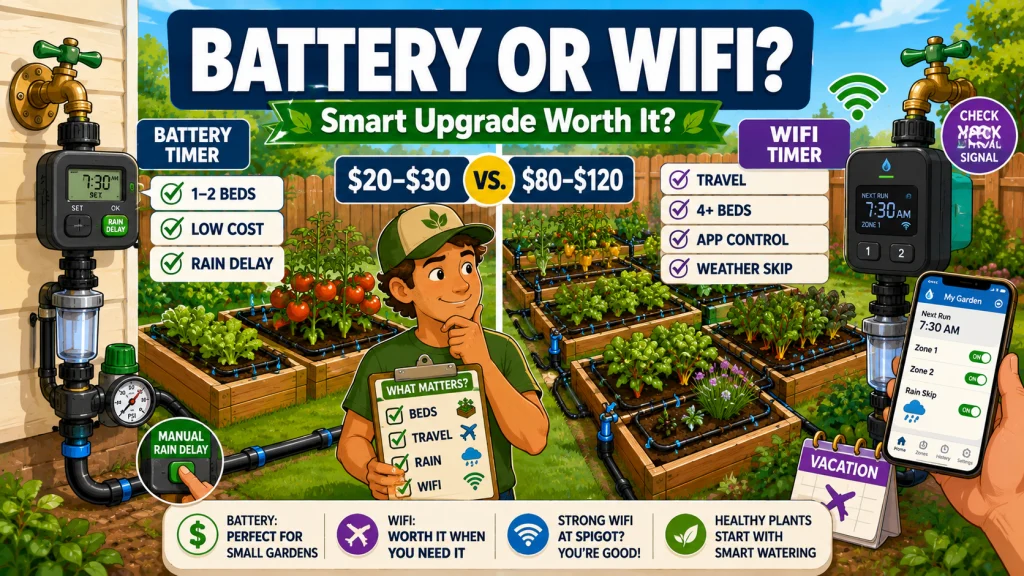
The battery timer vs wifi timer decision for raised bed drip irrigation usually comes down to a price gap that is hard to ignore. A basic digital battery timer runs somewhere in the 20 to 30 dollar range, while a wifi-connected smart hose timer typically lands between 80 and 120 dollars. For a two-bed vegetable garden running one zone off a single hose bib, that premium is rarely justified, because the battery timer already does the one job that matters most: it turns the water on and off on a schedule without you standing there with a hose.
Where the wifi version starts to earn its keep is everything beyond that basic schedule. Once you start asking the timer to adjust for weather on its own, send you a notification when something goes wrong, or run multiple valves with different watering needs, the comparison shifts. The rest of this guide breaks down exactly which raised bed situations tip the scale toward wifi and which ones do not.
What a Wifi Timer Actually Adds Over a Battery Timer
A wifi smart hose timer connects to your home network and pairs with a phone app, and that connection is where almost all of the added cost comes from. The app lets you change the watering schedule from anywhere instead of walking out to the spigot and pressing buttons on a small screen. Most models also support weather-based watering skip, which checks local forecast data and automatically holds off a cycle if rain already covered the bed. You typically get a notification when the system runs, skips a cycle, or loses connection, and some models integrate with broader smart home platforms so the same app that runs your thermostat can also run the raised bed.
None of that changes how the water actually reaches the plants. The drip line, the emitter spacing, and the run time still matter exactly as much as they do with a battery timer. What changes is how much manual attention the schedule needs once it is set, and whether you are physically present to notice and react when conditions change.
When the Wifi Upgrade Is Worth the Extra Money
The clearest case for a wifi timer is travel. If you are gone for more than a week during the growing season and cannot count on a neighbor to adjust the schedule when a heat wave or a storm rolls through, remote control stops being a convenience and starts being the reason the bed survives the trip. Checking the app from a different time zone and nudging the schedule beats hoping the fixed program you set two weeks ago still matches current weather.
The second case is scale. A garden with four or more raised beds, each running different crops with different water needs on separate valves, benefits from one app that schedules all of them instead of programming several separate battery timers by hand. The third case is simpler: if you already run a smart watering controller for your lawn and the same brand offers a hose-end version, sticking with one app for the whole property is a reasonable convenience argument even if the raised bed alone would not justify the cost.
- You travel for a week or more at least once during the growing season and have no one reliably adjusting the schedule for weather.
- You are running four or more beds with different crops on separate valves and want one schedule view instead of several timers.
- You already use a smart watering app for another part of the property and want the raised bed in the same interface.
- Your spigot location gets a strong wifi signal without needing an extender.
If two or more of those apply, the wifi premium is a reasonable trade. If none of them apply, keep reading, because the next section covers the more common situation.

A smart hose watering timer with an HWG040 WiFi and Ethernet gateway, app-based remote scheduling, weather-aware irrigation, flow tracking, and voice-control support for automated garden and drip watering.
Check On AmazonIf you click this link and buy, we earn a commission at no additional cost to you.
When a Wifi Timer Is Overkill for a Raised Bed
A single raised bed with a fairly predictable local climate is the most common case where the wifi upgrade does not pay off. If you are home for most of the growing season and can glance at the bed or check the forecast yourself, manually nudging a battery timer when rain is coming takes about ten seconds and costs nothing extra. The same goes for anyone who genuinely wants a set and forget schedule with a simple manual override rather than another app to manage on a phone that already has too many.
This is also where the difference between a 4-by-4 bed and a four-bed setup matters. One bed on one valve has almost nothing for a wifi timer to manage that a battery timer cannot already handle. The complexity that makes wifi useful only shows up once you add more beds, more crops, or more time away from home.
The Manual Rain Delay Button Covers Most of What You Are Paying For
A lot of digital battery timers already include a manual rain delay button, and that single feature handles roughly 80 percent of the weather adjustment problem at zero additional cost. If it rains, you press the button, the system skips a cycle or two, and the schedule resumes automatically afterward. The 20 percent that a battery timer cannot do on its own is reacting to weather when you are not there to press the button, which is exactly the gap a wifi timer is built to close.
That framing is the real question behind this whole decision: are you paying 60 to 90 dollars to solve a problem you already have, or a problem you might have a handful of times a year when you happen to be traveling. For most single bed and two bed setups, the honest answer is the second one, and a battery timer with a rain delay button already covers everything else.
| Factor | Battery Timer | Wifi Timer |
|---|---|---|
| Typical price range | 20 to 30 dollars | 80 to 120 dollars |
| Schedule control | Set manually at the unit | Adjust remotely from a phone app |
| Rain response | Manual rain delay button, you decide | Automatic weather-based skip in most cases |
| Best fit | 1 to 2 beds, gardener usually home | 4-plus beds or frequent travel during the season |
| Setup requirement | None beyond batteries | Reliable wifi signal at the spigot |
Use that table as a quick gut check before you spend anything. If your situation lines up with the battery timer column, there is rarely a good reason to pay for the app on top of it.

This battery-powered hose timer converts any standard faucet into an automatic single-zone watering system with programmable schedules and adjustable watering durations. The clear LCD display makes programming straightforward, and a built-in rain delay feature pauses irrigation automatically during wet weather. Designed for outdoor durability and water-resistant construction, it backs its reliability with a six-year limited warranty.
Check On AmazonIf you click this link and buy, we earn a commission at no additional cost to you.
What Can Go Wrong After You Choose?
Whichever side of this decision you land on, the first couple of weeks after setup is when small problems show up. A battery timer’s biggest weakness is that it depends entirely on you. Batteries die without warning, usually mid-cycle, and the small button screen is genuinely annoying to read in bright sun when you are trying to adjust a setting. The manual rain delay only works if you remember to press it before a storm, not after, so a missed window means the bed gets watered on top of rain you already knew was coming.
A wifi timer trades that dependency for a different one: the connection itself. A dropped wifi signal can stall a scheduled cycle without sending the notification you were counting on, and any companion hub or bridge that sits too far from the router can drop out the same way the timer does at the spigot. Weather-based skip also reads regional forecast data, not your specific yard, so a system that skips because the forecast says rain can still leave a raised bed dry if the storm misses your block entirely.
Either way, plan to watch the system closely for the first week instead of assuming it works. Run two or three cycles and check the soil afterward instead of trusting the timer display alone. Confirm the system actually opens and closes at the times you set, not just that the schedule looks right in the app or on the unit. Catching a missed cycle or a battery that is already low in week one is a lot less stressful than discovering it during a heat wave when the tomatoes are already stressed.

This dual-band WiFi 6 access point is built for large outdoor spaces including farms, estates, and RV areas, with four 8dBi fiberglass antennas delivering focused long-range signal distribution across extended distances. An IP67-rated enclosure protects against heavy rain, snow, dust, UV exposure, and extreme temperatures for year-round outdoor reliability. Supports AP, router, repeater, and WISP modes, works with 802.3af/at and passive PoE, and is fully compatible with Starlink and WAVLINK mesh networking.
Check On AmazonIf you click this link and buy, we earn a commission at no additional cost to you.
Final Thoughts: Match the Timer to the Garden You Actually Have
The battery timer vs wifi timer decision is not really about which one is better. It is about whether your raised bed setup has the kind of complexity or travel pattern that a phone app actually solves. Take an honest look at how many beds you are running, how often you are away during the season, and whether your spigot gets a solid wifi signal before you spend anything.
If you already have a working irrigation timer setup laid out in a broader look at timers for raised bed drip irrigation, this decision is the next layer on top of that, and it belongs in the same conversation as the rest of the system covered in a guide to choosing a raised bed drip irrigation kit.

This battery-powered four-outlet hose timer uses Bluetooth connectivity and app control to program and monitor watering schedules remotely. Built-in WeatherSense technology automatically adjusts schedules based on local weather data and drought conditions to conserve water. Weatherproof construction handles consistent outdoor use, and the unit is backed by a two-year limited warranty.
Check On AmazonIf you click this link and buy, we earn a commission at no additional cost to you.
FAQs
💰 Is a wifi timer worth it for a single raised bed?
Usually not. A single bed with a gardener who is home most of the season is well covered by a battery timer with a manual rain delay button, which costs far less and does most of the same job.
🌦️ Does a battery timer handle rain on its own?
Most digital battery timers need you to press a manual rain delay button. They do not check the forecast automatically, which is the main gap a wifi timer fills.
📶 Do I need strong wifi at the spigot for a smart timer to work well?
Yes. A weak or dropping signal can cause missed schedules and failed app syncs. Check signal strength at the actual spigot location before buying, especially on larger lots where beds sit far from the router.
🧮 Is a Rachio Smart Hose Timer a good fit for raised bed drip irrigation?
It can be, for gardeners running several beds on separate valves or traveling often during the season. For a single bed with manageable local weather, the added cost over a battery timer is harder to justify.
🪴 How many raised beds justify upgrading to a wifi timer?
Four or more beds with different crops on separate valves is usually the point where managing everything from one app becomes more convenient than handling several battery timers by hand.