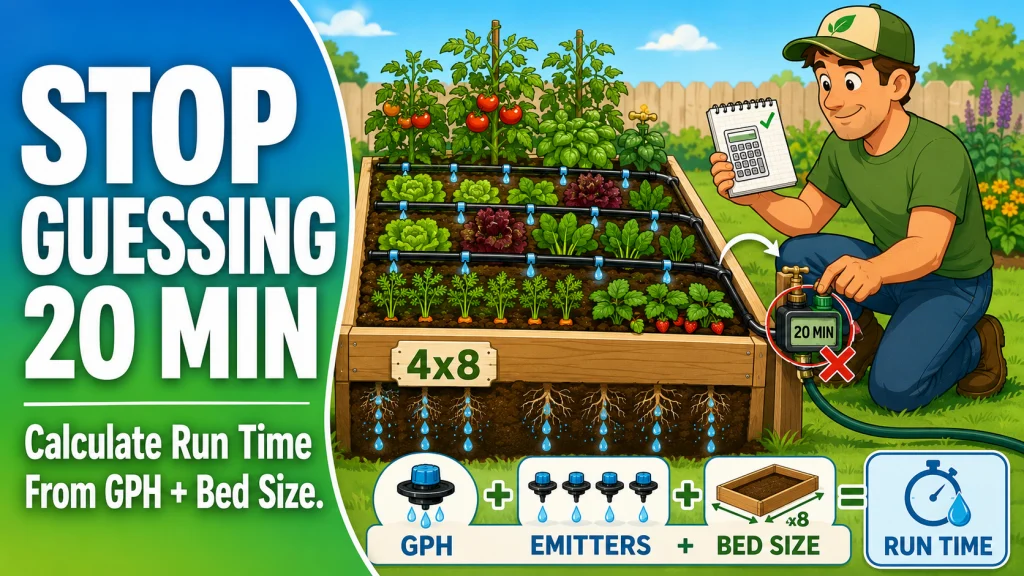
If you set your raised bed drip system to run for 20 minutes because that is the number everyone repeats online, I want to show you why that number is probably wrong for your exact setup. The real run time depends on three things: your emitter’s actual flow rate, how many emitters are feeding that specific bed, and how many gallons that bed needs per inch of water. In this guide I walk through the four-step calculation I use to turn those numbers into an actual run time, using a worked example on a 4×8 bed so you can see the math, not just the conclusion. By the end you will be able to plug in your own emitter spec and bed size and get a number that matches your system instead of a stranger’s.
The 20-Minute Number Only Works for One Setup
How long to run drip irrigation in raised beds comes down to math, not a universal rule. A 20-minute run time happens to be correct for one specific configuration: 1.0 GPH emitters spaced 6 inches apart, on soil with average drainage. Outside that exact combination, the 20-minute figure is a coincidence at best and an easy way to underwater one bed and overwater another at worst. I have walked up to raised beds running three different drip kits, all set to the same 20-minute timer, and watched one bed stay bone dry while another stayed soggy past the root zone.
This article is strictly about the run time calculation itself: how to go from your emitter’s flow rate to a real number of minutes. It does not get into how many days a week to water, which is its own calculation, and it does not cover adjusting that number for July heat or a cool spring, which depends on different variables again. Once you have a run time you trust, those questions become much easier to answer, because you are no longer guessing at the foundation underneath them.
Step 1: Find Your Emitter’s Actual Flow Rate
Every calculation starts with the number printed on the box or the spec sheet, not a guess. Drip emitters and drip tape are rated in gallons per hour (GPH), and that number varies more than most homeowners expect. A DIG ML50-style emitter line is commonly rated at 0.52 GPH per emitter, while a Rain Bird kit built around their standard GARDENKIT emitters runs closer to 0.8 GPH per emitter. Drip tape is different again: a common Homestead and Chill-style tape delivers around 0.25 GPH per emitter at 6-inch spacing.
Key point: a system built on 0.8 GPH emitters can deliver more than three times the water of a system built on 0.25 GPH tape, over the same run time. If you skip this step and assume “drip irrigation” is one flow rate, every number after it will be off, sometimes by a lot.
I usually tell people to check three places: the original packaging if it is still around, the manufacturer’s product page or spec sheet, or a stamp printed directly on the emitter line itself. If none of those are available, measure it directly: run one emitter into a measuring cup for exactly one minute, multiply by 60, and you have a working GPH number. It is not glamorous, but it is accurate, and accuracy is the entire point of this exercise.
- Does the kit list emitter GPH per emitter, not just one flow number for the whole kit?
- Does it list emitter spacing in inches?
- Does it say what water pressure that flow rate assumes?
- Does your bed’s actual line count and length match the layout the kit assumes?
If the box only gives you a timer suggestion with no flow specs behind it, treat that suggested time as a starting guess, not an answer.
Once you have confirmed those specs, you have everything Step 1 requires, and the rest of this calculation can actually be trusted instead of just hoped for.

This kit includes everything needed to water a raised bed up to 4 by 8 feet, with professional-grade components built for repeated seasonal use. It features 35 feet of emitter tubing with 70 built-in, pressure-compensating emitters spaced every 6 inches for even watering near the roots, plus 25 feet of easy-to-handle 1/4 inch distribution tubing. This low-volume design can save up to 80% on water while supporting healthier plants and better yields. Installation is straightforward thanks to an illustrated manual covering multiple layout options, and the system can be automated with a compatible Rain Bird hose-end timer sold separately.
Check On AmazonIf you click this link and buy, we earn a commission at no additional cost to you.
Step 2: Count How Many Emitters Are Actually Feeding That Bed
Once you know the flow rate per emitter, you need the total number of emitters delivering water to that particular bed, not the whole garden. Take a 4×8 bed laid out with 4 lines running the 8-foot length, with emitters spaced 9 inches apart. Each 8-foot line holds approximately 10 emitters at that spacing, so 4 lines comes out to roughly 40 emitters total in that bed.
Multiply that emitter count by the flow rate from Step 1. At 0.52 GPH per emitter (the DIG ML50-style spec), 40 emitters deliver about 20.8 GPH to that bed when the system is running. This is the number that ties your specific layout to your specific emitters, and it is also where I see the most counting mistakes. People forget a line that doubles back, or they count emitter spacing in feet instead of inches and end up with half the real total.
- Emitter flow rate (GPH), confirmed from the box, spec sheet, or a direct measurement
- Number of separate lines running through the bed
- Length of each line in feet
- Emitter spacing in inches, which determines emitters per line
- Total bed square footage (length times width)
Those five numbers are everything you need before you can calculate a run time with any real confidence. Skip one and the rest of the math is just a guess wearing a calculator.

This kit is custom designed for uniform watering in 8 by 5 foot raised vegetable and garden beds, with everything needed for setup included. It comes with up to six 1/4 inch driplines, each up to 8 feet long, delivering water directly to plant roots to minimize evaporation and ensure even coverage. No additional tools or expertise are required for installation, and the system is easily expandable as your garden grows. High-quality components are built for long-lasting, reliable performance season after season.
Check On AmazonIf you click this link and buy, we earn a commission at no additional cost to you.
Step 3: Work Out How Many Gallons the Bed Needs Per Inch
The next number is how much water “1 inch” actually means for your bed in gallons, since that is the unit most watering recommendations use. The commonly cited figure from extension and master gardener sources is 0.623 gallons per square foot to apply 1 inch of water. A 4×8 bed is 32 square feet, so 32 times 0.623 comes out to about 19.9 gallons needed to apply 1 inch across that entire bed.
This step is where bed size does most of the heavy lifting in the final answer. A 4×4 bed (16 square feet) only needs about 10 gallons for that same inch, while a 4×12 bed (48 square feet) needs closer to 30 gallons. If you are running multiple beds off the same setup, this is exactly why a single timer setting rarely treats every bed fairly unless they happen to be the same size with the same emitter layout.
Step 4: Turn Gallons Into Actual Run Time
With gallons needed and gallons delivered per hour both known, the run time calculation is just division. Take the 19.9 gallons needed for 1 inch and divide by the 20.8 GPH the system delivers, and you get 0.96 hours, or about 57 minutes, to apply a full inch to that 4×8 bed. That is the raised bed drip irrigation run time for one full inch, not for one watering session.
If you split weekly watering into 3 sessions rather than one long soak, 1 inch per week works out to about 19 minutes per session. For 1.5 inches per week, which is more typical for fruiting crops like tomatoes in hot weather, each of the 3 sessions runs closer to 29 minutes. Converting that gallons-needed number into timer minutes is the entire reason this calculation exists.
| Measurement | Value |
|---|---|
| Bed size | 4 ft x 8 ft (32 sq ft) |
| Lines in the bed | 4 lines, 8 ft each |
| Emitter spacing | 9 inches |
| Emitters per line (approx.) | 10 |
| Total emitters | 40 |
| Emitter flow rate | 0.52 GPH per emitter |
| Total delivery | 20.8 GPH |
| Gallons needed per inch | 19.9 gallons |
| Hours needed per inch | 0.96 hours (about 57 minutes) |
| Minutes per session, 1 in/week, 3 sessions | about 19 minutes |
| Minutes per session, 1.5 in/week, 3 sessions | about 29 minutes |
Notice that none of those numbers came from a generic rule. They came from this bed’s actual line count, this bed’s actual emitter spacing, and this bed’s actual square footage. Swap in a Rain Bird-style 0.8 GPH emitter on the same layout and the run time per inch drops, because more water is arriving per hour. That is the whole mechanism behind why two raised beds with the same dimensions can need two completely different timer settings.

This robust hose-end timer works with sprinklers, drip irrigation, and soaker hoses, offering simple automatic programming with full 7 day scheduling for worry-free watering. An extra-large dial and readout screen make setup and schedule review easy, while one-touch buttons allow quick cancellation, a rain delay of up to 96 hours, or manual watering on demand. The display also shows the next scheduled cycle and time remaining on the current one.
Check On AmazonIf you click this link and buy, we earn a commission at no additional cost to you.
Why Guides Disagree on How Long You Run Drip Irrigation
Extension research on this exact question has found a range of roughly 1.9 to 11.8 hours to apply 1 inch of water, depending entirely on emitter configuration. That is not a sign the research is unreliable, it is a sign that emitter flow rate and spacing genuinely matter that much. A bed running 0.25 GPH drip tape at 12-inch spacing on a narrow 4-foot-wide bed sits near the high end of that range, needing far more cumulative run time than a bed running 1.0 GPH emitters at 6-inch spacing, which sits near the low end.
Copying a 20-minute, three-times-a-week schedule from a YouTube video or a kit’s printed instructions, regardless of your own emitter spec or bed size.
Calculating raised bed drip irrigation run time from your own emitter’s GPH, your own emitter count, and your own bed’s square footage, then adjusting from there.
Field Note: I have seen the opposite mistake too, where a high-output system gets treated like a low-output one. A homeowner running a 98 GPH zone (the combined output of an entire multi-bed system, not the emitters on one small bed) for 45 minutes, 3 times a day, is putting down about 220 gallons a day on a setup that almost certainly does not need that much. Nobody set out to overwater that badly. It happened because the timer setting came from habit, not from the system’s real combined flow rate. This calculation is exactly what catches that kind of mistake before the roots start sitting in waterlogged soil.
Once you understand why the range is so wide, the disagreement between articles online stops being confusing. They are not contradicting each other, they are describing different emitter configurations without always saying so.
The Screwdriver Test: How I Verify the Math Before Trusting It
Math gets you close, but soil tells you the truth. After running the system for your calculated time, push a screwdriver or a soil probe about 6 inches down at the center of the bed, away from the emitter lines themselves. If the soil feels dry at that depth, add roughly 20 percent to your run time and test again on the next watering. If it feels saturated or waterlogged, cut the run time by about 20 percent instead.
This step matters because the calculation assumes ideal conditions: clean emitters, even pressure, and soil that absorbs water predictably. Clay-heavy mix holds water differently than a loose, sandy raised bed mix, and a clogged emitter or two can quietly throw off your real delivery rate without changing the math on paper. If you want a more thorough way to confirm the whole system is performing the way the calculation expects, it is worth reading through how to tell if drip irrigation is working in a raised bed, which walks through the broader signs of uneven delivery beyond just this one soil check.
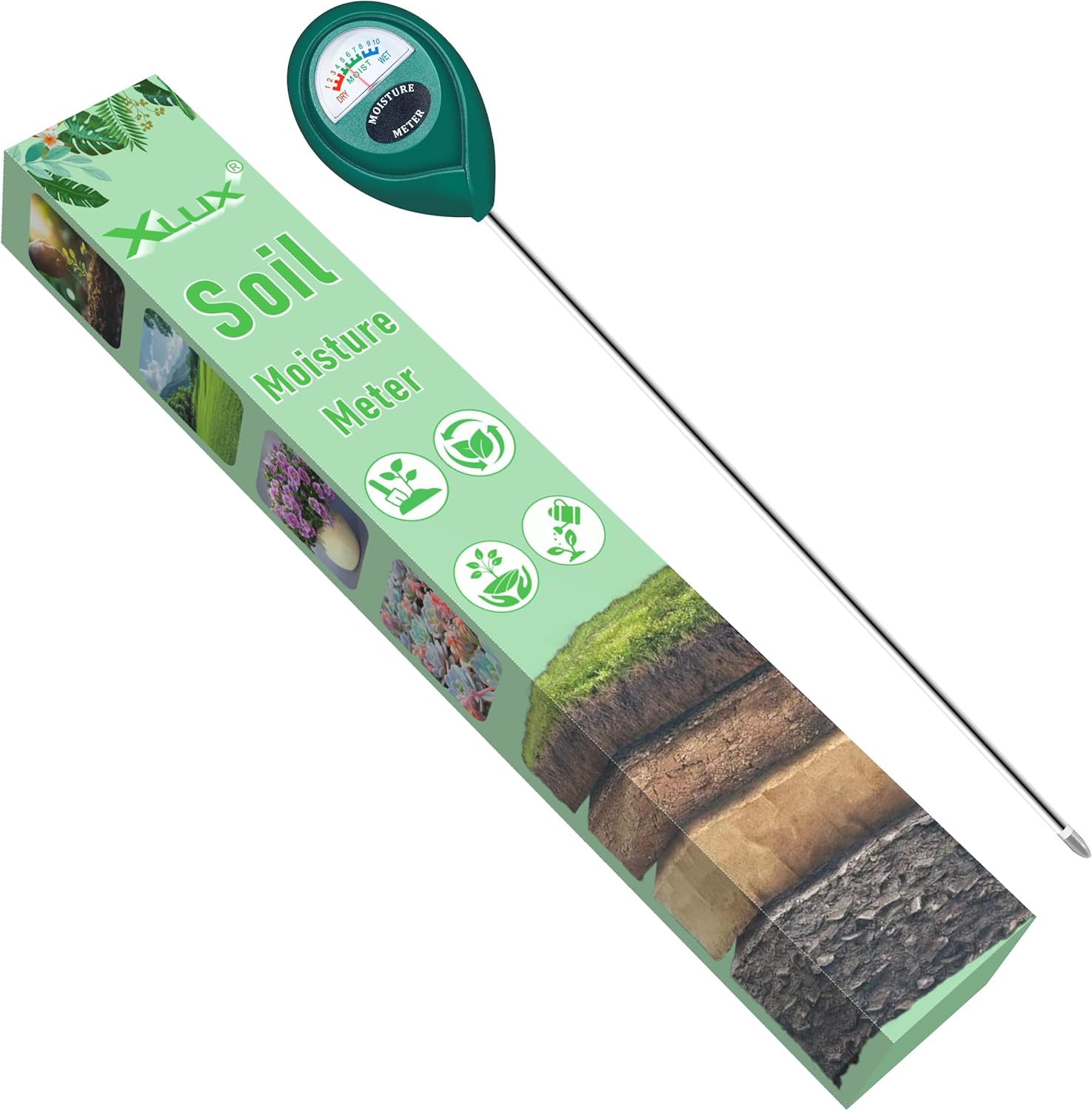
This moisture meter measures soil conditions deep inside pots and gardens with a probe 5.5 inches longer than standard styles, ideal for larger or deeper containers. Simply insert it into the soil for an immediate reading on the large, easy-to-read dial, which shows three zones across ten scales. Its single probe design causes less root disturbance than double or multiple probe meters. For best results, avoid testing hard soil or liquids, and remove the probe within 5 minutes to prevent corrosion of the metal tip.
Check On AmazonIf you click this link and buy, we earn a commission at no additional cost to you.
Final Thoughts: Your Run Time, Not a Stranger’s
What you have now is your own raised bed drip irrigation run time, built from your actual emitter spec, your actual line count, and your actual bed dimensions, not borrowed from a kit’s printed instructions or a stranger’s forum post. That number is a starting point, and the screwdriver test is what turns it from a calculation into something you have actually confirmed in your own soil.
This calculation deliberately stops at run time. It does not tell you how many days a week to water, since that depends on soil type and weather in ways that deserve their own explanation in the raised bed drip irrigation watering schedule guide. It also does not adjust for season, since a number that works in May rarely holds up in August without changes covered separately in the broader raised bed drip irrigation tips guide. Get this calculation right first, and those next decisions get a lot easier to make.

This multi-function kit connects 1/2 inch drip tubing to any 3/4 inch male threaded faucet or garden hose, helping ensure your drip irrigation system runs properly. It includes a backflow preventer, a 25 PSI pressure regulator, and a 150 mesh filter, along with a compression fitting that creates a leak-proof seal to 1/2 inch tubing. Built from UV and chemical-resistant materials for long-lasting durability, the kit can also be paired with a compatible Rain Bird hose-end timer for automated watering.
Check On AmazonIf you click this link and buy, we earn a commission at no additional cost to you.
FAQs
💧 How long should drip irrigation run for raised bed vegetables?
It depends on your emitter’s GPH, how many emitters feed that bed, and the bed’s square footage. A 4×8 bed running 0.52 GPH emitters at 9-inch spacing needs about 19 minutes per session for 1 inch a week split into 3 sessions; a different emitter or bed size changes that number.
🧮 What do I need to know to calculate raised bed drip irrigation run time?
You need five numbers: your emitter’s GPH rating, the number of lines in the bed, each line’s length, emitter spacing in inches, and the bed’s total square footage. Without all five, any run time is a guess rather than a calculation.
⏱️ Why do guides disagree on how long you run drip irrigation in a raised bed?
Because emitter flow rate and spacing vary widely between kits, and most guides quote a single number without naming the emitter configuration behind it. Research on this question shows a real range of roughly 1.9 to 11.8 hours to apply 1 inch, depending entirely on the setup.
🔍 How do I find my drip emitter’s GPH rating?
Check the original box, the manufacturer’s spec sheet, or a stamp printed on the emitter line itself. If none of those are available, run one emitter into a measuring cup for one minute and multiply by 60 to get a working GPH figure.
🌱 Does one drip irrigation run time work for every raised bed?
No. Bed size, emitter flow rate, and emitter spacing all change the math, so a 4×4 bed and a 4×12 bed on the same kit almost never need the same number of minutes. Recalculate per bed rather than copying one setting across all of them.
🪛 How do I check if my calculated run time is actually correct?
Run the system for the calculated time, then probe the soil about 6 inches deep at the center of the bed. Add roughly 20 percent run time if it feels dry, or cut about 20 percent if it feels saturated, and recheck on the next watering.