A raised bed drip irrigation watering schedule is not a single timer setting you choose once and forget. The right run time, frequency, and seasonal adjustment depend on your emitter flow rate, soil drainage, bed size, and the crops you’re growing. This guide breaks the schedule into the pieces that actually move it: how long to run the system, how often to water, how the schedule shifts with the season and the crop mix, and how to confirm the plants and soil agree with what the timer says. If the schedule still feels off after working through these pieces, the more likely problem is the system itself, not the timing, and that’s a separate diagnosis.

The Schedule Mistake That Breaks Most Raised Bed Drip Systems
A raised bed drip irrigation schedule rarely breaks because of bad tubing or a missed connector. The real damage comes from setting the timer once during install week and never touching it again. A 20-minute setting that keeps lettuce happy in May may do very little in August once the heat climbs and the same beds are pulling water twice as fast. The timer number on its own tells you almost nothing. What tells you something is the emitter flow rate, the total emitters on the line, and how long the soil actually holds that water before the bed starts drying out again.
Most generic advice treats schedule like a single fixed answer: water 20 minutes, three times a week, done. That assumes a specific emitter spacing, a specific flow rate, and soil that behaves the same in a 4×4 bed of sandy mix as it does in a 4×8 bed of clay-heavy fill. It rarely does. This guide walks through how to set a drip irrigation schedule for a raised bed using the variables that actually drive it, then how to adjust it by season and crop, and how to confirm it’s working once the system is running.
Why a Raised Bed Drip Irrigation Schedule Is Not One Number
A schedule comes out of five variables working together: emitter flow rate, total emitter count, soil drainage, crop water demand, and the season you’re in right now. Change one of those and the same timer minutes deliver a different result. A bed with 1 GPH emitters spaced 12 inches apart needs less run time than the same size bed fitted with 0.5 GPH emitters spaced 18 inches apart, even though both setups look nearly identical once the mulch goes down.
Before you touch a timer dial, it helps to know which of these factors you’re actually solving for:
- Emitter flow rate and total emitter count on the line
- Soil type and how fast it drains (sandy mix vs clay-heavy fill)
- Crop water demand (shallow-rooted lettuce vs deeper tomatoes)
- Bed size and how many beds share one line
- Current season and ambient temperature
Key point: A schedule is a working hypothesis based on emitter specs and soil type, not a fixed fact. Treat the first number you set as a starting point, not a final answer.
Most of the confusion I run into with new raised bed gardeners comes from skipping straight to a number without identifying which of these is actually driving their problem. A vegetable-bed drip schedule also needs revisiting at least once each season instead of being set once at install and left alone. If you’re still deciding how the beds are physically laid out, that’s a separate conversation from scheduling them, and the raised bed drip irrigation setup basics are worth getting settled first.
Pro Tips: Run a simple first-week calibration routine after you set the baseline schedule, instead of assuming it’s right and walking away.
- Day 1: run the baseline schedule, then check soil moisture a few inches below the surface, not just at the top.
- Day 3: note whether any wilting happens at the same time each day or only during the hottest stretch of afternoon sun.
- Day 5 to 7: adjust one variable at a time, either run time or frequency, never both in the same week.
- If the soil is still dry a few inches down despite the timer running on schedule, treat it as a delivery problem and check the system before changing the schedule again.
This kind of first-week check is what turns a calculated schedule into a confirmed one, and it’s worth doing before assuming the math alone got it right.

This robust hose-end timer works with sprinklers, drip irrigation, and soaker hoses, offering simple automatic programming with full 7 day scheduling for worry-free watering. An extra-large dial and readout screen make setup and schedule review easy, while one-touch buttons allow quick cancellation, a rain delay of up to 96 hours, or manual watering on demand. The display also shows the next scheduled cycle and time remaining on the current one.
Check On AmazonIf you click this link and buy, we earn a commission at no additional cost to you.
How Long to Run Your Raised Bed Drip System
Run time comes down to math before it comes down to feel. You need to know how many gallons your bed actually needs in a week, how many emitters are on the line, and what flow rate each emitter delivers. A 4×8 bed running sixteen 1 GPH emitters needs a noticeably different run time than the same bed running eight 0.5 GPH emitters, even though both setups look the same from the surface.
This is the calculation layer of the schedule, and it’s detailed enough that it deserves its own walkthrough rather than a shortcut here. That deeper walkthrough on how long to run drip irrigation is where the gallons-per-bed math, emitter GPH, and run time per inch of water actually belong.
How Often to Water a Raised Bed With Drip Irrigation
Once you know total weekly water, the next decision is how to split it across the week. A sandy mix that drains fast usually does better with shorter, more frequent sessions, maybe daily or every other day, because it can’t hold a big slug of water for long. A clay-heavy mix holds water longer and tends to do better with fewer, longer sessions instead of daily watering that never lets the bed dry between cycles.
Weather changes this fast. A stretch of 95-degree days pulls more water out of the soil than a mild week, even with the exact same timer setting. I usually tell people to think of raised bed drip irrigation timing as two settings, not one: a baseline frequency for normal weather, and a heat adjustment you dial up when the forecast changes. Use the raised bed drip irrigation frequency guide when the real question is daily versus every other day for your specific soil type.
Adjusting the Schedule by Season
Spring, summer, fall, and winter aren’t just weather changes, they’re schedule changes. A spring ramp-up usually starts conservative while seedlings establish, then increases as plants size up and days get longer. Summer peak is where most raised beds need the most water and the most attention, especially once temperatures consistently sit above 85 degrees and the canopy fills in enough to shade the soil from view but not from heat.
Fall reduction and winter shutdown are schedule decisions too, not just maintenance tasks tacked onto the end of the season. Cutting back too early in fall stresses crops still producing, and waiting too long into winter risks lines full of water when a freeze hits. The raised bed drip irrigation schedule by season guide lays out exactly when to start scaling back and what triggers a full shutdown.
Adjusting the Schedule by Crop
Tomatoes, cucumbers, lettuce, herbs, and carrots don’t drink the same way, and a mixed bed makes the schedule harder, not easier. Lettuce has shallow roots and wants more frequent, lighter watering, while a tomato plant with roots a foot or more down can handle a deeper, less frequent cycle without stressing. Put both in the same 4×8 bed on the same line and one of them is usually getting the wrong amount.
Field Note: The version of this I run into most often is a 4×8 bed split between lettuce on one end and tomatoes on the other, both running off a single zone built around whichever crop the gardener cared about more at install time. The lettuce edge stays wilted by afternoon while the tomato end sits in soggy soil.
Grouping crops with similar water needs on the same line, or running separate zones within one bed, usually solves more of this than adjusting the timer ever does. The raised bed drip irrigation schedule by crop guide handles those mixed-bed cases in more detail.

This upgraded hose timer features two separate programmable zones, letting you set custom start times and durations for healthier, water-efficient watering. Upgraded valves reduce flow resistance by 40%, and the IP65 waterproof housing has passed 20,000 cycle testing for long-term durability. It offers auto, manual, and rain delay modes with up to 72 hours of rain delay, plus a 2.5 inch LED display showing schedules, power status, and low battery alerts. The 3/4 inch interface fits most standard faucets, and the large button, rotating design makes setup easy for users of any age.
Check On AmazonIf you click this link and buy, we earn a commission at no additional cost to you.
How to Verify the Schedule Is Actually Working
No timer setting is the ground truth. The plants and the soil are. A schedule can look correct on paper, with the right run time and the right frequency for the season, and still miss if pressure dropped, an emitter clogged, or the line shifted after mulching. Verification is the step that catches the gap between what the timer says and what the bed is actually getting.
Two checks tell you most of what you need to know: how the plants are behaving, and what the soil feels like a few inches down, not just on the surface. A soil probe, or even a finger pushed past the dry top layer, tells you whether water is reaching root depth or just wetting the surface and running off. The how to tell if drip irrigation is working guide spells out both checks in more detail.

Trusted since 2015 and backed by over 60,000 verified ratings, this soil moisture meter uses a high-sensitivity probe to reach the root zone for an accurate, real-time reading with no batteries required. Its large, color-coded dial features 10 distinct scales from dry to wet, making it easy for beginners and experienced gardeners alike to know exactly when to water. The slim single-probe design, made from 304 stainless steel, slides into soil with minimal disturbance to protect delicate roots. It ships with a protective sleeve to keep the probe in pristine condition.
Check On AmazonIf you click this link and buy, we earn a commission at no additional cost to you.
When a Correct Schedule Still Fails
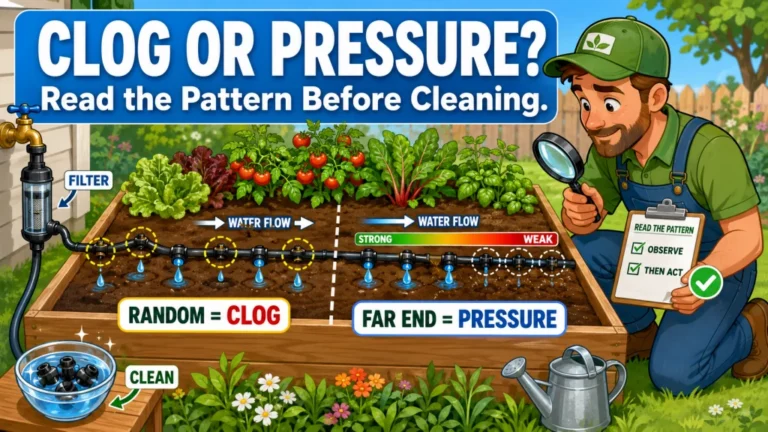
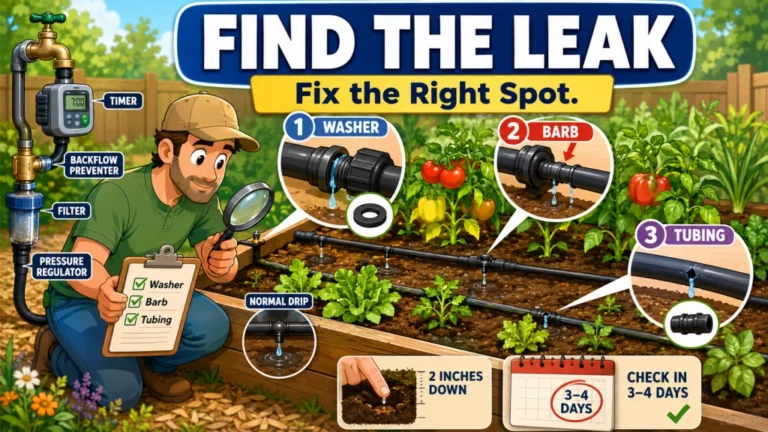
Sometimes the schedule is right and the system still isn’t delivering what the math says it should. Clogged emitters cut flow without changing what the timer reports. A pressure change upstream, like another zone running at the same time or a partially closed valve, changes total flow without any obvious sign at the bed. A slow leak earlier in the line can drop pressure at the far end of a run just enough that the last few feet of bed get less water than the rest, even though the schedule itself never moved.
If you’ve worked through the run time, frequency, seasonal, and crop adjustments above and the bed still isn’t responding the way it should, the next step is diagnosing the system itself rather than adjusting the timer again. That’s a different problem than scheduling, and the guide on raised bed drip irrigation troubleshooting walks through clogging, pressure issues, and leak patterns specific to raised beds.
Keeping the Schedule Dependable Through the Season
A schedule that’s correct in June can quietly stop being correct by September if the system itself isn’t maintained. Filters that aren’t checked start restricting flow gradually, which looks a lot like a schedule that’s suddenly underwatering even though nothing about the timer changed. Flushing the lines periodically clears sediment before it builds into a clog, and that’s upkeep, not scheduling, even though the symptom shows up as a watering problem.
End-of-season draining and spring startup matter for the same reason. A line left full of water before a hard freeze can crack a fitting that then leaks or underperforms the moment you turn the system back on, and none of that shows up by adjusting run time or frequency. The seasonal upkeep side, including flushing, filter checks, draining, and spring startup, is covered in the guide on raised bed drip irrigation seasonal maintenance.

This pressure regulator maintains an optimal 25 PSI to keep drip lines and emitters running at consistent flow, with a 20 gallon per minute capacity to support larger systems. It connects to any 3/4 inch male threaded faucet, garden hose, or component for easy setup. Built from UV and chemical-resistant materials, it offers durable, reliable performance season after season, and pairs well with a compatible Rain Bird hose-end timer for automated watering.
Check On AmazonIf you click this link and buy, we earn a commission at no additional cost to you.
Final Thoughts: Start With the Math, Then Let the Bed Correct It
A raised bed drip irrigation schedule starts as a calculation: emitters, flow rate, bed size, and weekly water need. It doesn’t end there. The bed, the soil, and the plants get the final word, and the schedule that survives the season is the one you’re willing to keep checking and adjusting, not the one you set once and trust by default. Work through the run time and frequency math first, layer in the seasonal and crop adjustments, then verify with the soil and the plants rather than the timer alone.

This combination unit pairs a 200 mesh, 75 micron stainless steel filter with a 30 PSI pressure regulator in a single piece, reducing the number of parts needed and speeding up installation. It protects downstream drip components from clogging and works with all types and brands of 3/4 inch irrigation valves. The cap unthreads easily for quick cleaning, and the glass-filled polypropylene body and 3/4 inch male pipe threads are rated for 150 psi, ensuring long-lasting, reliable performance.
Check On AmazonIf you click this link and buy, we earn a commission at no additional cost to you.
Explore More Raised Bed Drip Irrigation Schedule Guides
Explore more in this section: each piece of a drip irrigation schedule for a raised bed vegetable garden has its own walkthrough below, with the full math, the season-specific numbers, or the verification steps, depending on what you need next.
| Guide | What it helps with |
|---|---|
| How Long to Run Drip Irrigation in Raised Beds | Walks through the gallons-per-bed math using emitter GPH and total emitter count to land on an actual run time. |
| Raised Bed Drip Irrigation Frequency | Breaks down daily, every-other-day, and twice-weekly splits by soil drainage and current weather. |
| Raised Bed Drip Irrigation Schedule by Season | Covers spring ramp-up, summer peak, fall reduction, and winter shutdown as separate schedule decisions. |
| Raised Bed Drip Irrigation Schedule by Crop | Compares water needs across tomatoes, cucumbers, lettuce, herbs, and carrots, including mixed-bed zoning. |
| How to Tell if Drip Irrigation Is Working in a Raised Bed | Covers the plant and soil probe checks that confirm the schedule is reaching root depth. |
Working through these in order, starting with run time, usually clears up more confusion than jumping straight to seasonal or crop adjustments first.
FAQs
💧 How long should I run drip irrigation in a raised bed?
It depends on your emitter flow rate, total emitter count, and bed size, not a fixed number of minutes. A bed with higher-flow emitters needs less run time than one with lower-flow emitters spaced further apart for the same amount of water. The full calculation is covered in the dedicated run time guide above.
⏱️ How often should I water a raised bed with drip irrigation?
Frequency depends mainly on soil drainage and current weather, not a fixed number of days. Sandy mix usually wants shorter, more frequent sessions, while clay-heavy mix holds water longer and does better with fewer, longer sessions. Hot stretches push frequency up regardless of soil type.
🌱 Does a raised bed drip schedule need to change by crop?
Yes, if the bed mixes shallow-rooted crops like lettuce with deeper-rooted crops like tomatoes. Running both off one schedule built around a single crop usually leaves one of them over or underwatered. Grouping similar water needs on the same line solves more of this than adjusting the timer.
☀️ How do I adjust my raised bed drip schedule for summer heat?
Treat heat as a separate adjustment layer on top of your baseline schedule, not a permanent change. A stretch of days consistently above 85 degrees usually calls for more frequent sessions or longer run time, then a step back down once temperatures ease.
🧪 How do I know if my raised bed drip irrigation schedule is actually working?
Check the plants and the soil, not just the timer. A soil probe or a finger pushed a few inches past the dry top layer tells you whether water is reaching root depth. Wilting at the same time every day despite a correct-looking schedule usually points to a system issue rather than a timing one.
❄️ Should I change my raised bed drip schedule in fall?
Yes, fall usually calls for a gradual reduction rather than an abrupt stop, especially if late crops are still producing. Cutting back too early stresses plants still pulling water, while waiting too long into cold weather risks lines left full before a freeze.