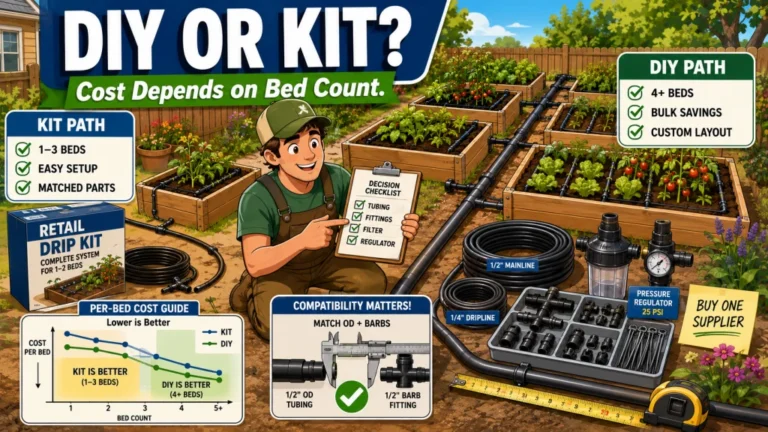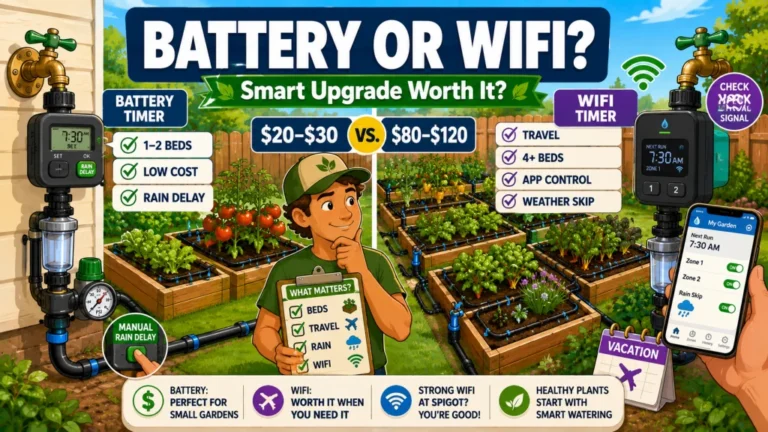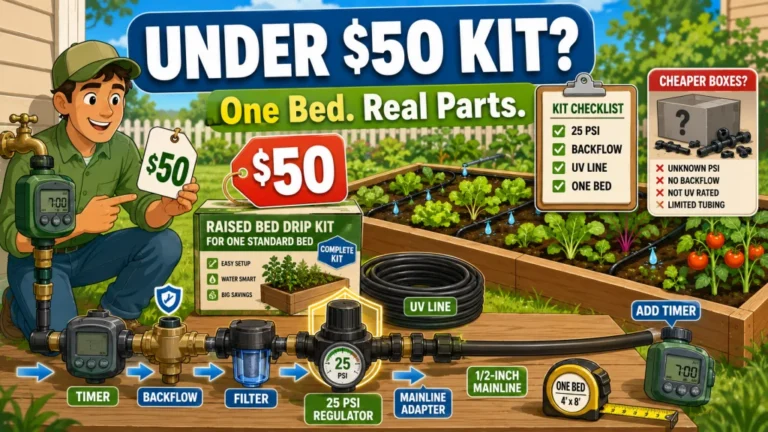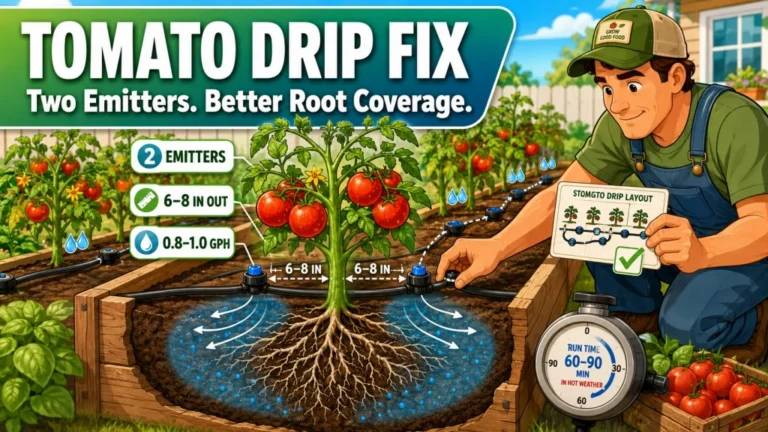
Soaker hose for raised bed vegetable gardens is a real option, not just a downgrade from drip irrigation, but it only holds up under specific conditions. On a short, flat bed close to the spigot, it waters about as evenly as a drip system at a fraction of the cost and assembly time. Past a certain distance, on a slope, or across several beds chained together, the same hose starts watering one end while leaving the other dry. In this guide I walk through exactly where that line sits, what a season of soaker hose actually looks like, and what to check before you buy if you decide it is the right fit.
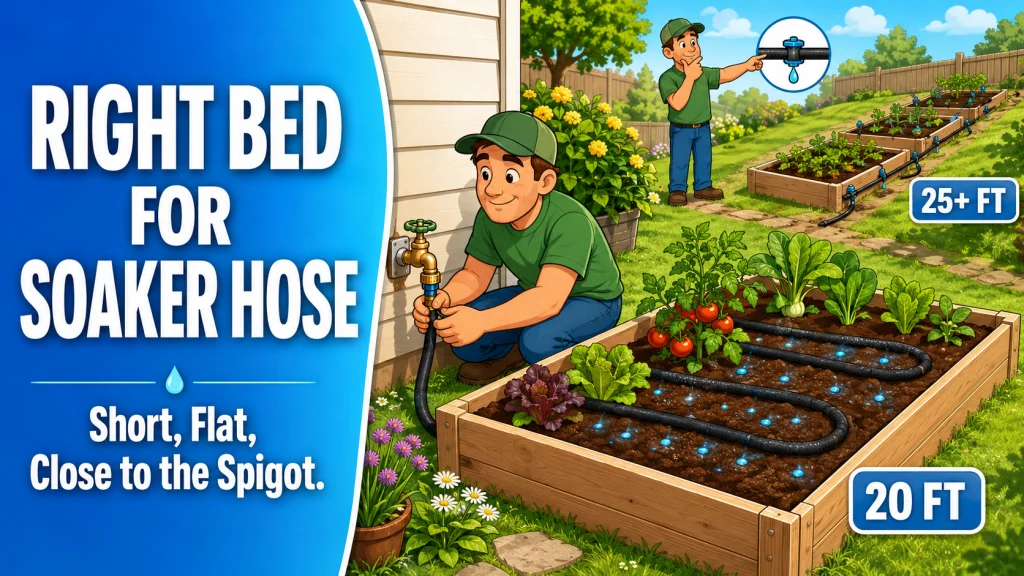
A Soaker Hose on a Short, Flat Bed Works Surprisingly Well
Soaker hose for raised bed vegetable gardens is one of those decisions where the honest answer is “it depends on your setup,” not a flat yes or no. On a single level raised bed close to the water source, a soaker hose waters about as evenly as a drip system, costs roughly one third as much, and takes a fraction of the time to set up. On a sloped bed, or a bed sitting more than 25 feet from the spigot, that same hose fails consistently, and not in a subtle way.
This guide stays narrow on purpose. It is about soaker hose specifically for raised beds: when it works, when it does not, and what to look for if you go that route. It does not get into drip tape as its own category, and it does not cover emitter dripline kits or specific product picks for those systems, since those decisions deserve their own depth elsewhere. The goal here is simpler: figure out whether soaker hose is the right call for your specific bed before you buy anything.
Why Soaker Hose Works So Well in a Short Raised Bed
Raised beds are typically short, usually somewhere between 4 and 8 feet, and that short distance is exactly why soaker hose performs fine in this setting when it struggles elsewhere. Soaker hose relies on water seeping through thousands of tiny pores along its length, and pressure inconsistency across that length is negligible over 4 to 8 feet. The near end and far end of the hose end up delivering close enough to the same amount of water that the difference rarely shows up in the soil.
The bed frame itself helps too. A wood or metal raised bed edge keeps the hose contained and roughly in place, so you are not fighting a hose that wants to drift across open ground the way it would in an in-ground row. There are no emitters to clog, no fittings to align, and setup is closer to coiling the hose into the bed and connecting it to a hose bib than assembling a kit. For a single 4×8 bed of mixed vegetables near the house, that simplicity is a legitimate reason to skip drip irrigation entirely, not just a shortcut for people who do not want to bother with it.

Made from heavy duty recycled rubber, this soaker hose is built to last through many gardening seasons and works well for gardens and flower beds alike. Quick attach reinforced fittings are included, making it easy to connect additional hoses and extend coverage as needed. It can reduce water usage by up to 70% compared to traditional sprinkling systems, helping keep your garden green while conserving water.
Check On AmazonIf you click this link and buy, we earn a commission at no additional cost to you.
The Pressure Problem That Shows Up on Longer Runs
Soaker hose depends on roughly uniform pore pressure along its full length to water evenly, and that assumption holds up fine over a short bed but breaks down as the run gets longer. Past about 25 feet, the end of the hose closest to the spigot receives noticeably more water than the far end, because pressure drops as water travels and escapes through pores along the way. I have run into this exact complaint described on irrigation forums out of hot, dry climates like Arizona, where gardeners running soaker hose more than 20 feet from the spigot reported one end of the bed staying wet while the far end stayed dry, and eventually switched to an emitter dripline setup instead.
Field Note: the failure pattern is almost always the same. The first few feet of bed look perfectly watered, sometimes even a little too wet, while the last stretch stays dry enough that plants there show stress before anyone realizes the hose is the problem. It rarely looks like a hose issue at first. It looks like a plant problem, until someone digs near the far end and finds dry soil under healthy-looking foliage.
Slope makes this worse, not better. On a sloped bed, gravity adds to the pressure differential that already exists along the hose’s length, so the downhill end gets even more water relative to the uphill end than it would on flat ground. A soaker hose that performs acceptably on a level 6-foot bed can fail noticeably on a sloped bed of the same length, which is part of why “soaker hose works on raised beds” is true for some setups and false for others that look similar on the surface.
When Soaker Hose Is the Wrong Choice for a Raised Bed
Soaker hose versus drip irrigation for a raised bed usually comes down to a few specific conditions rather than a general preference. Outside of a short, flat, single bed close to the water source, the failure modes show up reliably enough that I would steer someone away from soaker hose before they spend money on it.
- Three or more beds running off a single soaker hose line, since the pressure drop compounds with each additional bed
- Any bed sitting more than roughly 25 feet from the spigot or first connection point
- Hard, clay-heavy soil where water needs to be targeted at specific root zones rather than spread along a broad damp line
- A sunny, UV-exposed run with no mulch covering the hose, since direct sun breaks down the hose material faster than it would affect emitter dripline
A bed packed with tomatoes and peppers in clay-heavy mix is a good example of where soaker hose struggles even on a short run. Those crops want water concentrated near the root zone, and clay-heavy soil already drains slowly, so the broad, shallow wetting pattern from a soaker hose can leave the surface looking damp while the deeper root zone stays drier than it appears.
What a Season of Soaker Hose Actually Looks Like
Soaker hose performance is not constant across a growing season, and that change in performance is something most buying guides skip entirely. In spring and early summer, a properly sized soaker hose on a suitable bed waters about as evenly as you would expect. By August, after months of daily sun exposure, the same hose often starts showing uneven performance, with some sections delivering noticeably less water than they did in May.
| Factor | Soaker Hose | Quality Emitter Dripline |
|---|---|---|
| Setup time | Coil and connect, minutes | More fittings and layout planning |
| Cost for a short bed | Lower upfront cost | Higher upfront cost |
| Evenness past ~20-25 ft | Degrades noticeably | Stays consistent |
| Evenness on a slope | Worsens with grade | Largely unaffected by grade |
| Typical lifespan | 1 to 3 seasons | 5 or more years |
That lifespan gap matters more than it looks on paper. A soaker hose that needs replacing every other season costs more over five years than the upfront price difference suggests, especially if it is left exposed to direct sun without mulch. Mulching over the hose slows that breakdown considerably, but it does not eliminate the gap entirely between soaker hose and a well-maintained emitter dripline.
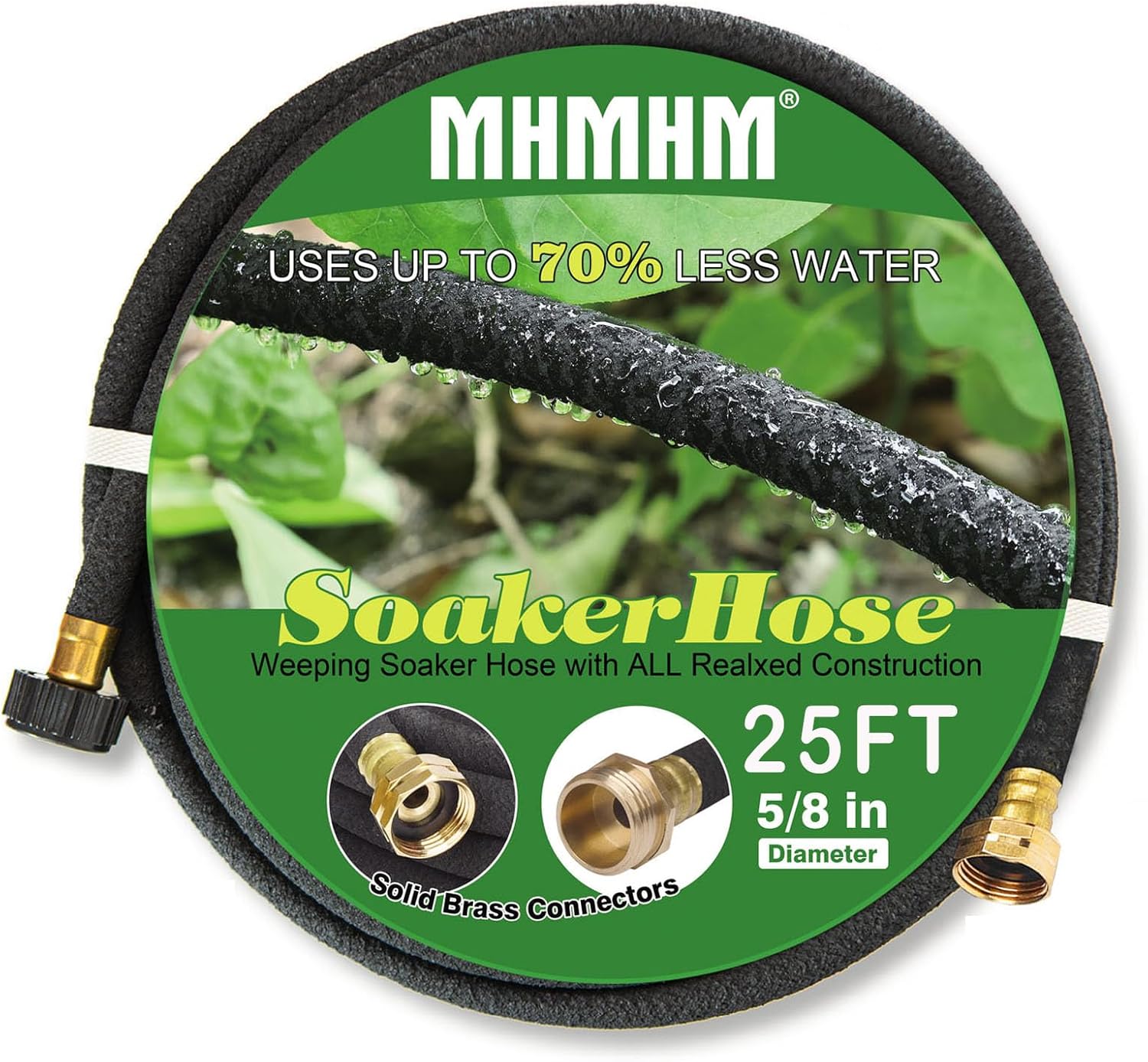
A 25-foot, 5/8-inch round soaker hose with solid brass fittings for slow, even watering around flower beds, vegetable gardens, and landscaped planting areas.
Check On AmazonIf you click this link and buy, we earn a commission at no additional cost to you.
What to Check Before You Buy Soaker Hose
If your bed fits the short, flat, close-to-the-spigot profile, soaker hose is a legitimate choice, not a compromise. Roughly 1 to 2 flat beds within about 20 feet of the spigot is the range where I would tell someone to stop overthinking it and just buy soaker hose instead of assembling a drip kit for the same result.
- Wall thickness and material: thicker, recycled-rubber style hose generally outlasts thin vinyl under UV exposure
- Length matched to the actual bed run, rather than oversized and coiled tightly, which can create uneven pressure inside the hose itself
- A pressure regulator ahead of the hose if your hose bib runs higher than the low pressure soaker hose is designed for
- Replaceable end caps and connectors, since those typically fail before the porous body of the hose does
None of this requires a specific brand recommendation to apply. Walk into any garden center or browse any retailer with those four points in hand, and you can tell within a minute or two which option on the shelf is actually built for a raised bed instead of just labeled for one.

This pressure regulator maintains an optimal 25 PSI to keep drip lines and emitters running at consistent flow, with a 20 gallon per minute capacity to support larger systems. It connects to any 3/4 inch male threaded faucet, garden hose, or component for easy setup. Built from UV and chemical-resistant materials, it offers durable, reliable performance season after season, and pairs well with a compatible Rain Bird hose-end timer for automated watering.
Check On AmazonIf you click this link and buy, we earn a commission at no additional cost to you.
The Upgrade Path: You Are Not Starting Over
One thing that gets overlooked when people weigh soaker hose against drip irrigation is what happens if you outgrow it. If you add beds, move to a sloped site, or simply want more even coverage later, the mainline and timer from a soaker hose setup can usually carry over to an emitter dripline upgrade. You are replacing the hose itself, not rebuilding the water source connection from scratch.
For a closer look at how soaker hose stacks up against drip tape specifically, drip tape vs soaker hose for raised beds goes deeper into that particular comparison. And if you eventually decide a full drip setup is the better long-term fit for your beds, the best raised bed drip irrigation kit guide picks up from there once you are ready to choose a system.

This single outlet hose timer turns any faucet into an automatic sprinkler system, using a quick program dial to set precise, adjustable watering schedules for healthier lawns and gardens. A large LCD display and simple controls make programming straightforward, while rugged, weatherproof construction with a brass swivel connection ensures dependable performance outdoors. It's backed by a six-year limited warranty for private use, reflecting Orbit's trusted reputation for water-saving solutions.
Check On AmazonIf you click this link and buy, we earn a commission at no additional cost to you.
Final Thoughts: Match the Hose to the Bed, Not the Other Way Around
Soaker hose for a raised bed vegetable garden is the right call for a narrow but real set of situations: 1 to 2 flat beds, close to the spigot, without hard clay soil demanding targeted watering. Outside that range, the pressure inconsistency and slope effects are consistent enough that I would not bet a season of tomatoes on it.
If your setup matches the small, level, near-spigot profile, buy with the wall thickness, length, and connector points in mind and expect 1 to 3 good seasons out of it. If it does not match, that is useful information too, since it tells you to start with an emitter dripline option instead of buying soaker hose and discovering the gap once the plants are already in the ground.

This kit includes everything needed to water a raised bed up to 4 by 8 feet, with professional-grade components built for repeated seasonal use. It features 35 feet of emitter tubing with 70 built-in, pressure-compensating emitters spaced every 6 inches for even watering near the roots, plus 25 feet of easy-to-handle 1/4 inch distribution tubing. This low-volume design can save up to 80% on water while supporting healthier plants and better yields. Installation is straightforward thanks to an illustrated manual covering multiple layout options, and the system can be automated with a compatible Rain Bird hose-end timer sold separately.
Check On AmazonIf you click this link and buy, we earn a commission at no additional cost to you.
FAQs
🌱 Is soaker hose good enough for a raised bed vegetable garden?
For 1 to 2 flat beds within about 20 feet of the spigot, yes. Past that distance, on a slope, or across several beds on one line, soaker hose starts watering unevenly and a drip system is the more reliable choice.
🍅 Can I use soaker hose for raised bed tomatoes?
You can on a short, flat bed, but tomatoes in clay-heavy soil benefit more from targeted root-zone watering than the broad, shallow pattern soaker hose produces. In sandy or loam mix on a short run, soaker hose works fine for tomatoes.
⚖️ Is soaker hose or drip irrigation better for a raised bed?
It depends on bed length, slope, and how many beds you are watering. Soaker hose wins on cost and simplicity for short, flat, single beds; drip irrigation wins on evenness for longer runs, slopes, or multiple beds on one line.
📏 How far can a soaker hose run before watering gets uneven?
Unevenness commonly shows up past about 25 feet, where the end of the hose closest to the spigot delivers noticeably more water than the far end. Under roughly 20 feet on flat ground, the difference is usually negligible.
⛰️ Does a sloped raised bed need a different watering setup than soaker hose?
Often yes. Gravity adds to the pressure differential along a soaker hose’s length, so the downhill end gets more water than the uphill end. A bed on a slope is more likely to need an emitter dripline setup than a flat bed of the same length.
☀️ How long does soaker hose last in a raised bed?
Typically 1 to 3 seasons, compared with 5 or more years for quality emitter dripline. Daily sun exposure without mulch cover speeds up that breakdown, while mulching over the hose slows it down.
🧱 Should I use soaker hose in clay-heavy raised bed soil?
It is not the best match. Clay-heavy soil already drains slowly and benefits from water targeted at specific root zones, which soaker hose’s broad, shallow wetting pattern does not do as precisely as an emitter dripline.