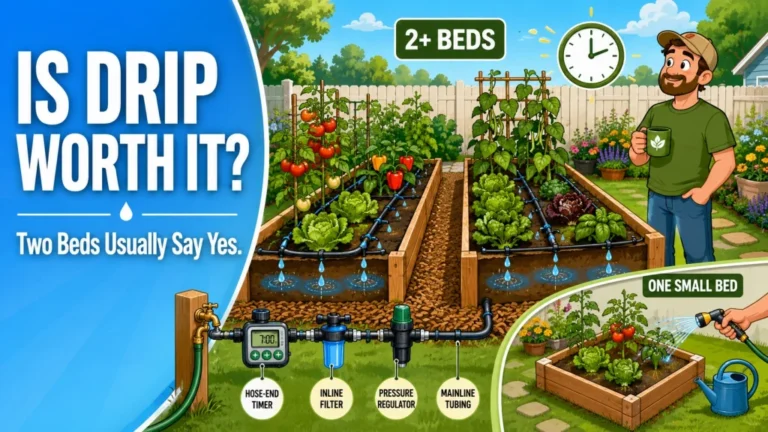
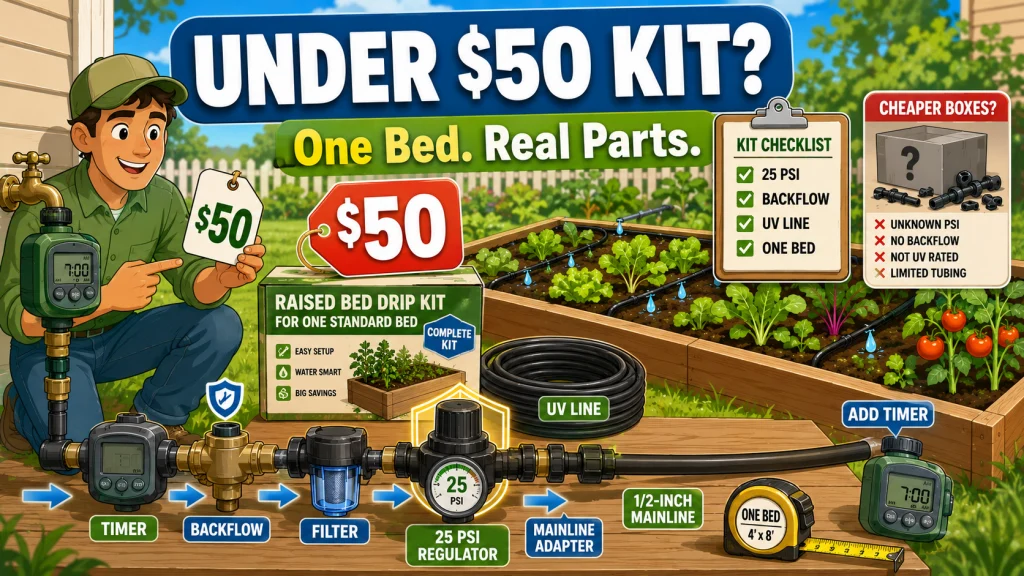
Yes, a working drip irrigation kit for a raised bed under 50 dollars exists, and it isn’t a stretch or a compromise system held together with hope. What changes at this price point is coverage, not reliability: you’re getting a single-bed system, not an expandable one, and the parts that matter most, the pressure regulator and the backflow preventer, are still present in the kits worth buying. Where people get burned is reaching for the cheapest unbranded option on Amazon instead of a slightly higher-priced kit that includes the parts that actually keep a system running past one season.
What 50 Dollars Actually Buys for a Raised Bed Drip Kit
At this budget, the realistic landscape narrows to two kinds of single-bed kits, and the difference between them matters more than the dollar amount on the price tag. The first type sits in the low 40 dollar range, generally 40 to 43 dollars, includes a pressure regulator, a backflow preventer, and roughly 50 feet of dripline, and is built to cover a single bed up to about 4 by 8 feet. The second type sits a few dollars lower, around 38 to 40 dollars, and trades a slightly shorter dripline run or a simpler regulator for that lower price while still covering the same single-bed footprint.
I’ve set up versions of both, and the honest takeaway is that either one will water a single raised bed properly if it includes a real pressure regulator and backflow preventer rather than skipping them to shave a few dollars off the price. The choice between them usually comes down to bed size and how much dripline you actually need: a 4 by 4 bed rarely uses the full 50 feet included in the higher-priced option, so the slightly cheaper kit with a shorter run is the more sensible buy there, while a full 4 by 8 bed gets more out of the longer dripline and tends to be the better fit for the pricier of the two.
That distinction matters more than people expect going in. A gardener with one smaller bed doesn’t need the extra dripline length built into the larger kit, so the leaner option is the more rational choice in that situation, not just the cheaper one. The mistake I see is gardeners assuming “budget” means “compromised,” when for a single bed it usually just means matching the kit’s coverage to the bed in front of you.

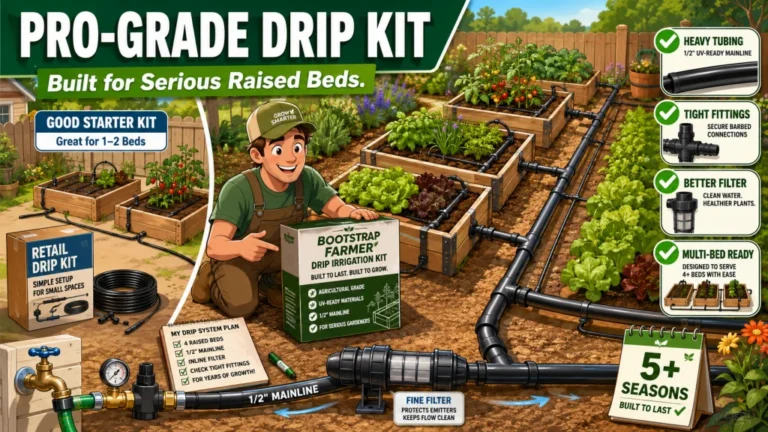
This kit includes everything needed to water a raised bed up to 4 by 8 feet, with professional-grade components built for repeated seasonal use. It features 35 feet of emitter tubing with 70 built-in, pressure-compensating emitters spaced every 6 inches for even watering near the roots, plus 25 feet of easy-to-handle 1/4 inch distribution tubing. This low-volume design can save up to 80% on water while supporting healthier plants and better yields. Installation is straightforward thanks to an illustrated manual covering multiple layout options, and the system can be automated with a compatible Rain Bird hose-end timer sold separately.
Check On AmazonIf you click this link and buy, we earn a commission at no additional cost to you.
What to Expect From a Sub-50-Dollar Kit
A budget raised bed drip kit in the right price range will give you a functional single-bed system that runs reliably for 2 to 3 seasons with basic upkeep: checking the filter, flushing the line at the start of the season, and replacing a clogged emitter here or there. That’s a realistic expectation, not an optimistic one, as long as the kit includes the core regulation parts rather than skipping them to hit a lower price.
What you should not expect at this price is premium fittings throughout, pressure-compensating emitters across the whole system, or coverage that stretches past the bed size the kit was built for. If a listing advertises a budget kit that claims to cover several beds with the same dripline length as a single-bed kit, that’s a red flag worth checking against the actual footage included, not the marketing copy on the box.
Branded Budget Kits vs. Unbranded Amazon Kits
This is where the real budget mistake happens, and it isn’t spending too much, it’s spending too little in the wrong direction. Searches for an affordable drip irrigation kit for a raised bed turn up plenty of unbranded options in the 20 to 35 dollar range that look like an even better deal than either of the two single-bed kits described above. On paper they often are. In practice, I see a recurring pattern with these: thin-wall dripline without UV protection, weaker pressure regulators, and fittings that start weeping or separating at the connections by the second season.
The savings don’t actually hold up once you account for that. A 25 dollar kit that needs replacing after one season costs more over two years than a 40 dollar kit that runs for three. I’m not saying every unbranded kit fails this way, but it’s a common enough pattern that I’d rather a budget-conscious gardener spend the extra 10 to 15 dollars upfront on a kit from a manufacturer that specifies UV-stabilized dripline and a rated pressure regulator than gamble on an unlabeled listing with no spec sheet behind it.
- Check whether the dripline is listed as UV-stabilized or UV-resistant before buying. If the listing doesn’t mention it, assume it isn’t.
- Look for a stated pressure regulator rating (commonly around 25 to 30 PSI for raised bed kits). No stated rating is a sign the part may be a generic, unrated piece.
- Read the most recent reviews, not just the average rating. Fitting failures and leaks tend to show up in reviews from the second season, not the first week.
- Compare total dripline length and emitter count against the bed size you’re actually covering, not the largest bed size mentioned in the listing.
None of this means you have to spend more than 50 dollars. It means the 40 to 45 dollar range tends to be where the core parts hold up, and dropping below that range is where the real risk starts.
The Timer Question: Where Most Budgets Actually Go Over
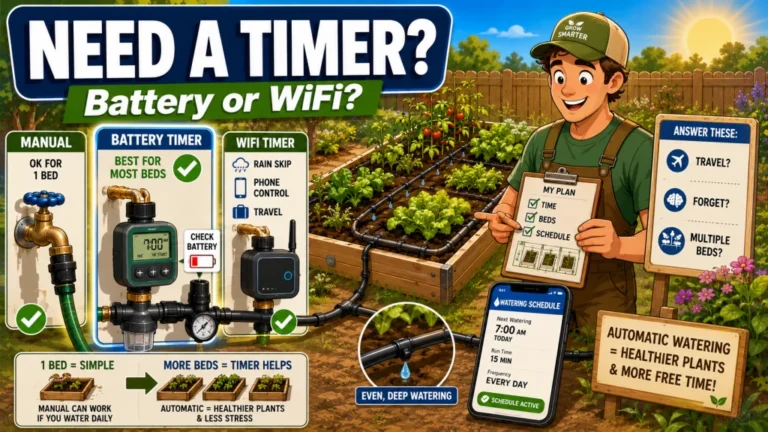
If there’s one place the under-50-dollar budget gets tested, it’s the timer. A basic battery-operated hose timer adds roughly 20 to 30 dollars on top of the kit itself, which pushes the realistic total for a fully automated single-bed system closer to 60 to 70 dollars rather than under 50. I bring this up because a lot of people budget for the kit and forget the timer is what actually makes the system hands-off.
Without a timer, a sub-50-dollar single-bed setup still works, you just have to turn the hose bib on and off manually on a schedule, which defeats a chunk of the convenience that made drip appealing in the first place. For most gardeners, especially anyone who travels or simply forgets to water consistently, the timer is the upgrade I’d prioritize over almost anything else if the budget allows for it, even if that means going slightly over the initial 50 dollar target.
Buying the cheapest kit available to stay strictly under 50 dollars, then adding a timer later without checking if it’s compatible with the kit’s connections.
Budgeting for a mid-range branded kit around 40 dollars first, then treating the timer as a near-term add-on once the core system is confirmed to run without leaks.
Either way, the timer decision is separate from the kit decision, and it’s worth thinking about both before you check out rather than after the kit is already installed and you’re realizing the manual on-off routine isn’t sustainable.

This portable kit packs 100 feet of self-dispensing quarter-inch blank distribution tubing alongside 40 pressure-compensating emitters in three flow rates, 0.5, 1.0, and 2.0 gallons per hour, plus 20 barbed couplers, 20 barbed tees, 10 tubing stakes with bug caps, and 10 tubing plugs. Rain Bird's patented emitter installation and removal tool is included, making it easy to punch in or swap out emitters and quarter-inch fittings. Everything stores in a compact plastic pouch with individually organized bags.
Check On AmazonIf you click this link and buy, we earn a commission at no additional cost to you.

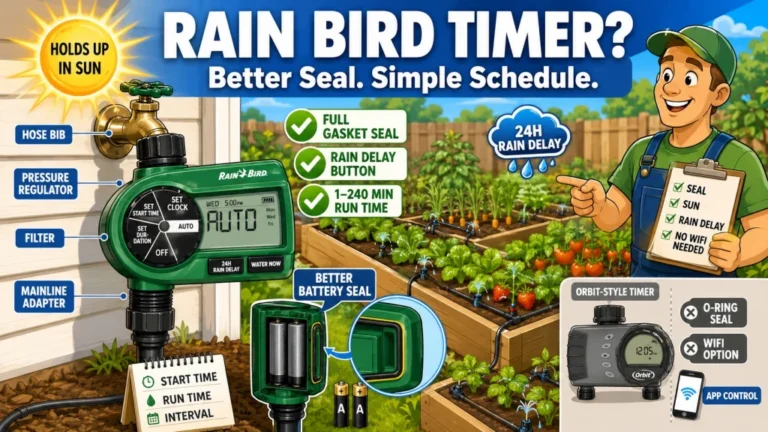
This battery-powered hose timer converts any standard faucet into an automatic single-zone watering system with programmable schedules and adjustable watering durations. The clear LCD display makes programming straightforward, and a built-in rain delay feature pauses irrigation automatically during wet weather. Designed for outdoor durability and water-resistant construction, it backs its reliability with a six-year limited warranty.
Check On AmazonIf you click this link and buy, we earn a commission at no additional cost to you.
Final Thoughts: Set the Right Expectation Before You Buy
A working drip irrigation kit for a raised bed under 50 dollars is realistic for a single bed, but only if you spend that money on a kit with a real pressure regulator and UV-rated dripline rather than the cheapest unbranded listing you can find. Between the two single-bed options described earlier, the shorter-dripline kit around 38 to 40 dollars makes more sense for a smaller 4 by 4 bed, and the longer-dripline kit around 40 to 43 dollars makes more sense for a full 4 by 8 bed, since you’re more likely to actually use that extra footage. The money you save going unbranded tends to disappear the first time a fitting fails mid-season, and at that point you’ve paid for the system twice. If you’re still deciding between a budget single-bed setup and something built to grow with more beds later, how to compare raised bed drip irrigation kits by bed count walks through that decision, and the kit comparison guide covers the broader buying criteria if budget isn’t the only factor you’re weighing.

This robust hose-end timer works with sprinklers, drip irrigation, and soaker hoses, offering simple automatic programming with full 7 day scheduling for worry-free watering. An extra-large dial and readout screen make setup and schedule review easy, while one-touch buttons allow quick cancellation, a rain delay of up to 96 hours, or manual watering on demand. The display also shows the next scheduled cycle and time remaining on the current one.
Check On AmazonIf you click this link and buy, we earn a commission at no additional cost to you.
FAQs
💰 Can you get a good drip irrigation kit for a raised bed under 50 dollars?
Yes, for a single raised bed. Kits in the 40 to 45 dollar range typically include a pressure regulator, backflow preventer, and enough dripline for one bed, which covers what most single-bed gardeners need.
⚠️ Are cheap unbranded drip kits on Amazon worth buying?
Often not. Many unbranded kits in the 20 to 35 dollar range use thin-wall dripline without UV protection and weaker fittings that tend to leak by the second season, which can cost more than a branded kit over time.
🔧 What’s missing from a sub-50-dollar drip irrigation kit?
Mainly coverage beyond one bed and premium fittings. The core regulation parts are usually present in budget kits worth buying, but expansion to multiple beds requires additional tubing and fittings bought separately.
⏱️ Does a budget drip irrigation kit need a separate timer?
A timer isn’t included in most sub-50-dollar kits and adds roughly 20 to 30 dollars on top, but it’s the upgrade that turns a manual system into an automated one and is worth it for most gardeners.
🌱 How long does a budget drip irrigation kit last in a raised bed?
A well-built budget kit with UV-rated dripline and a real pressure regulator typically runs 2 to 3 seasons with basic maintenance like filter checks and seasonal flushing.