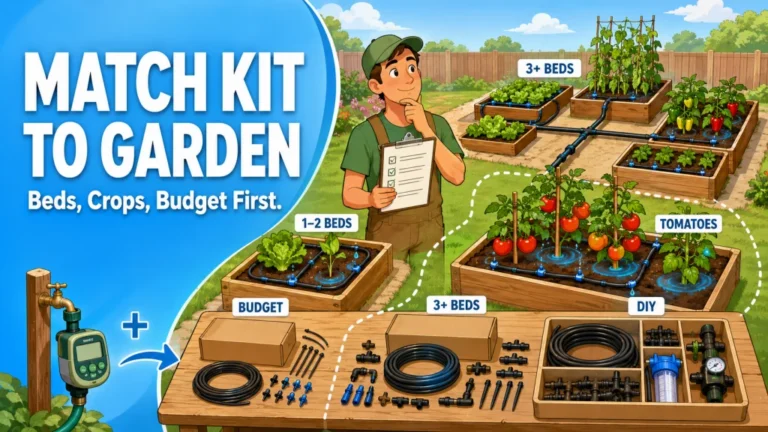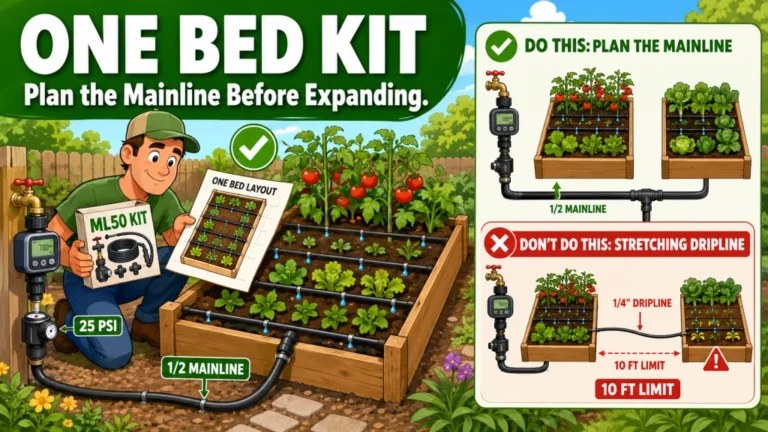
Choosing between drip tape, soaker hose, and emitter dripline is the decision that actually determines whether a raised bed irrigation setup works or turns into a leaking mess by midsummer. Most people skip straight to buying a kit before answering this question, and that is where the trouble starts. This article frames the choice as a field installer would: by raised bed situation, not by brand. The right system type depends on how many beds you have, whether the ground is level, what you are growing, and how mineral-heavy your water is.
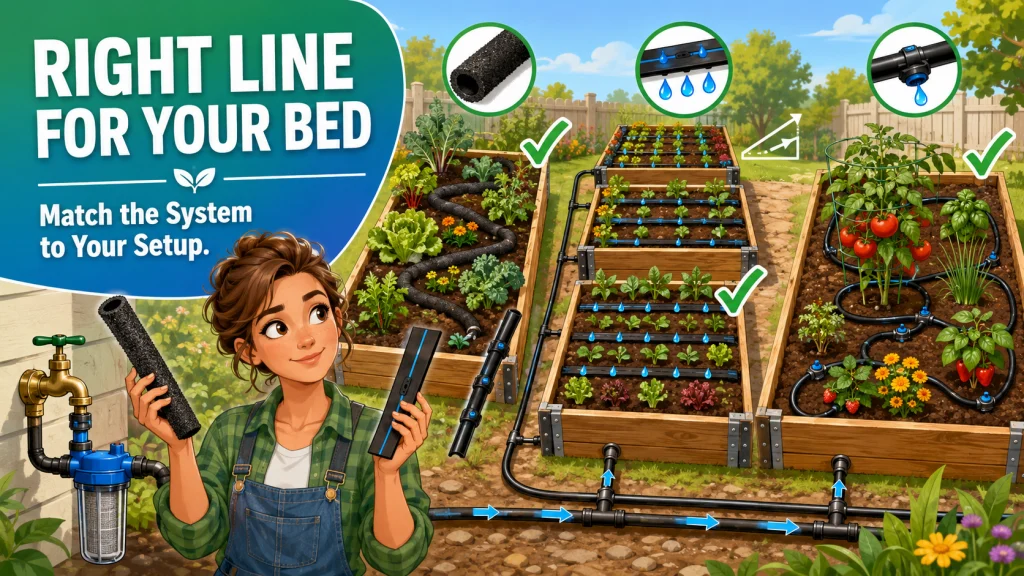
Get the System Type Right Before You Buy Anything
The single most common mistake I see on raised bed installs is choosing a system type that does not match the setup. A homeowner picks up a soaker hose kit because it looked simple at the hardware store, runs it through three 4×8 beds, and wonders six weeks later why the far end of the third bed is always dry. Or someone buys drip tape because a gardening blog said it was more efficient, then deals with two fittings blowing off at the manifold every time the hose bib pressure spikes. The system itself was not wrong. The wrong system type was chosen for the situation.
Drip tape vs soaker hose for a raised bed is not a question with a universal answer. It is a decision tree. The right starting point is your raised bed situation: how many beds, how they are arranged, what you are planting, whether the ground slopes, and how your water behaves over time. Once that is clear, the system type choice becomes straightforward. Then you pick a kit or components within that type. If you are still deciding whether any drip irrigation setup makes financial sense for your beds, the question of whether drip irrigation is worth it for raised beds is worth settling before you go further.
| Your raised bed situation | Best first choice | Why it fits | Watch out for |
|---|---|---|---|
| One flat 4×4 or 4×8 bed, mixed vegetables, beginner setup | Soaker hose | Fastest and simplest to set up, lowest upfront cost | Output uneven over distance; shorter lifespan than drip tape |
| Three or more beds, row-planted vegetables, or any slope | Drip tape | Better coverage consistency and lower cost per foot | Needs correct pressure regulation and seasonal flushing |
| Mixed plant spacing, permanent layout, or individual plant zones | Emitter dripline | Most flexible for non-standard planting patterns | More parts, more assembly time, higher upfront cost |
| Hard or mineral-heavy water | Emitter dripline or flushable drip tape | Easier maintenance access than soaker hose | Inline filter and seasonal flushing matter more, not less |
The sections below break down each situation in more detail, including where each system type tends to fail and what the setup actually looks like in a real raised bed.
When a Soaker Hose Makes More Sense
Soaker hose is the right call for a narrow set of situations, but within those situations, it is genuinely the simplest option. One or two raised beds on flat, level ground with municipal water and a gardener who wants to be done in an afternoon. That is the scenario where a soaker hose setup delivers on its promise. You run it through the bed, connect it to a hose bib, and you are watering. No manifold, no pressure regulator debate, no emitter spacing to think through.
The upfront cost is lower than drip tape or emitter line for a single-bed setup, and winterizing is two minutes of work: disconnect, coil, store. For someone with one 4×4 or 4×8 bed planted with mixed vegetables, a soaker hose is a reasonable, functional choice. The tradeoff is consistency. Soaker hose output is not uniform across the full length, and on any meaningful slope, water will follow gravity instead of the root zone. It also degrades faster than drip tape under UV exposure and mineral buildup. The section on soaker hose for raised bed vegetable gardens goes into how those limitations play out across different bed sizes, crops, and soil types.
Where soaker hose loses: multiple beds, any slope, row-planted crops that need even distribution across the full bed length, and areas with hard water. In those situations, the limitations show up fast and the workarounds get messy.

Made from a partially permeable material, this soaker hose distributes water evenly along its entire length rather than from isolated holes, soaking the ground around your plants. It can be laid on top of the soil or buried under mulch to stay hidden and retain moisture, delivering water at ground level to keep foliage dry and reduce fungal growth. With simple screw fittings, it connects easily to a faucet or another hose and works well with timers. It performs best at around 10 PSI and is available in lengths from 10 to 150 feet.
Check On AmazonIf you click this link and buy, we earn a commission at no additional cost to you.
When Drip Tape Is the Better Fit
Drip tape is what I reach for when the setup involves more than two beds, any slope, or row-planted vegetables where emitter spacing needs to match plant spacing. The output is consistent along the full tape length in a way soaker hose cannot match. Emitters are factory-spaced at fixed intervals, usually 6, 8, or 12 inches, and the flow is metered through fixed emitter points rather than relying on wall porosity like soaker hose does. That matters a lot in a 4×8 bed planted in rows of tomatoes, peppers, or bush beans.
Drip tape is also cheaper per linear foot than emitter dripline or soaker hose when you are covering multiple beds. A 4-bed setup irrigated with drip tape costs less in material than the same beds plumbed with emitter line, and the installation is faster once you have your mainline laid. The flat profile also makes it easier to run multiple parallel lines across a wide bed without tubing fighting back against the soil.
Slope changes the calculation
On uneven ground, pressure-compensating drip tape or a properly regulated drip tape layout keeps output more consistent from the first emitter to the last than a soaker hose can. Soaker hose tends to deliver more water to the low end of a sloped bed, because the output follows gravity rather than a fixed emitter interval. If your raised beds sit on ground that is not perfectly level, or if you are running multiple beds downhill from each other, drip tape is usually the more reliable system type if you want even watering without constant adjustment. Spacing, pressure, and layout options for sloped multi-bed setups are covered in the comparison of drip tape for raised beds.

Drip Depot Drip Tape - 5/8-inch: Drip Depot Drip Tape is designed with excellent uniformity for consistent emitter flow and output.Features:A longer flow path with a new type of labyrinth passages provides excellent resistance to cloggingHigh quality material and advanced technology provide corrosion resistance and longer lifespanExtruded with emitters inside a seamless tape for extended lifecycle.
Check On AmazonIf you click this link and buy, we earn a commission at no additional cost to you.
When Emitter Dripline Fits Better Than Either
Emitter dripline, sometimes called emitter tubing or drip line, is not the same as drip tape. Drip tape is thin-walled, flat, and designed for uniform row coverage. Emitter dripline is heavier, round, and built for more permanent setups where individual plant spacing varies. It handles mixed plantings better than drip tape because you can space the emitters to match your plant layout instead of accepting a factory-fixed interval.
A raised bed with tomatoes at 18-inch centers, basil at 6-inch centers, and a row of peppers in between is exactly the kind of non-standard layout where drip tape’s fixed emitter spacing becomes a limitation. Emitter dripline lets you route to each plant grouping and adjust output by emitter type. The tradeoff is that it costs more per foot, takes longer to assemble, and involves more parts: barbed fittings, stakes, and sometimes individual emitters inserted by hand. For beds with mixed plantings or non-standard layouts, that assembly time is worth it. For beds planted in rows, it is usually more work than the flexibility is worth. Layout, emitter selection, and fitting choices for that kind of setup are what the emitter dripline comparison covers.
If you are comparing all three options side by side and trying to match one to your specific bed count and crop mix, starting with the full kit selection framework at best raised bed drip irrigation kit gives you the decision criteria before you get into individual product picks.
The Factor Most Comparisons Skip: Hard Water
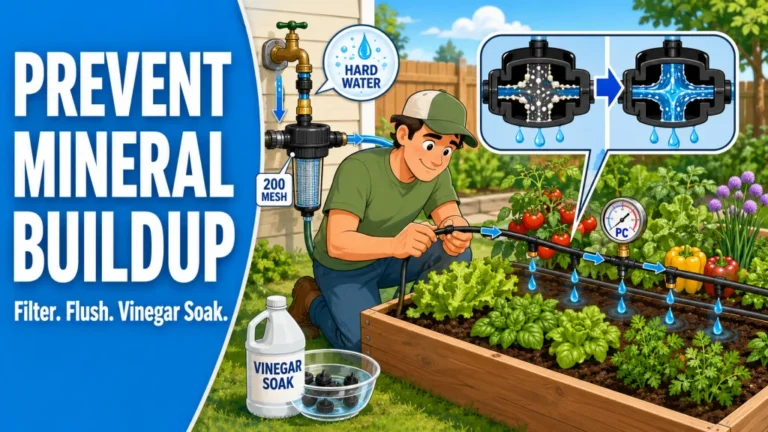
Hard water changes the drip tape vs soaker hose decision in a way that most comparison articles do not address. Mineral-heavy water deposits calcium and magnesium inside emitters over time. In drip tape, those deposits build up inside the emitter channel and restrict or block flow, often unevenly across the tape. You end up with dry patches in beds that were watering fine in the spring. In soaker hose, mineral buildup clogs the porous wall and creates the same dry-patch problem, sometimes faster because the pores are smaller and less forgiving than a molded emitter channel.
Emitter dripline with flushing caps gives you a maintenance advantage here because you can flush each line at the end of the season and clear the mineral load before it hardens. But the more important factor is filtration upfront. A properly installed inline filter before your pressure regulator catches sediment before it reaches the emitters. Without it, any system type will clog faster in hard-water areas, and the clogging is not always visible until a section of the bed starts showing stress.
| System type | Hard water clog risk | Maintenance approach |
|---|---|---|
| Soaker hose | High: wall pores clog gradually, hard to flush | Replace sooner; filter is still worth adding at source |
| Drip tape | Moderate: emitter channels clog but can often be flushed | Flush tape ends seasonally; always filter before regulator |
| Emitter dripline | Moderate to low: larger emitter openings, flushable | Flush caps at line ends; filter required; inspect emitters annually |
If you know your water is on the harder side, or if you have had clogging problems with a previous drip setup, it is worth understanding how mineral buildup affects each system type before settling on one. That is what the piece on drip irrigation in raised beds with hard water focuses on.
A Practical Decision Frame Before You Buy
Most of the confusion I see on raised bed drip setups comes from jumping to a kit before the situation is clear. The system type question is not complicated once you run through a short set of conditions. It does not require engineering. It requires knowing a few things about your beds, your water, and your garden.
- One or two beds, flat ground, municipal water, beginner setup: Soaker hose is the simplest starting point. Expect to replace it sooner than drip tape, and add a filter if your water has any mineral load.
- Three or more beds, or any slope: Drip tape will outperform soaker hose on coverage consistency and cost per foot. Worth the slightly longer setup time.
- Mixed plantings, non-standard bed layouts, or individual plant spacing: Emitter dripline gives you the flexibility neither drip tape nor soaker hose can match. Budget more time for assembly.
- Hard or mineral-heavy water: Any system benefits from a sediment filter before the pressure regulator. Emitter dripline with flush caps gives the best long-term maintenance access. Soaker hose will degrade faster in this condition.
- Still deciding if drip irrigation is worth adding at all: Settle that question first before picking a system type.
Once the system type is clear, the next layer is kit selection: how the components fit together, what pressure regulation your hose bib actually needs, and which configurations work for your bed count. That layer is covered in the raised bed drip irrigation kit comparison once you know which system type direction you are heading.
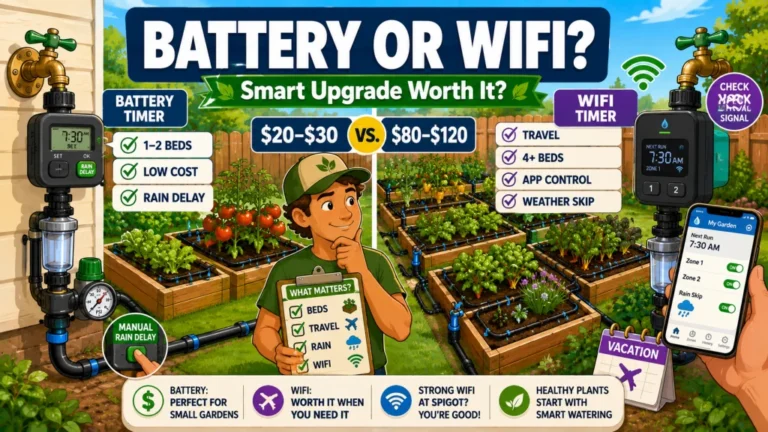
Timing and run schedules are a separate question from system type. A drip tape setup and a soaker hose setup on the same beds in the same soil will not run on the same timer schedule. That part of the setup, including how to match run time to soil type, emitter flow rate, and season, is covered in the section on drip irrigation timers for raised beds.

This kit includes everything needed to water a raised bed up to 4 by 8 feet, with professional-grade components built for repeated seasonal use. It features 35 feet of emitter tubing with 70 built-in, pressure-compensating emitters spaced every 6 inches for even watering near the roots, plus 25 feet of easy-to-handle 1/4 inch distribution tubing. This low-volume design can save up to 80% on water while supporting healthier plants and better yields. Installation is straightforward thanks to an illustrated manual covering multiple layout options, and the system can be automated with a compatible Rain Bird hose-end timer sold separately.
Check On AmazonIf you click this link and buy, we earn a commission at no additional cost to you.
Final Thoughts: System Type First, Kit Second
Every raised bed drip setup fails or frustrates for one of a handful of reasons: wrong system type for the situation, missing pressure regulator, no filter, bad emitter spacing, or a timer schedule that does not match the soil and season. System type is the first decision because every other component choice follows from it. Drip tape is not better than soaker hose in the abstract. It is better for specific situations. So is emitter dripline. So, occasionally, is soaker hose.
The fastest way to an irrigation setup you do not have to babysit is to match the system type to your beds before you look at a single kit. That is what this comparison is for. Once you have the type locked in, the rest of the setup decisions have a clear direction. Start there, then move to the component and kit layer that matches your choice.

This multi-function kit connects 1/2 inch drip tubing to any 3/4 inch male threaded faucet or garden hose, helping ensure your drip irrigation system runs properly. It includes a backflow preventer, a 25 PSI pressure regulator, and a 150 mesh filter, along with a compression fitting that creates a leak-proof seal to 1/2 inch tubing. Built from UV and chemical-resistant materials for long-lasting durability, the kit can also be paired with a compatible Rain Bird hose-end timer for automated watering.
Check On AmazonIf you click this link and buy, we earn a commission at no additional cost to you.
Explore More in This Section
Each of the following covers a specific comparison angle or system type in more depth. If one of the situations above matched your setup, the corresponding piece takes you into the detail this overview does not have space for.
| Guide | What it helps with |
|---|---|
| Soaker hose for raised bed vegetable gardens | How soaker hose performs across different bed sizes, crops, and soil types, with specific setup and replacement guidance |
| Drip tape for raised beds | Emitter spacing, pressure requirements, layout for multi-bed setups, and how slope affects output |
| Drip emitter line for raised beds | When emitter dripline outperforms drip tape, how to configure it for mixed plantings, and fitting and assembly guidance |
| Drip irrigation in raised beds with hard water | How mineral buildup affects each system type, filtration requirements, and seasonal maintenance to prevent clogging |
| Is drip irrigation worth it for raised beds | Cost vs benefit analysis for small and larger raised bed setups, before committing to any system type |
If the system type decision is settled and you are ready to move into kit selection by bed count and vegetable garden situation, the raised bed drip irrigation kit comparison is the next step.
FAQs
💧 What is the difference between drip tape and soaker hose for a raised bed?
Drip tape uses factory-spaced emitters molded into a flat, thin-walled tube. Output is consistent along the full length and regulated by each emitter. Soaker hose sweats water through a porous wall with no fixed emitter points. Drip tape handles slope and multi-bed runs better. Soaker hose is simpler for a single flat bed with light use.
🌱 Can I use soaker hose in a 4×8 raised bed?
Yes, but with caveats. On flat ground with one or two beds, soaker hose can work adequately. The limitation is output consistency across the full bed length, especially once the hose ages or mineral deposits accumulate. For a 4×8 bed with row-planted vegetables, a single run of soaker hose often underdelivers at the far end.
📐 How many lines of drip tape do I need in a raised bed?
It depends on bed width and what you are growing. A 4-foot-wide bed usually benefits from two parallel lines rather than one center run. A wider bed or one with dense plantings may need three. Emitter spacing along each line should match root zone width for the crop, typically 6 to 12 inches for most vegetables.
🧱 Does hard water ruin drip tape or soaker hose faster?
Both are affected, but soaker hose generally clogs faster because mineral deposits fill the porous wall from the inside and the damage is not reversible with flushing. Drip tape emitters can sometimes be flushed at the end of the season to clear mineral buildup. A sediment filter before the pressure regulator slows the process in both cases.
⛰️ Does slope affect whether I should use drip tape or soaker hose?
Yes, significantly. Soaker hose output follows gravity on a slope, which means the low end of the bed gets more water than the high end. Pressure-compensating drip tape, or a properly regulated drip tape layout, keeps output more consistent on uneven ground than a soaker hose. If your raised beds sit on any meaningful slope, drip tape is the more reliable choice.
🔧 Do I need a pressure regulator for drip tape or soaker hose in a raised bed?
For drip tape, yes. Most drip tape is rated for 8 to 12 PSI, and most residential hose bibs run 40 to 60 PSI without a regulator. Running drip tape at hose bib pressure will blow fittings and shorten the tape’s lifespan. Soaker hose is more tolerant of moderate over-pressure, but a regulator still helps extend its life and improves output consistency.