Three months into doing residential drip installs, I gave a homeowner advice I would not give today. She followed it exactly. Her system failed in August, and I did not connect the dots until six months later. This is not a buying guide, an installation walkthrough, or a troubleshooting list. It is a rundown of a few specific things I believed early in my career that turned out to be incomplete, and the seasons that proved me wrong.
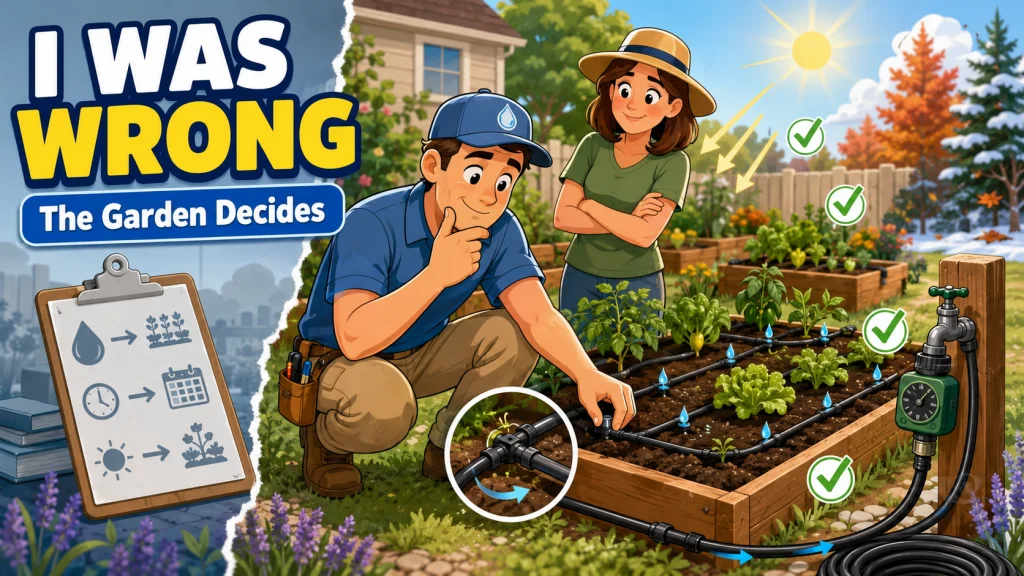
Three Months In, I Gave Advice I Would Not Give Today
The homeowner had a single raised bed and a straightforward question about how to connect a kit to her hose bib. I answered it confidently, the way you do when you have just enough experience to sound sure and not quite enough to know what you have not seen yet. The advice was not reckless. It was just incomplete in a way I had no reason to notice at the time.
Her system ran fine through spring. It struggled by midsummer and failed outright in August, right when the bed needed water the most. I heard about it secondhand, filed it away as a one-off, and moved on. It took another homeowner with a nearly identical setup, six months and a different season later, before I noticed the pattern instead of the incident. That gap between seeing a problem and understanding it is most of what this piece is about.
The part I missed was not the connector itself. It was everything around it: how much sun the tubing would take, whether the fittings would stay outside through winter, and whether the homeowner would know what “working normally” looked like after I left. At the time, I treated those as side details. Later, they turned out to be the job.
What I Believed About Kit Quality
For longer than I want to admit, I treated raised bed drip kits as interchangeable. Same pressure regulator on paper, similar drip line diameter, similar price point. I assumed similar performance, and I told people as much when they asked whether one kit was as good as another.
That assumption held up fine during a demo in someone’s driveway. It did not hold up after a full season of UV exposure on cheaper tubing, or after a winter freeze hit fittings that were rated for the job on paper but not built for it in practice. I will not name brands here. That kind of side-by-side comparison belongs in a dedicated raised bed drip irrigation kit guide, which can go into the differences with more care than a confession like this one can.
What I Believed About Soaker Hose
I steered every homeowner toward drip line, almost automatically, for years. I had decided early on that soaker hose was the lesser option and never really revisited that decision. It is an easy belief to hold onto, because drip line is genuinely the better fit for a lot of layouts.
What changed my mind was watching a handful of small one-bed and two-bed installs run cleanly on soaker hose for entire seasons with almost no fuss. Soaker hose tends to work best for exactly this kind of smaller, level setup, and I had been recommending against it on reflex instead of on a real comparison. Soaker hose is not the right call for every raised bed. It is just not the wrong call as often as I used to assume.
What I Believed About Winter and Drip Tubing
I underestimated the freeze line more than once early on. I gave a homeowner in a colder zone a winterizing instruction that was looser than what her climate actually needed, mostly because I was thinking about my own milder zone and not hers. The lines and fittings I described as low risk were not low risk where she lived.
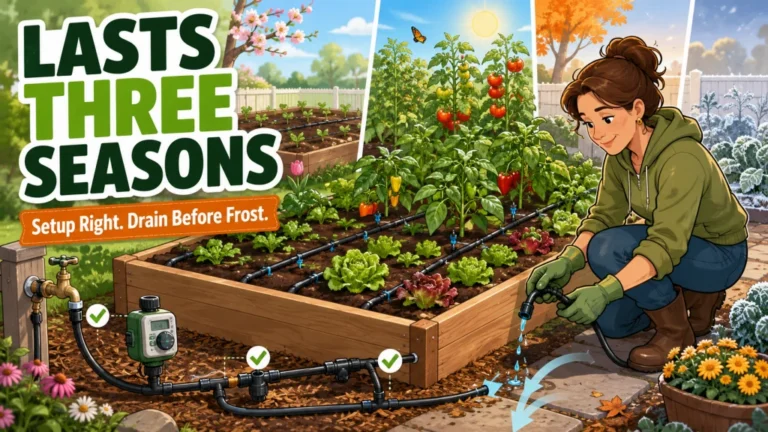
Field Note: Standing water left in fittings is what cracks them once it freezes and expands, and the colder the zone, the less margin there is for skipping that step. I learned this from a spring callback, not from a manual.
That callback is the reason I now ask about climate zone before I say anything else about winterizing. The right approach varies enough by zone that it deserves its own breakdown, which is what the seasonal raised bed drip irrigation schedule on this site is built to cover.
What I Believed About How Homeowners Would Use the System
I assumed people would walk out to their raised beds every few weeks and glance at the tubing, the way I would. Most homeowners do not check a drip system until something looks wrong with the plants, and by then the problem has usually been running quietly for weeks, not days.
That delay between when a problem starts and when someone notices it is part of why so many systems get blamed for failures that started much earlier. It changed how I do end-of-install walkthroughs. I now spend a few extra minutes showing people what a working line looks and sounds like, so they have a baseline to notice when something is off, instead of waiting for wilted leaves to tell them.
Where I Started vs Where I Landed
Laid out side by side, the pattern across all four beliefs is the same: I trusted a general rule over the specific garden in front of me. Here is the short version.
| What I Believed Early On | What Changed My Mind |
|---|---|
| Kits with similar specs perform similarly | A full season of UV exposure and one hard freeze |
| Soaker hose is always the weaker choice | Small one-bed and two-bed installs that ran clean for seasons |
| My local freeze risk applies everywhere | A spring callback from a colder zone |
| Homeowners check their system often | Hearing how long a problem usually runs before anyone notices |
None of these were dramatic failures on my part. They were blind spots that only experience could have closed, which is exactly why a confident answer early in anyone’s career deserves a little skepticism.
- I ask about climate zone before giving any winterizing advice, not after.
- I ask about bed count and layout before assuming drip line is the default, instead of recommending it on reflex.
- I walk every homeowner through what a working system looks like before I leave, instead of assuming they will check it the way I would.
That short list is most of what changed in how I work. None of it required new tools. It just required noticing the distance between what I assumed and what the garden was actually telling me.
Final Thoughts: Being Wrong Had Real Costs for Real Gardens
None of these were harmless misunderstandings. A failed bed in August, a spring callback, a homeowner who lost weeks of growing season before noticing a problem. Those are real costs that landed on real gardens, not abstract lessons. Being honest about that here is more useful to a reader than pretending those seasons went smoothly.
Most of what I am describing came from too little experience rather than carelessness, and that is part of why an honest irrigation technician owes readers the specifics instead of a polished version of the story. If you are early in your own raised bed drip irrigation learning curve, there is a decent chance you are about to make one of these same assumptions. The guides on this site exist so that you do not have to learn it the same way I did.
Where These Lessons Line Up With Outside Sources
None of this is just personal recollection. A few outside sources back up the patterns behind these professional drip irrigation mistakes:
- Eartheasy’s comparison of drip irrigation and soaker hoses confirms that soaker hose is a reasonable fit for smaller, level garden setups, which lines up with what changed my mind about recommending it so rarely.
- Homestead and Chill’s raised bed drip irrigation tutorial notes that standing water left in pipes or valves can crack them once it freezes and expands, which matches exactly what caused the spring callback that changed my winterizing advice.
- Rain Bird’s winterizing guide points out that many homeowners only discover irrigation damage once they restart the system in spring, which is the same delayed-discovery pattern I now plan for during every install walkthrough.
None of these sources changed my mind on their own. They confirmed, after the fact, why the costly version of each lesson happened the way it did.
FAQs
🔧 Are all raised bed drip irrigation kits the same quality?
No. Kits with similar specs on paper can perform very differently after a full season of sun exposure or a winter freeze. The differences usually show up in tubing and fittings, not in the parts that are easy to compare on a box.
🌱 Is soaker hose ever a better choice than drip line for a raised bed?
Yes, for a single small bed or a couple of beds with a simple layout. Soaker hose runs cleanly in setups like that. It becomes less practical once you have more beds, longer runs, or a layout that needs precise emitter placement.
❄️ Why did my drip system fail after winter even though it worked fine before?
Standing water left in fittings can freeze, expand, and crack components that look fine until the system is pressurized again in spring. This is more likely if the winterizing instructions you followed were written for a milder climate than yours.
👀 How often should I check on a raised bed drip system?
More often than most people think to. Problems can run for weeks before plants show visible stress, so a quick look at the tubing every couple of weeks catches issues earlier than waiting for wilted leaves to prompt a check.
🧰 Should I trust general drip irrigation advice that does not mention my climate zone?
Be cautious with it, especially for winterizing. Freeze risk and timing vary enough by zone that advice written for one climate can be genuinely wrong for another, even when it sounds confident.