Some raised bed drip systems come out after one season. Others are still running three years later. When I look at the installs from my own work that have held up the longest, the same pattern shows up every time. It has nothing to do with which kit the homeowner bought. It has everything to do with a few decisions made early and one habit most people skip at the end of the year.
I Keep a Loose Mental List
I keep a loose mental list of the raised bed drip installs I did more than three seasons ago that are still running without a callback. Not a spreadsheet, not a written log. Just the gardens I think about when someone asks me whether drip irrigation is really worth setting up for a few vegetable beds. When I work through that list, there are more systems still running than I would have predicted early in my career.
The ones on that list are not all in the same neighborhood, not all the same bed count, and not all set up with the same components. What they share is harder to name than a specific brand or a specific kit. It comes down to how the system was treated in the first season and what the homeowner did once the growing season ended. I have thought about it enough to be fairly confident it is not a coincidence.
Three seasons is the number I keep landing on because it means something specific. A system that lasts one season might have just gotten lucky with water pressure and mild weather. A system still running in its third year has been through at least two full spring startups, two summers under load, two falls where the homeowner had to decide whether to drain the lines or leave them. It has survived a freeze or two, a hot week that would expose any dry spot in the layout, and the quiet attrition of a garden that actually gets used. If the system is still intact at that point, it is not luck. Something about the setup held, and that is worth paying attention to.
The Pattern Is Not What Most People Expect
When people ask what separates a three-season system from a one-season system, they usually assume the answer is money spent on the kit. Better tubing, branded fittings, a more capable timer. That assumption does not match what I actually see. Some of the longest-running installs I know of used mid-range drip kits from a big-box store. Some of the shortest-lived systems had more expensive components. The difference was not in the quality of the parts.
What I keep coming back to is simple: the long-running systems were treated carefully early, then protected before winter every year. I will not turn that into a checklist here because the setup and schedule guides already do that work. For this story, the important part is that I have seen it often enough to trust it, and it has nothing to do with which brand name is on the tubing.
It is also worth saying what the pattern is not. The homeowners with the longest-running systems are not checking lines every week or buying replacement emitters every spring. If anything, the opposite tends to be true. The setup was done right early, so the system runs without drama. The ones I think about most often are the ones who put the work in at the beginning and then largely left it alone. That is the part that surprises people the most when I describe it.
The Install I Still Think About
One homeowner had four raised beds and a spigot on the far side of her yard. The run distance from the hose bib to the last bed made me nervous at the time. Long mainline runs can create pressure drop that does not always show up immediately, and I was not entirely sure how the system would behave once all the emitters were loaded and running together. I went through everything I could check before I left, but I drove away with the kind of unease that comes from a variable I could not fully control.
Three seasons later, she sent me a photo. August. Full beds, everything looking exactly the way it should. The tomatoes were heavy. The lines were intact. The system was still running on a schedule she had not changed since the second year.
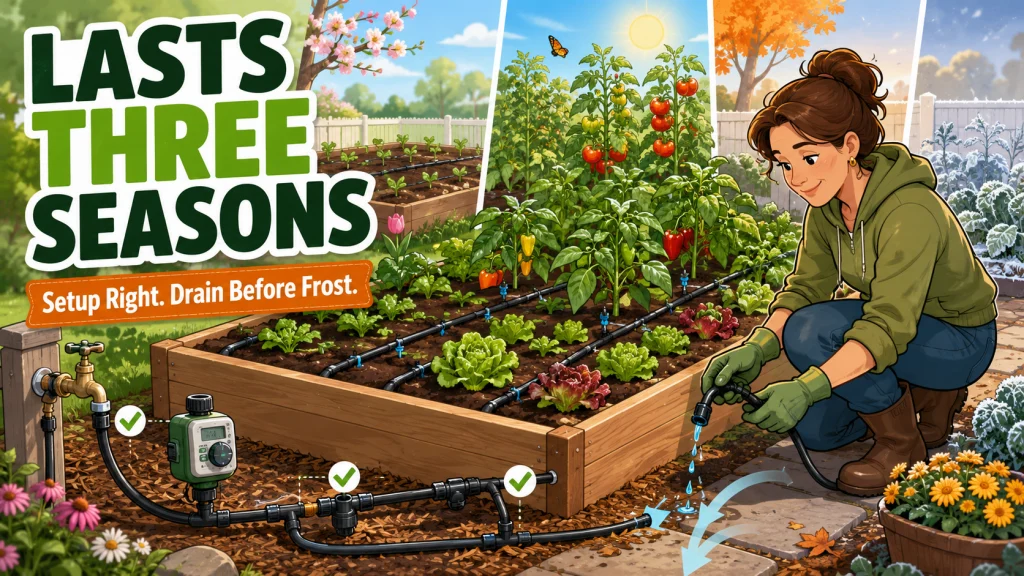
When I asked what she had done over the years in terms of maintenance, she mentioned one thing. At the end of every season, before the first hard frost, she drained and disconnected the lines. That was it. No special tools, no replacement parts ordered in the fall, no winter repair work in the spring. Just that one step, done consistently, before the ground froze. Most homeowners skip it because it sounds optional or because they run out of time when the rest of fall cleanup is happening. In her case, it kept plastic fittings and tubing intact through three winters in a climate where overnight temperatures can drop fast and without much warning.
Field Note: The most common thing I find in failed second-year drip systems is water left in the lines over winter. The tubing often holds, but the fittings at the connections do not. By spring, the weak points have cracked or pulled loose, and the homeowner is looking at a repair job before the season even starts.
What the Short-Lived Systems Had in Common
The other side of the list is worth thinking about too. The installs that did not make it past season two are not clustered around one type of homeowner or one type of yard. They are not the result of bad gardens or bad equipment. They are accumulation failures, and they almost always trace back to a single step that got skipped in the first season, usually in the rush of spring planting when there was too much happening at once.
The most common patterns I see in systems that did not last:
- A fitting that was not fully seated at install, which starts weeping by midsummer and is never addressed because it seems minor.
- A section of tubing routed incorrectly and kinked at a corner, which eventually splits under pressure once the summer heat cycles it enough times.
- An emitter that clogged in late August and was never cleared before the system was shut down, so by the following spring that entire run is delivering almost nothing to the root zone.
None of these are catastrophic on their own. Each one is fixable in about ten minutes. But when a system keeps needing small repairs instead of just running, the motivation to fix one more thing disappears quickly. By season two, the whole setup comes out and does not go back in. The homeowner concludes drip irrigation did not work for them, when what actually happened is that a few small skips accumulated into a system that felt like more trouble than it was worth.
What This Means If You Are Just Starting Out
If you are somewhere in that early phase right now, the purchase decision is the smaller part of what determines whether the system is still running two years from now. What comes next is what actually matters: how the setup gets handled in the first season, and whether the end-of-season shutdown becomes a habit or an afterthought. Most people do not realize this when they are still comparing kit prices. They figure it out in year two, when they are either repairing things or they are not.
The raised bed drip irrigation setup guide covers the early decisions that shape how a system holds up over time. For the seasonal habits that tend to separate the long-running installs from the ones that need repairs every spring, the guide on the raised bed drip irrigation seasonal schedule is the one worth reading before the first frost warning of the year.
Final Thoughts: The Work That Happens in Season One
I do not have a drip system in my own raised beds that has failed past season two when I installed it myself. The ones that hold up have something that is hard to fully describe until you experience it: by the third season, the system has become part of how the garden runs, not something you manage on top of it. You are not hauling tubing out in October wondering whether to bother putting it back. You are not starting each April with a repair list. It just runs, and you stop thinking about it the way you stopped thinking about the timer on your porch lights.
That does not happen automatically. It happens because someone made a set of careful decisions early and then protected the system before winter without deciding the step was optional. The photo she sent me in August was three years of those decisions in one image. That is what the long-running installs have in common, and it is what I keep hoping more first-time setups figure out before they give up on the whole thing.
Sources and References
- Homestead and Chill: Multi-season raised bed and drip irrigation reporting from experienced home growers, including seasonal maintenance patterns and long-term system use from real gardens.
- Utah State University Extension: Drip irrigation guidance for home gardens, including winterization recommendations and component care for cold-climate regions where freeze damage to fittings and tubing is a documented failure point.
- University of California Agriculture and Natural Resources: Research-based drip irrigation publications covering emitter performance, system efficiency, and seasonal setup and shutdown procedures for home garden applications.
FAQs
💧 How long does a raised bed drip system typically last?
With correct setup and basic seasonal maintenance, a drip system in a raised bed can run reliably for three seasons or more. The main factors are whether the lines were drained before winter and whether the early setup addressed pressure, filtration, and emitter placement correctly. The components are durable when they are not stressed by freeze cycles or high-pressure damage. Setup habits usually determine the lifespan more than the parts themselves.
❄️ Do I need to drain drip irrigation lines before winter?
Yes, in most US climates. Water left in drip tubing and fittings over winter can freeze, expand, and crack fittings or pull apart connections at emitter sites and mainline joints. Draining and disconnecting the lines before the first hard frost is the single maintenance step I see most consistently separating long-running systems from the ones that need repair work every spring.
🌱 What causes most raised bed drip systems to fail in year two?
Usually a step that was skipped in the first season, not a problem with the equipment itself. The most common patterns are water left in lines over winter, a fitting that was never fully seated and eventually starts leaking, or a clogged emitter that was not cleared before seasonal shutdown. Each issue is fixable on its own, but together they create a system that needs constant small repairs instead of just running.
🔧 How often should I check a running drip system in a raised bed?
A quick visual check every week or two during the growing season is usually enough. Look for dry spots in the bed, any fitting that is weeping, and any section of tubing that has shifted away from the root zone. If the setup was done correctly at the start, the system should not need frequent intervention. The checks are about catching small problems before they compound into something harder to fix mid-season.
🪴 Is drip irrigation worth setting up for just one or two raised beds?
It depends on your situation. For a single small bed, hand watering is often simpler. For two beds or more, or for anyone who travels during the growing season, a basic drip setup starts making sense quickly. The value increases with bed count, bed size, and how often you are away during summer. The setup investment is usually a few hours, and the payoff is consistent watering without having to think about it every day.