If your raised bed drip system runs off a hose bib with no automatic timer, you are the timer right now, and that works fine until the morning you sleep through it during a heat wave. This guide walks through whether your setup actually needs one, what a basic battery timer covers compared to a Wi-Fi-connected one, and where Orbit and Rain Bird differ as the two most common battery timer brands for raised beds. We will also get into when paying extra for a Wi-Fi timer makes sense, when it is overkill for a small vegetable garden, and the buying mistakes worth avoiding either way. What this guide will not do is walk you through mounting the timer to your spigot or dialing in the exact watering schedule once it is running; those are separate decisions for a separate day.
A Timer Is What Turns a Drip Kit Into an Actual System
A drip irrigation system without a timer is basically a manual watering setup with extra fittings attached to the raised bed it is feeding. The tubing, the emitters, and the pressure regulator still do the job of spreading water evenly across the bed, but somebody still has to walk out and open the valve at the right time, every time. I have installed plenty of raised bed kits where the homeowner skipped the timer to save $20 or $30, then found themselves standing at the hose bib every morning anyway because the bed dried out the one day they slept in.
That is the real job a timer does here. It is not a luxury add-on bolted onto a finished setup; it turns a drip kit into an automatic raised bed timer system instead of one more thing you have to remember every morning. Whether you actually need one, and which type makes sense, comes down to a few honest questions about how present you are and how many beds you are running.
Do You Actually Need a Timer for Your Raised Bed?
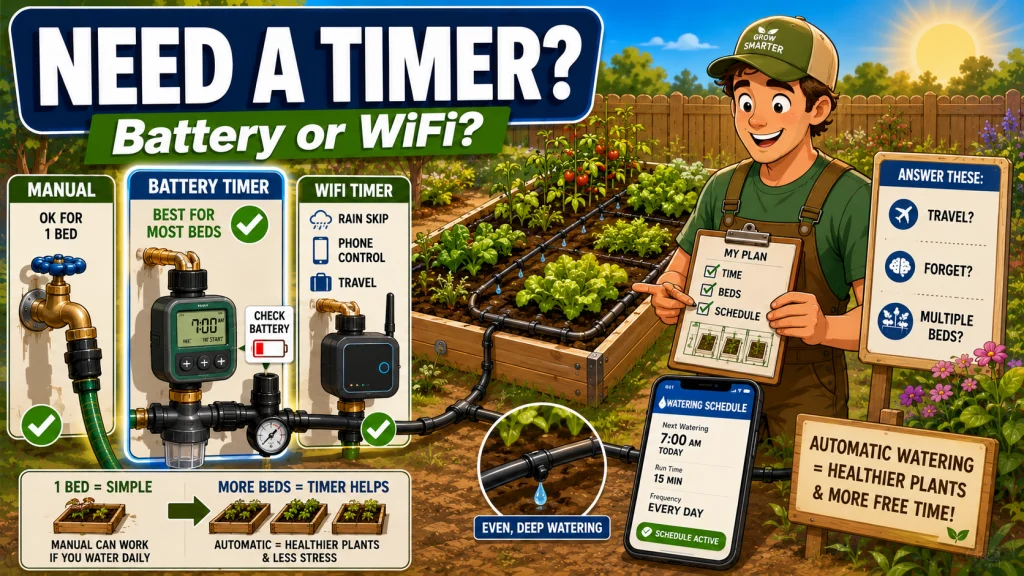
If you already have a kit installed and you are consistently around at roughly the same time every day, a simple manual shutoff valve can work fine. You open it for the number of minutes your bed needs, you close it, you are done. For a single 4-by-4 lettuce bed with a gardener who waters every morning before work, paying for a timer is not solving a real problem yet.
The case for a timer gets stronger fast once your situation changes. If you travel for even a weekend, forget more often than you would like to admit, run more than one bed, or want the system running at dawn before the heat sets in rather than whenever you happen to be home, a timer stops being optional and starts being the thing that keeps your tomatoes alive while you are not looking. A few signs usually point to the same conclusion:
- You have left town for two or more days without arranging for someone to water
- You are running three or four raised beds off one hose bib and hand-timing each one is eating your mornings
- You want watering to happen before 7 a.m., before you are realistically awake to do it yourself
- You have already had at least one bed go dry because you forgot, not because the system failed
If any of that sounds familiar, a timer is the next correct move. For the cases where it genuinely is not worth the money yet, whether your raised bed setup needs a timer goes deeper into those trade-offs than I have room for here.
Before any of this matters, though, you need a kit actually laid out in the bed and watering correctly on its own. If you have not settled on a raised bed drip irrigation kit yet, or you are still weighing how raised bed drip kits compare, that decision comes first. The timer is something you add once the lines and emitters are already running without help, not a fix for a kit that is not laid out correctly yet.

This battery-powered hose timer converts any standard faucet into an automatic single-zone watering system with programmable schedules and adjustable watering durations. The clear LCD display makes programming straightforward, and a built-in rain delay feature pauses irrigation automatically during wet weather. Designed for outdoor durability and water-resistant construction, it backs its reliability with a six-year limited warranty.
Check On AmazonIf you click this link and buy, we earn a commission at no additional cost to you.
Timer Types and Where Each One Actually Fits a Raised Bed
Once you have decided a timer makes sense, the next question is which kind. Raised bed gardeners are usually choosing between three categories, and each one is built for a different level of involvement.
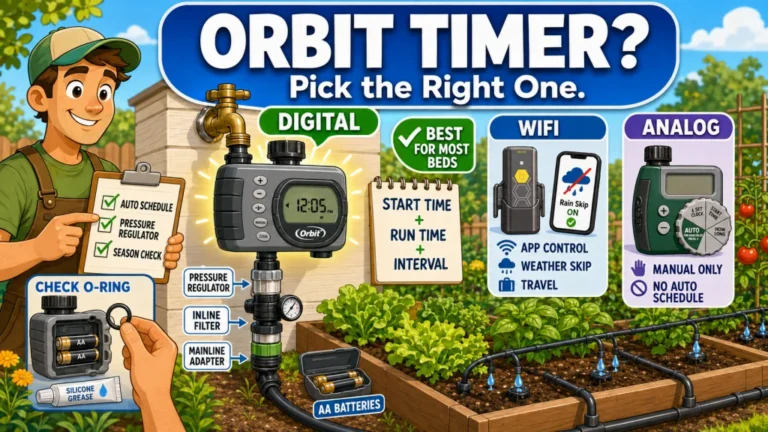
Basic analog dial timers run on a simple mechanical mechanism, no batteries required, and they can sit on a hose bib for years without anything to charge or replace. The trade-off is that most only handle a single duration setting; you twist the dial, the water runs for that long, then it shuts off. They do not know what day it is and cannot run a different schedule on Tuesday than Thursday. Digital battery timers solve that by adding day and time scheduling, usually off two AA batteries, and they are the closest thing to a default hose timer for a raised bed drip kit right now. Wi-Fi-connected timers go a step further: app-based control, weather or rain-skip features, and the ability to adjust a schedule from your phone instead of walking out to the bib. At that point you are running a small drip irrigation controller for the raised bed, not just a simple valve, and that comes with a different price tag.
| Timer Type | Good Fit For | Watch Out For |
|---|---|---|
| Analog dial | One bed, simple daily run, no day-of-week needs | No scheduling by day, easy to forget to reset after a manual override |
| Digital battery | Most raised bed setups, 1 to 4 beds, want a real schedule | Battery life drops fast in cold weather, display can be hard to read in bright sun |
| Wi-Fi-connected | Frequent travelers, multiple beds, want rain-skip and phone control | Depends on home Wi-Fi reaching the hose bib, costs more upfront |
That table is a starting point, not the final word. The bed count and how often you can physically check the system still matter more than which logo is on the timer.
Why a Battery Timer Is Usually the Best Choice for a Raised Bed Drip Kit
For most raised bed setups I have worked on, a digital battery timer ends up being the right call, and it is not close. It gives you actual day and time scheduling, it does not depend on your home network reaching all the way to the hose bib, and it sits in a price range that does not feel like a second purchase on top of the kit. Orbit and Rain Bird both make hose-end battery timers in roughly the same $20 to $30 range, and between the two of them they cover the large majority of raised bed installs I see.
The honest caveat is that a battery timer is not bulletproof. I usually check the battery contacts before I blame the valve itself when a homeowner tells me their hose timer for the raised bed drip kit stopped opening on schedule; corrosion on the contacts is a more common failure than people expect. A 4-by-8 bed running two parallel drip lines does not ask much more of the timer than a single 4-by-4 bed does, since the timer is just opening and closing a valve, not metering exact volume. If you want the full side-by-side on which specific battery timers hold up best, hose timers built for raised bed drip systems covers that in more detail than fits into one section here.
Field Note: The most common timer complaint I hear is not that the timer broke, it is that the battery died quietly in the middle of August and nobody noticed until the bed looked stressed. A timer with a low-battery warning light is worth the extra few dollars over one without, just so the failure is loud instead of silent.

This multi-function kit connects 1/2 inch drip tubing to any 3/4 inch male threaded faucet or garden hose, helping ensure your drip irrigation system runs properly. It includes a backflow preventer, a 25 PSI pressure regulator, and a 150 mesh filter, along with a compression fitting that creates a leak-proof seal to 1/2 inch tubing. Built from UV and chemical-resistant materials for long-lasting durability, the kit can also be paired with a compatible Rain Bird hose-end timer for automated watering.
Check On AmazonIf you click this link and buy, we earn a commission at no additional cost to you.
Orbit and Rain Bird: How the Two Most Common Brands Compare
Orbit and Rain Bird dominate the raised bed timer market for a reason: both are widely available at home improvement stores, both make a battery timer in a similar price bracket, and both are built simply enough that a first-time gardener can program one without pulling up a manual on their phone. Where they actually differ is in the programming interface, the battery life under normal use, and the way each tends to fail when something goes wrong.
Orbit’s dial-and-button interface tends to be a little more forgiving for someone setting a schedule for the first time, while Rain Bird’s button sequence asks for a few more steps to reach the same result but tends to hold a setting more reliably once it is dialed in. Neither brand is hiding a dramatically better product; the difference shows up more in small daily friction than in whether your tomatoes get watered. Orbit timer performance on a raised bed walks through that brand on its own if that is the direction you are leaning.
When a Rain Bird Timer Specifically Makes Sense
A Rain Bird hose-end timer tends to be the better pick when you want a schedule that does not drift after a power blip or a battery swap; in my experience the programmed settings hold more consistently through a battery change than some competing models do. That matters more than it sounds like it should, because losing a saved schedule mid-season usually means a bed goes unwatered for a day before anyone notices. If you are running more than one raised bed off the same hose bib through a splitter, that consistency is worth paying attention to. the Rain Bird timer for raised beds gets into the specifics of programming it and where it tends to fall short.
Battery Timer or Wi-Fi Timer: Which One Is Worth the Extra Cost?
A Wi-Fi-connected timer usually runs $60 to $80 more than a basic digital battery model, and whether that is worth it depends entirely on what you are trying to solve. If you are managing a single 4-by-4 or 4-by-8 raised bed and you check on it every couple of days anyway, the extra cost is paying for convenience you may not use. If you are running four beds, traveling often, or you genuinely want the system to skip a cycle automatically after a rainstorm instead of watering an already-soaked bed, the Wi-Fi option starts to earn its price.
Buying a Wi-Fi timer for one small raised bed because it looks more advanced, then never opening the app after the first week because a basic schedule was all that bed ever needed.
Starting with a digital battery timer on a single bed, and only stepping up to a Wi-Fi-connected drip irrigation controller for the raised bed once you add a second or third bed or start traveling often enough that rain-skip and remote control actually get used.
That sequence matters more than which specific brand you pick. battery versus Wi-Fi timer comparison for raised beds breaks down the cost difference in more detail, including the situations where the Wi-Fi features genuinely change your watering outcomes instead of just sitting unused on your phone.
Pro Tips: Whatever timer you land on, run it manually once before trusting the schedule. Catching a stuck valve while you are standing right there beats finding a dry bed three days later.

This Wi-Fi enabled hose timer supports fully customizable watering schedules that can be monitored, adjusted, and activated remotely through a mobile app. Battery-powered with AA batteries, it features weatherproof housing for reliable outdoor performance. Backed by a two-year limited warranty.
Check On AmazonIf you click this link and buy, we earn a commission at no additional cost to you.
What to Avoid Before You Buy a Raised Bed Drip Timer
Most of the bad timer purchases I see are not bad products, they are the right product bought for the wrong situation. Before you hand over your card, run through the mistakes below and rule out the ones that actually apply to your raised bed.
- Don’t buy an analog dial timer if you need a different schedule on different days; it only knows one duration, not a calendar.
- Don’t buy a Wi-Fi timer if your home network does not reliably reach the hose bib, since a weak signal turns a smart timer into an expensive dumb one.
- Don’t add a timer before your dripline layout is already watering the bed evenly; a timer automates whatever schedule you give it, including a bad one.
- Don’t skip the low-battery warning feature if you travel often, since a silent battery death is how a bed goes dry for a week while you are away.
- Don’t pay for “smart” features you will not use; if a fixed daily schedule covers your needs, app control and rain-skip are paying for convenience you will forget to open.
- Don’t choose a timer by brand alone; choose it by how many beds you are running, how often you are away, and whether you actually need rain-skip or manual override.
None of these mistakes are expensive to avoid. They just take five minutes of honesty about how your raised bed setup actually runs before you commit to a specific timer.
Final Thoughts: Match the Timer to How Present You Actually Are
The honest answer to whether you need a drip irrigation timer for your raised bed has less to do with the bed itself and more to do with how reliably you show up at the hose bib. A gardener who is home every morning and checks the bed daily can get by on a manual valve for a long time. A gardener who travels, forgets, or wants water running before sunrise needs the timer to do the remembering instead.
From there, most setups land on a digital battery timer from Orbit or Rain Bird, with a Wi-Fi-connected option reserved for multiple beds or frequent travel. None of these choices fix a kit that was laid out wrong in the first place. Get the layout right first, then let the timer take the job off your plate.
Explore More Raised Bed Drip Irrigation Guides
Each of these covers a piece of the timer decision in more depth than fits into one guide, from specific brand comparisons to the honest case for skipping a timer altogether.
| Guide | What it helps with |
|---|---|
| Best Hose Timers for Raised Bed Drip Irrigation | Side-by-side comparison of specific battery timers worth buying for a raised bed kit |
| Orbit Hose Timer for Raised Bed Drip Irrigation | A closer look at programming, battery life, and common failures with Orbit’s timer |
| Rain Bird Timer for Raised Bed Drip Irrigation | Programming steps and where a Rain Bird timer tends to outperform or fall short |
| Battery vs Wi-Fi Timer for Raised Beds | Full cost and feature breakdown for deciding between the two categories |
| Do You Need a Timer for Raised Beds | The honest decision framework for skipping a timer versus adding one now |
Start with whichever guide matches where you are stuck, whether that is choosing a brand or deciding if you need a timer at all.

This battery-powered hose timer converts any standard faucet into a two-outlet automatic watering system with programmable schedules and adjustable watering durations. The clear LCD display makes programming straightforward, and a built-in rain delay feature pauses irrigation automatically during wet weather. Designed for outdoor durability and water-resistant construction, it backs its reliability with a six-year limited warranty.
Check On AmazonIf you click this link and buy, we earn a commission at no additional cost to you.
FAQs
⏱️ Do I really need a timer for a raised bed drip system?
Only if you cannot reliably show up at the same time every day. If you travel, forget, or want watering before sunrise, a timer replaces the part of the system that depends on you remembering.
🔋 How long does a battery last in a raised bed drip timer?
Most digital battery timers run six months to a year on standard AA batteries under normal use, though cold weather and frequent programming changes drain them faster. Check the contacts for corrosion if a timer stops opening on schedule before the batteries should be dead.
📶 Is a Wi-Fi timer worth it for one small raised bed?
Usually not. A single 4-by-4 or 4-by-8 bed rarely needs the rain-skip or remote scheduling features enough to justify the extra $60 to $80 over a basic digital battery timer.
🆚 What is the actual difference between Orbit and Rain Bird timers?
Both cover the same core job at a similar price, but they differ in programming interface and how well a saved schedule holds through a battery change. Orbit tends to be easier to program at first; Rain Bird tends to hold its schedule more consistently afterward.
🌅 Can a timer water my raised bed before sunrise automatically?
Yes, that is one of the main reasons gardeners add a timer in the first place. Both digital battery and Wi-Fi timers let you set a start time before you are realistically up to open the valve yourself.
🧰 Does an analog dial timer work for a raised bed drip kit?
It can, but only for simple setups since it usually runs one fixed duration with no day-of-week scheduling. Most raised bed gardeners outgrow it once they want different watering on different days.
❌ What’s the most common mistake people make buying a raised bed drip timer?
Buying based on features instead of the actual situation, most often a Wi-Fi timer for a single small bed or a basic timer for someone who travels constantly and needs rain-skip. Match the timer to your bed count and how often you are away, not to which one looks the most advanced.