A drip irrigation system for raised beds pays for itself in the first growing season for most vegetable gardeners who have been hand-watering. Whether it makes sense for you depends on how many beds you have, what you grow in them, and how much time you currently spend at the end of a hose. This article covers the real case for and against: the time savings, the plant health argument, the water savings, what the setup actually costs, and the specific situations where drip irrigation is the wrong call. One of those situations is more common than most people admit.
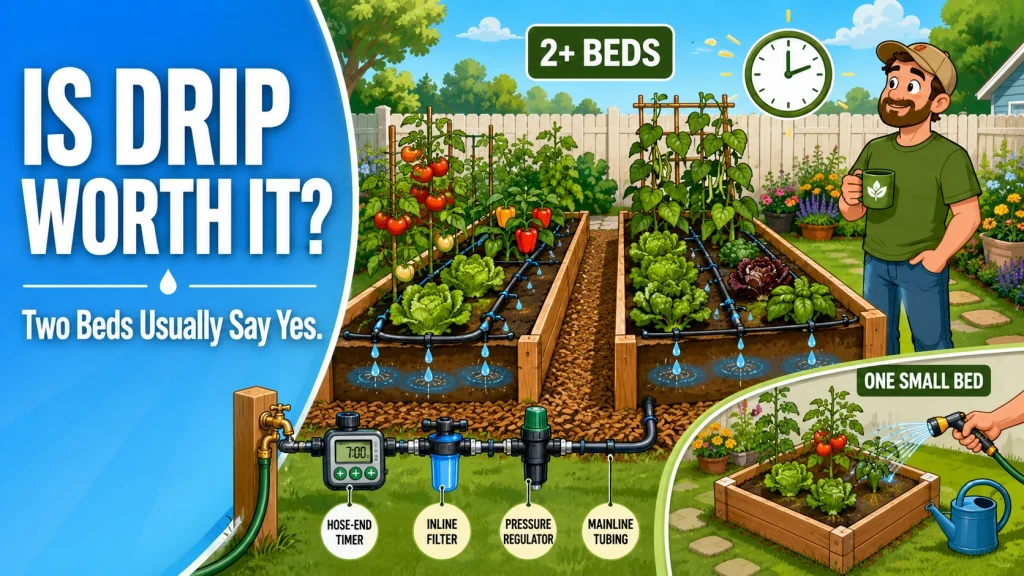
The Calculation Most Worth-It Articles Skip
Is drip irrigation worth it for raised beds? The answer the internet gives you almost always depends on who is writing the article. Kit sellers say yes, always. Generic garden blogs say yes, usually. What they rarely tell you is when the honest answer is no, and there are real situations where it is.
The short version: a drip system makes strong financial and practical sense for a gardener with two or more raised beds growing vegetables, especially if hand-watering is already taking more than fifteen minutes a week. It does not make sense for a single small bed that can be watered in two minutes with a hose. The math between those two situations is not close, and this article walks through both cases.
What Hand-Watering Really Costs You Over a Season
The time argument for drip irrigation is the one I find most convincing, and it is the one most gardeners underestimate before they run the numbers. Hand-watering two 4×8 raised beds thoroughly in peak summer takes fifteen to twenty minutes a day. That is not a complaint about the task itself; it is just the reality of doing it right. A hose moves slowly, root zones need to be soaked not sprinkled, and raised beds drain faster than in-ground soil. UGA Extension research confirms that raised beds require more frequent irrigation than in-ground beds specifically because they drain so quickly. You are not imagining that your raised beds dry out fast.
Over a ninety-day summer growing season, fifteen to twenty minutes per day adds up to twenty-two to thirty hours of watering time. That is a full workweek at the end of a hose. A drip system on a timer brings that to near-zero daily watering time once it is set up and calibrated. You check it occasionally, clear a clogged emitter every few weeks, and let the timer run. The seasonal time savings alone is enough to justify the cost for most vegetable gardeners, even before you look at plant health or water bills.
Field Note: The most common thing I hear after someone finally installs drip is that they wish they had done it two seasons earlier. Not because the setup is complicated, but because they had not done the time math until they were standing in the garden at 7 AM with a hose for the third day in a row during a heat wave.

This complete kit includes 10 vortex emitters, 20 spray emitters, 50 feet of 5/16 inch mainline tubing, 50 feet of 1/4 inch drip tubing, plus couplers, splitters, end plugs, and a water connector, enough to cover up to 3 raised garden beds. It runs on 20 to 45 PSI with adjustable, detachable emitter heads that resist clogging and rotate for precise watering at each plant's roots. The UV-resistant tubing holds up year-round above or below ground, and 7.5 inch bubbler stakes anchor securely even in loose soil. A printed instruction guide and digital growing guide are included.
Check On AmazonIf you click this link and buy, we earn a commission at no additional cost to you.
The Plant Health Case Is Stronger Than Most Gardeners Expect
Drip irrigation delivers water directly to the root zone. That sounds simple, but the consequence matters more for vegetables than for most other plants. When you water from overhead with a hose or a sprinkler attachment, you wet the foliage. Wet foliage in warm, humid conditions creates the right environment for fungal diseases like powdery mildew, early blight, and septoria leaf spot. Tomatoes and squash are the two crops I see suffer the most from overhead watering, and they are also two of the most common plants in raised beds.
Keeping foliage dry does not guarantee a disease-free season. Spores travel on the wind, not just on your hose water. But reducing the frequency and duration of leaf wetness is a real, documented factor in disease management. For a gardener who has watched tomato leaves go from healthy to spotted mid-July without a clear cause, the watering method is often the first place to look.
The consistency argument matters too. Raised bed vegetable crops, particularly fruiting plants like tomatoes, peppers, and cucumbers, are sensitive to uneven soil moisture. Irregular watering can contribute to blossom end rot in tomatoes and tip burn in lettuce. A drip system on a timer waters on a schedule the plants can count on, regardless of whether you are home, busy, or just tired after work.
Water Savings: What the Numbers Actually Mean
Drip systems typically reduce water use by thirty to fifty percent compared to hose or overhead watering. That figure comes from the fact that drip delivers water at the root zone rather than broadcasting it across the soil surface, the path between beds, and the surrounding area. Most of what you deliver with a hose is going somewhere other than plant roots.
For a household on a metered water supply, the savings are real but modest for one or two beds. A few dollars per month over a growing season is not a dramatic return. The water savings argument becomes more meaningful in three situations: a gardener on a well who wants to reduce pump run time, someone in a water-restricted area during drought conditions, or a gardener running four or more beds whose total outdoor water use adds up to something significant. For most urban and suburban vegetable gardeners, the water savings is a supporting reason to get drip, not the main one.
Note: The thirty to fifty percent savings estimate is based on drip irrigation compared to sprinkler or overhead hose watering. It assumes the drip system is properly sized for the bed, the emitters are matched to the soil type and plant spacing, and the timer is calibrated for the season. An oversized or mistimed drip system can use just as much water as a hose.
When Drip Irrigation Is Worth It Without Question
There are a handful of situations where the case for drip is clear enough that I would not spend much time debating it. If you check yes on more than one of these, a drip system is a straightforward investment.
- Two or more raised beds growing vegetables. The per-bed cost of a drip system drops as you add beds to the same mainline. Four 4×8 beds share one hose connection, one pressure regulator, one filter, and one timer. The incremental cost per additional bed is mostly just the drip line.
- Crops that need consistent moisture. Tomatoes, peppers, cucumbers, squash, and beans are all sensitive to uneven watering. Lettuce and other leafy greens bolt faster under moisture stress. If these are your main crops, drip irrigation solves a real problem.
- You travel during the growing season. A timer and a drip system keep the beds alive while you are away. Hand-watering depends on you or a neighbor showing up reliably.
- You are currently spending more than fifteen minutes a week hand-watering. At that point, the time savings alone justifies the cost within one season.
- You have had disease problems on tomatoes or squash. Switching from overhead watering to drip is one of the first changes I recommend when someone describes repeated foliar disease issues.
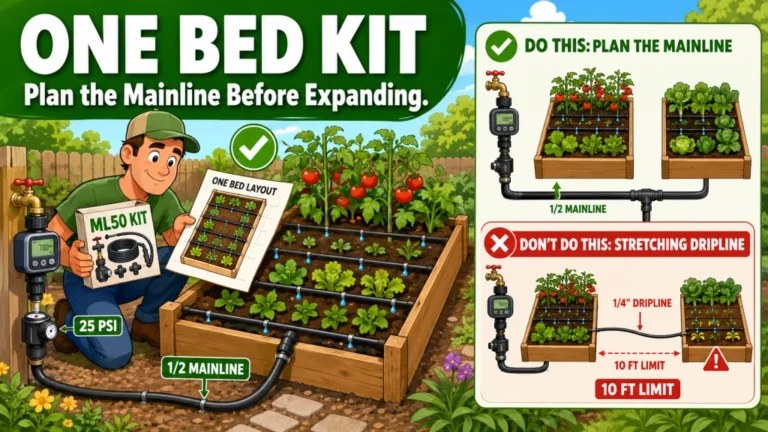
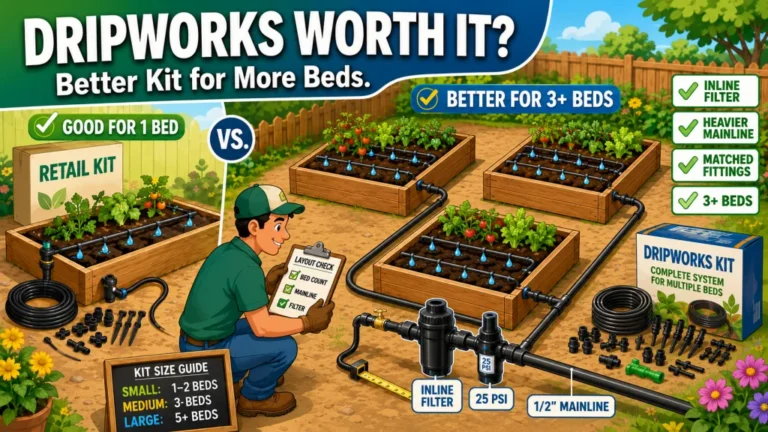
The bigger the vegetable garden and the more consistent your crop needs, the stronger the case becomes. A gardener running four 4×8 beds with tomatoes, peppers, and beans is not really asking whether drip is worth it at this point. They are asking which setup to buy. For kit selection based on bed count and layout, the section on raised bed drip irrigation kit options covers how to match components to your specific setup.

This all-in-one drip irrigation kit is designed specifically for standard 4 by 8 foot raised beds, with options covering 2 to 10 beds depending on the tier you choose. Everything needed to connect to a standard outdoor faucet or garden hose is included, and all fittings require only hand tightening. The tubing cuts easily with household scissors, and the fully modular design lets you expand or customize the system over time.
Check On AmazonIf you click this link and buy, we earn a commission at no additional cost to you.
When the Honest Answer Is No
This is the section most drip irrigation articles do not write because most of them exist to sell systems. But there are real situations where drip does not pay for itself, and being honest about them saves someone forty to one hundred dollars and a weekend of setup they will not use.
| Situation | Why drip probably does not make sense |
|---|---|
| One small raised bed (4×4 or smaller) | A single small bed can be watered thoroughly in two minutes with a hose. The payback period on a kit is measured in years, not one season. |
| Crops that prefer drier conditions | Herbs like rosemary, thyme, lavender, and oregano are drought-tolerant and do not benefit from frequent drip irrigation. Overwatering them is more likely to cause problems than hand-watering once or twice a week. |
| Beds you replant completely every season | Drip layouts are designed around specific plant spacing and row positions. If you rearrange the bed entirely each spring, the existing line positions become irrelevant and you are re-laying the system from scratch. |
| You only water twice a week regardless | If your current habit is an occasional deep soak and your crops handle it, you are not losing time or causing consistent moisture problems. Drip solves a problem you may not have. |
| You are renting and cannot modify the hose bib | Some landlords restrict permanent or semi-permanent hose connections. A basic kit still works, but verify before buying. |
The single-bed situation is the most common case where I see gardeners buy a kit, install it, and then wonder why it did not feel worth the effort. One 4×4 raised bed with a couple of tomato plants is a two-minute watering job. That does not need a drip system. It needs a good watering can or a gentle hose attachment and a couple minutes of attention most mornings.
The replanting issue is real too, and it trips up gardeners who rotate crops heavily. If you grow a different layout every season, the drip lines almost never land in the right place by year two. The workaround is adjustable emitter spacing and modular fittings, but it adds complexity. This is worth knowing before you set up a system that assumes a stable layout.
What a Basic Raised Bed Drip Setup Actually Costs
A basic drip kit sized for one or two raised beds typically runs forty to fifty dollars. That price usually includes a mainline, drip line or emitter tubing, fittings, and a pressure regulator. A hose-end timer adds another twenty-five to fifty dollars depending on the features. The full setup with a timer lands in the eighty to one hundred dollar range for a two-bed system.
That is the all-in cost for a gardener starting from nothing. Water savings at typical residential rates will recover five to fifteen dollars per season for most small setups, so water savings alone does not pay back the kit quickly. What does pay it back is the time savings and the avoidance of crop losses from inconsistent watering or disease. One season of tomatoes lost to blossom end rot from uneven watering is worth more than a drip kit. One week of hand-watering stress when you are already busy is worth more than the timer.
The question worth asking is not whether eighty dollars is cheap. It is whether eighty dollars is worth twenty-five to thirty hours of watering time, more consistent plant health, and the ability to leave for a week without worrying about the beds. For most vegetable gardeners, the answer is yes in the first season. For a gardener with one small bed they water in two minutes, the answer is genuinely no.
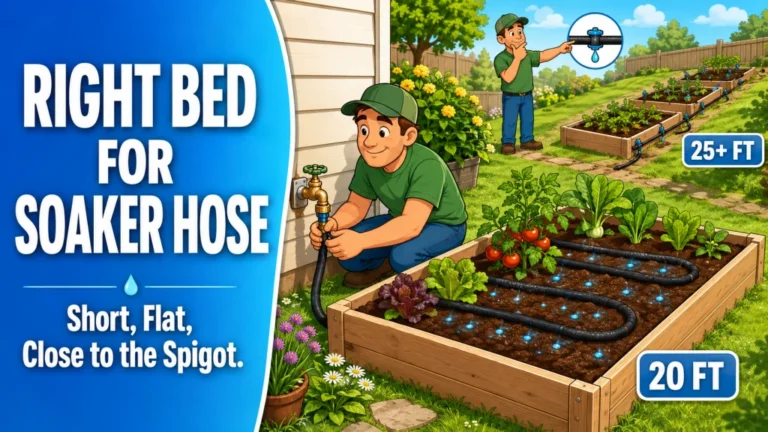
One component decision that affects the cost and layout is whether to use drip tape or standard emitter line. They behave differently in raised beds, especially at different soil types and bed widths. That comparison is covered in detail in the section on drip tape vs soaker hose for raised beds if you are trying to settle that part of the decision before buying.
Buying the most feature-rich kit available for one small raised bed and expecting it to pay for itself in water savings alone. The math does not work for a single 4×4 or 4×8 bed on a standard residential water bill.
Starting with a basic kit and timer for the beds you actually have now. If the system works and you expand to more beds next season, the same mainline and timer can support the addition. Start simple, scale if it makes sense.

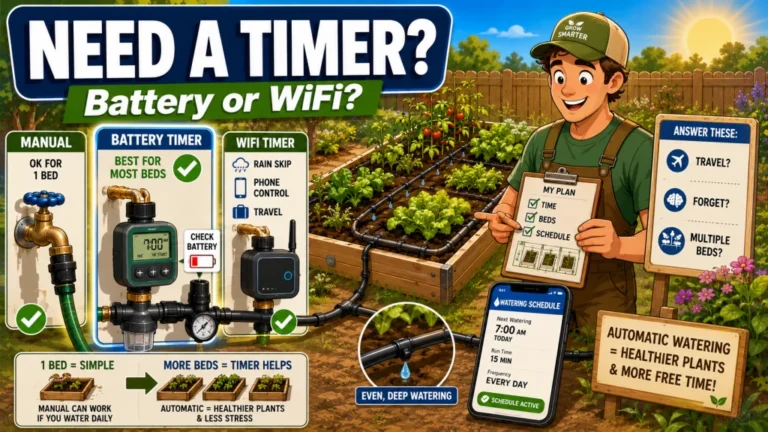
This robust hose-end timer works with sprinklers, drip irrigation, and soaker hoses, offering simple automatic programming with full 7 day scheduling for worry-free watering. An extra-large dial and readout screen make setup and schedule review easy, while one-touch buttons allow quick cancellation, a rain delay of up to 96 hours, or manual watering on demand. The display also shows the next scheduled cycle and time remaining on the current one.
Check On AmazonIf you click this link and buy, we earn a commission at no additional cost to you.
Final Thoughts: Make the Call Before Next Season Starts
One thing worth naming before you decide: drip is not zero maintenance. It saves the daily watering routine, but it still asks for a few minutes every few weeks: check the filter, clear a clogged emitter if coverage looks uneven, and flush the lines at the end of the season. In cold climates, you drain the system before the first freeze or the fittings split. None of that is hard or time-consuming, but if the appeal of drip is completely hands-off once installed, that is not quite accurate. The more honest description is hands-off daily, with light seasonal attention.
The pattern I see consistently is that gardeners who install drip for raised beds do not regret it, and gardeners who install it for a single small bed sometimes feel like it was more setup than it was worth. Those are both reasonable outcomes, and the difference comes down to bed count, crop type, and how much time they were spending at the hose before.
If you have two or more beds, grow vegetables that need consistent moisture, and are currently spending real time hand-watering, the case for drip is solid. The system pays for itself in time savings within one season and usually reduces crop stress in ways you will notice by mid-summer. If you have one small bed and a five-minute watering routine that is working, there is no urgent reason to change it. Drip irrigation is a good tool for the right situation, not a universal upgrade for every raised bed.
The one thing I would say to anyone still on the fence: install it before the season starts, not three weeks in when you are already behind on everything else. Setting up drip when the beds are empty is a calm thirty-minute job. Setting it up after the plants are in is an awkward puzzle around root zones and stems that nobody enjoys.

This inline filter protects downstream drip components from debris using a pre-installed 200 mesh stainless steel filter element rated to catch particles as small as 75 microns. The glass-filled polypropylene body handles up to 150 psi and fits any standard three-quarter inch irrigation valve via male pipe thread connections on both ends. The cap unthreads quickly for easy filter cleaning without tools.
Check On AmazonIf you click this link and buy, we earn a commission at no additional cost to you.
FAQs
💧 Is drip irrigation worth it for just one raised bed?
Usually not, unless that one bed is large (4×8 or bigger) and packed with vegetables that need consistent moisture. A single small raised bed can be watered thoroughly in two minutes with a hose. The time savings from a drip system barely registers, and the cost does not pay back quickly on water savings alone.
🍅 Which vegetables benefit most from drip irrigation in raised beds?
Tomatoes, peppers, cucumbers, squash, and beans are the crops that benefit most. They are sensitive to uneven moisture and to wet foliage. Leafy greens like lettuce and spinach also benefit from consistent watering, especially in warm weather. Drought-tolerant herbs like rosemary and thyme are the clear exceptions; they do not need a drip system.
💸 How quickly does a drip system pay for itself?
For most vegetable gardeners with two or more beds, the time savings alone covers the cost within one season. A basic setup with a timer runs eighty to one hundred dollars. Water bill savings at residential rates are real but modest; the bigger return is in hours saved over a ninety-day growing season and in reduced crop losses from inconsistent watering or disease.
🌱 Can I use drip irrigation if I replant my raised beds every season?
You can, but it adds complexity. Drip layouts are designed around specific plant rows and emitter positions. If you completely rearrange the bed each spring, the existing lines will rarely be in the right place. Adjustable fittings and modular emitter tubing help, but expect to spend time repositioning lines each season rather than just turning the system on.
⏱️ Do I need a timer for a raised bed drip system?
You do not need one to get drip working, but a timer is where most of the value comes from. Without a timer, you are still manually turning the system on and off, which removes the time savings and means you are still tied to a watering schedule. For a raised bed drip system to run while you are away or busy, a hose-end timer is the component that makes it actually automatic.
🌿 Does drip irrigation prevent fungal disease in raised beds?
It reduces one of the contributing factors, which is wet foliage from overhead watering. Fungal spores spread by air and through the soil regardless of how you water, so drip does not eliminate disease risk. What it does is keep leaf surfaces dry and reduce the conditions that allow spores to germinate and spread. For tomatoes and squash in particular, this is a meaningful difference over a full season.