DripWorks has been selling drip irrigation components since 1991, and their raised bed kits are sized well beyond what most backyard gardeners expect. The small kit covers up to three standard 4 x 8 beds, the medium handles up to nine, and the large is built for up to eighteen. Those published numbers assume a fairly standard layout, and your actual yard may shift the math. What separates DripWorks from retail kit options is the component specification: a true inline filter, heavier-wall mainline tubing, and a pressure regulator matched to residential hose bib conditions. Whether those differences justify the price depends on how many beds you are running, how far the mainline runs, and whether you have already been through one season of leaking fittings or clogged emitters.
What DripWorks Is and Why You Will Not Find It at Home Depot
DripWorks is a direct-to-consumer irrigation supplier that has been operating since 1991. You will not typically find their kits on a Home Depot or Lowe’s shelf. They sell primarily through their own website and irrigation-focused channels, including some marketplace listings, but their model is built around complete, correctly specified systems rather than competing for retail shelf space with simplified kits designed to look approachable next to a hose bib display.
In irrigation circles, DripWorks is a recognized name. They supply components that residential drip installers use alongside Rain Bird and Hunter hardware, which puts them in a different category from the brands most raised bed gardeners encounter first. That does not automatically make DripWorks the right choice for every backyard vegetable garden, but it does mean their component specifications reflect actual irrigation practice rather than packaging convenience. When their spec sheet lists a pressure range or filter type, it comes from a supplier that has been working with these components professionally for decades.
One thing worth saying upfront: this review covers the DripWorks raised bed kit line only. DripWorks also sells agricultural drip tape, large-scale orchard systems, and commercial irrigation components. None of that is what a raised bed gardener needs, and none of it is what this review covers.
The Kit Lineup: Small, Medium, and Large
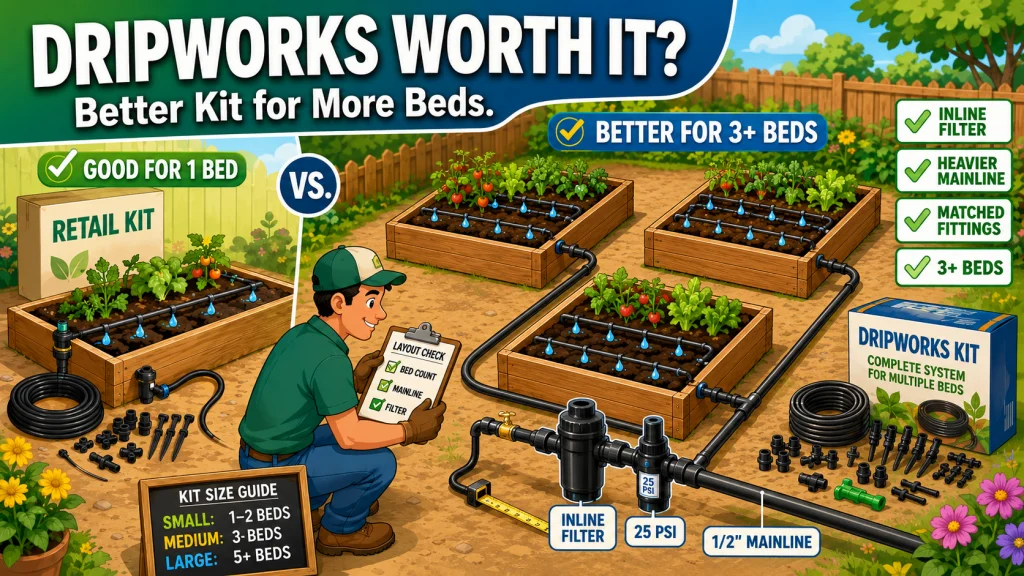
DripWorks offers three kit sizes for raised bed gardens. The small kit is rated for up to three standard 4 x 8 beds, the medium covers up to nine 4 x 8 beds, and the large handles up to eighteen. Pricing runs approximately $99 for the small, $167 for the medium, and $330 for the large. The small and medium kits use 1/2-inch mainline tubing; the large kit steps up to 3/4-inch mainline to manage the longer runs and higher fitting count that come with a garden at that scale.
Every kit in the lineup includes the core components: mainline tubing, 1/4-inch soaker dripline, an inline filter, a pressure regulator, and a fitting set. The component categories are consistent across sizes, which means even the small kit gives you a filtered, regulated system rather than a bare-minimum setup that needs supplementing before it runs reliably. That is different from most retail kits, where the filter is a washer screen at the hose connection and the pressure regulator is sized for a single bed run, not a longer one.
Published Coverage vs Your Actual Layout
The “up to X beds” numbers DripWorks publishes assume a reasonably standard layout: beds of similar size, placed fairly close together, with the mainline running a practical distance from the hose bib. Your yard may not match that assumption. Before choosing a kit size, it is worth checking a few things beyond the bed count:
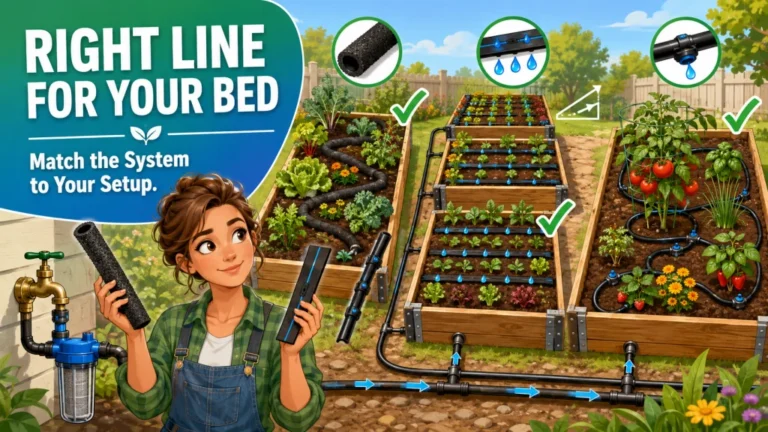
- Total mainline length from hose bib to the last bed: A compact three-bed layout in a 12-foot row is a very different run than three beds spread across a larger backyard with an L-shaped routing.
- Bed spacing and routing complexity: A straight-line run stays within kit specs more easily. Corners, obstacles, and split runs use up mainline and fittings faster than the diagram on the product page suggests.
- Whether your beds are standard 4 x 8: Longer beds or irregular sizes change the dripline footage you need per bed.
- Expansion plans: If you are likely to add a bed next season, sizing up now is less disruptive than buying extension components later.
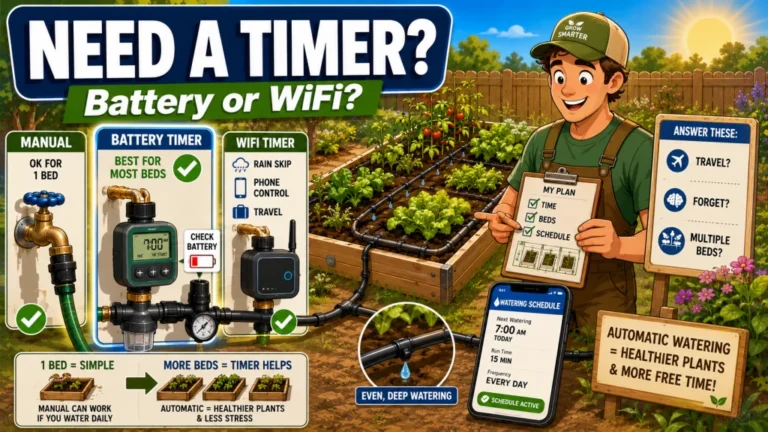
- Timer from the start: DripWorks sells timers matched to their kit thread sizes, so adding one at the time of purchase removes compatibility guesswork. Decide before ordering if automation is part of the plan.
The bed count on the product page is a useful starting point. The layout of your specific garden is what determines whether that kit size actually fits.
What DripWorks Includes That Retail Kits Leave Out
The component differences between a DripWorks kit and a standard retail drip kit are not marketing language. They show up in how the system performs after the first season, particularly on longer runs with more emitters in the line.
The Filter
Most retail kits include a filter washer: a small mesh screen built into the hose connection at the top of the system. A filter washer catches large debris but has limited surface area and can clog faster than expected when city water carries fine sediment, or when well water brings particulate into the line. DripWorks kits use a true inline filter positioned downstream from the hose connection. The larger filter surface area catches finer particles before they reach the 1/4-inch emitter holes, which is where clogging actually happens. In my experience, most mid-season dry spots in drip beds trace back to clogged emitters that a better upstream filter would have prevented.
A filter washer at the hose connection catches coarse debris but has a small surface area. On a single short run with clean city water, it is adequate. On a longer run with multiple beds in the line, fine sediment accumulates at the emitters over the course of a season.
A larger-surface-area filter positioned in the line before the mainline tubing. Catches finer sediment and handles higher debris loads on multi-bed runs. Keeps emitters clear longer with less mid-season maintenance.
The Mainline Tubing
The 1/2-inch mainline in the DripWorks small and medium kits uses heavier-wall tubing rated for longer runs and better fitting pull-out resistance. Retail kit mainline tends to be thinner-wall tubing that works fine on a single bed but shows stress at barbed fittings when the run gets longer or when a fitting is disconnected and reconnected more than a few times. The most common place retail kits start weeping in year two is not at the emitters; it is at the barbed connections where thin-wall tubing gradually loses its grip. The large DripWorks kit steps to 3/4-inch mainline precisely because a garden at that scale needs more flow capacity and more durable connections across a much longer run.
Timer Compatibility
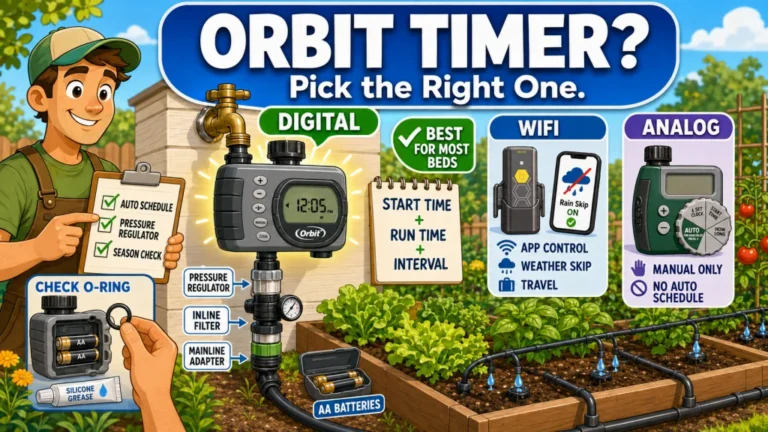
DripWorks sells timers matched to their kit thread sizes and pressure specifications. For a gardener who wants to add automation at the time of purchase, this removes the compatibility guesswork that comes with buying a separate retail timer and hoping it threads correctly onto a pressure regulator from a different manufacturer. This sounds minor until you are standing beside a hose bib with a timer in one hand and a pressure regulator from a different brand in the other, trying to figure out why the threads are not lining up before the plants are in the ground.

This robust hose-end timer works with sprinklers, drip irrigation, and soaker hoses, offering simple automatic programming with full 7 day scheduling for worry-free watering. An extra-large dial and readout screen make setup and schedule review easy, while one-touch buttons allow quick cancellation, a rain delay of up to 96 hours, or manual watering on demand. The display also shows the next scheduled cycle and time remaining on the current one.
Check On AmazonIf you click this link and buy, we earn a commission at no additional cost to you.
The Price Reality
DripWorks kit pricing runs roughly $99 for the small, $167 for the medium, and $330 for the large. A retail drip kit from Rain Bird or DIG at a big-box store runs $40 to $55 for a single-bed setup. The gap looks large at first comparison. It narrows quickly when you factor in how many retail kits you would need to cover the same number of beds and whether those retail kits are actually designed for multi-bed runs.
| Garden size | Retail kit approach (estimated cost) | DripWorks option (approximate price) | Practical notes |
|---|---|---|---|
| 1 to 2 beds (4 x 8) | $40 to $110 (one or two retail kits) | Small kit ~$99 | Retail wins on price for one or two beds. Small DripWorks kit is harder to justify at this scale. |
| 3 standard beds (4 x 8), compact layout | $120 to $165 (three separate retail kits) | Small kit ~$99 | DripWorks small is competitive here. Better filter and tubing for less than chaining three retail kits. |
| 3 beds, longer run or L-shaped layout | $120 to $165 plus extension parts | Medium kit ~$167 | When layout complexity pushes beyond what the small kit covers cleanly, medium makes more sense. |
| 4 to 9 beds | Complex; four or more retail kits or custom sourcing | Medium kit ~$167 | DripWorks medium is purpose-built for this range. No retail kit is designed for it. |
| 10 to 18 beds | Not practical as a kit-based approach | Large kit ~$330 | DripWorks large with 3/4-inch mainline is the only sensible kit option at this scale. |
The table above uses standard 4 x 8 beds in a compact layout. If your beds are spread out, the mainline run is longer, or the routing is not straight, the effective coverage of each kit shrinks and sizing up becomes the safer choice. For three beds in a tight row from a close hose bib, the DripWorks small kit is genuinely competitive. For the same three beds spread across a larger yard with a corner in the run, the medium kit is the more reliable fit.
For a fuller look at what each kit option delivers across different bed counts and layouts, the drip irrigation kit options for multiple raised beds covers the tradeoffs in more detail, including where retail kits can still compete.

This large-scale kit covers up to 18 standard 4 by 8 foot raised beds and includes 250 feet of three-quarter inch mainline tubing, 200 feet of quarter-inch micro tubing, 100 feet of soaker dripline with 12-inch emitter spacing, and over 240 fittings and plugs. A three-quarter inch filter, 30 psi pressure regulator, punch and cut tool, and Easy-Loc mainline connectors are also included for a fully self-contained setup. All components are UV-resistant and rated for both above-ground and underground installation.
Check On AmazonIf you click this link and buy, we earn a commission at no additional cost to you.
When DripWorks Is the Right Choice
There are specific situations where DripWorks makes more sense than sourcing a retail kit, and they mostly come down to garden scale, layout complexity, and setup history.
- Three or more beds where retail chaining does not work cleanly: Chaining three retail kits means mismatched fitting sizes, a filter washer that was not designed for a longer combined run, and thin-wall mainline that was sized for a single bed. The DripWorks small or medium kit is a single coherent system for that same garden.
- Any garden with a long mainline run: Heavier-wall tubing holds fittings more securely and resists weeping better over time. On longer runs, the bigger issue is matching mainline size and flow capacity to the number of beds, which is why the large DripWorks kit steps up to 3/4-inch mainline.
- Gardener who has had retail kit fittings fail: The typical failure point in a retail kit is the barbed fitting-to-tubing connection on thin-wall mainline. DripWorks tubing addresses that directly. Buying a more durable system after a retail kit fails is a frustrating path, but it is a common one.
- Adding a timer from the start: Matched timer and kit components remove one compatibility variable. For a gardener not familiar with irrigation thread sizes, that matters at 7 a.m. before work.
- Medium or large gardens that need room to expand: Choosing the right size with a little layout headroom can make expansion easier next season. The small kit is the most forgiving for modest add-ons, while medium and large layouts should be sized more carefully around flow, bed count, and mainline distance.
I have set up raised bed systems using DripWorks components alongside retail kit components in similar-sized gardens. The fitting connection quality is noticeably better on the DripWorks side, and the inline filter keeps the emitter tubing running cleaner through a full summer. For a gardener running four or five beds of tomatoes and peppers all season, fewer mid-season checks for clogged emitters or weeping fittings is worth something that the purchase price comparison does not fully capture.
A side-by-side look at DripWorks alongside Rain Bird, DIG, and the other main kit options is available in the raised bed drip irrigation kit comparison if you want to weigh all the choices before committing.

This all-in-one drip irrigation kit is designed specifically for standard 4 by 8 foot raised beds, with options covering 2 to 10 beds depending on the tier you choose. Everything needed to connect to a standard outdoor faucet or garden hose is included, and all fittings require only hand tightening. The tubing cuts easily with household scissors, and the fully modular design lets you expand or customize the system over time.
Check On AmazonIf you click this link and buy, we earn a commission at no additional cost to you.
When a Retail Kit Makes More Sense
For one or two raised beds, a retail drip kit at $40 to $55 is the logical starting point. A Rain Bird or DIG kit covers a single bed, runs on a standard hose connection, and delivers consistent drip coverage when the emitter spacing matches the crop. Notably, DripWorks themselves have acknowledged Rain Bird as a quality choice for smaller garden and raised bed applications. A brand that points customers toward a competitor for certain setups is confident in their own product’s position, and that position is clearly the multi-bed end of the market.
First-time drip irrigation buyers tend to do better starting with a retail kit because there is a learning curve. Understanding emitter spacing, run time, soil type, and how 1/4-inch tubing behaves at your hose bib pressure takes a season to feel natural. A $45 kit that runs one or two beds through one summer teaches you what you actually need before spending $99 to $167 on a system designed for more. I have seen gardeners buy a multi-bed kit before they understood their layout, then spend the first season moving emitter lines and adjusting mainline routing once the plants were in and the dry spots showed up.
Field Note: The mistake I see most often with first-time multi-bed buyers is purchasing a single retail kit intended for one bed and assuming the mainline will cover two or three beds evenly. It will not. Most retail kit mainline runs 25 to 50 feet, but on thin-wall tubing with three beds in the line, the far bed sees noticeably less pressure than the near one. The packaging will not tell you this. The dry corners in the last bed will.
If you are still working out which kit type fits your specific setup, the guide to the best drip irrigation kits for raised beds covers the full decision from single-bed retail options through multi-bed specialist systems.

This kit includes everything needed to water a raised bed up to 4 by 8 feet, with professional-grade components built for repeated seasonal use. It features 35 feet of emitter tubing with 70 built-in, pressure-compensating emitters spaced every 6 inches for even watering near the roots, plus 25 feet of easy-to-handle 1/4 inch distribution tubing. This low-volume design can save up to 80% on water while supporting healthier plants and better yields. Installation is straightforward thanks to an illustrated manual covering multiple layout options, and the system can be automated with a compatible Rain Bird hose-end timer sold separately.
Check On AmazonIf you click this link and buy, we earn a commission at no additional cost to you.
Final Thoughts: Size the Kit to the Garden, Not the Other Way Around
DripWorks makes well-specified raised bed kits. The published coverage numbers are real: up to three beds for the small, up to nine for the medium, up to eighteen for the large. Those numbers assume a reasonably standard layout, so measure your actual run before choosing a size. The component quality is above retail grade across the board, and the step to 3/4-inch mainline in the large kit reflects a real engineering decision about what a garden at that scale needs.
For one or two beds, a retail kit wins on price and the quality gap does not matter much at that scale. For three beds in a compact layout, the DripWorks small kit is competitive with chaining three retail kits and gives you better components for roughly the same total spend. Beyond that, DripWorks is increasingly the cleaner option, not because the brand name matters but because no retail kit is actually designed to run four, six, or nine beds from a single hose bib. The price difference reflects a system that is built for the job rather than adapted to it.
FAQs
💧 Is DripWorks worth the price compared to a Home Depot drip kit?
For one or two raised beds, a retail kit at $40 to $55 delivers the same basic function at a lower cost. DripWorks becomes worth the price difference at three beds or more. The small DripWorks kit at around $99 covers up to three standard 4 x 8 beds and includes better filter and tubing than three separate retail kits would give you for $120 to $165. At four to nine beds, the medium kit is the appropriate comparison and no single retail kit competes with it.
🌱 What does each DripWorks raised bed kit size cover?
The small kit is rated for up to three standard 4 x 8 beds, the medium for up to nine, and the large for up to eighteen. These numbers assume a compact, standard layout. If your beds are spread across a longer mainline run or arranged in a non-linear routing, the effective coverage shrinks and sizing up is the safer choice. Measure your actual mainline distance before ordering.
🧱 How does DripWorks compare to Rain Bird for raised beds?
Rain Bird retail kits work reliably for one or two raised beds and cost less. DripWorks kits use heavier-wall mainline and a true inline filter rather than a filter washer, which gives better performance on longer multi-bed runs. For a single bed, Rain Bird is the competitive choice on price. DripWorks is the more complete solution when you need one system to cover three or more beds.
🔧 Why does DripWorks use an inline filter instead of a filter washer?
An inline filter has a larger surface area than a filter washer and catches finer sediment before it reaches the drip emitters. On a single short run, a filter washer handles the load adequately with clean city water. On a multi-bed run with more emitters in the line, fine sediment buildup becomes a real maintenance problem, and an inline filter keeps emitters clear through a full season with less intervention.
⏱️ Can I add a timer to a DripWorks raised bed kit?
Yes. DripWorks sells timers matched to their kit thread sizes and pressure specifications. Adding a timer at purchase removes compatibility guesswork. A basic hose-end timer set to run once or twice per day covers most raised bed watering schedules. Adjusting run time based on soil type, plant stage, and season matters more than which timer you use.
🍅 How many drip lines should I run in a 4 x 8 bed?
Two to three parallel runs of the 1/4-inch soaker dripline across the 4-foot width is standard. Two lines spaced about 18 inches apart works for most vegetable mixes. For dense lettuce or herb plantings with shallow roots, three lines give more even coverage. For widely spaced tomatoes or peppers, two lines placed closer to the plant rows is usually enough.
🌿 Does the DripWorks large kit use different tubing than the small and medium?
Yes. The large kit uses 3/4-inch mainline tubing rather than the 1/2-inch mainline in the small and medium kits. At a garden scale of up to eighteen 4 x 8 beds, the larger mainline diameter is necessary to maintain adequate flow and pressure across the longer run. The 1/4-inch soaker dripline in the beds stays the same across all three kit sizes.