Orbit sells three different hose-end timers, and the one that usually ends up in a raised bed gardener’s cart is not always the one that fits the job. The single-outlet digital model handles most automated drip schedules cleanly and covers the majority of raised bed situations. The analog dial version looks similar on the shelf but cannot run an automated schedule on its own. The Wi-Fi-enabled model in the Orbit lineup, the B-hyve Smart Hose Timer, adds app control and weather sensing at a significantly higher price, which makes sense for some gardeners and adds unnecessary complexity for others. There is also a known failure mode on the digital timers that tends to surface in the second season, and understanding it before it happens is easier than diagnosing a dead timer mid-summer.
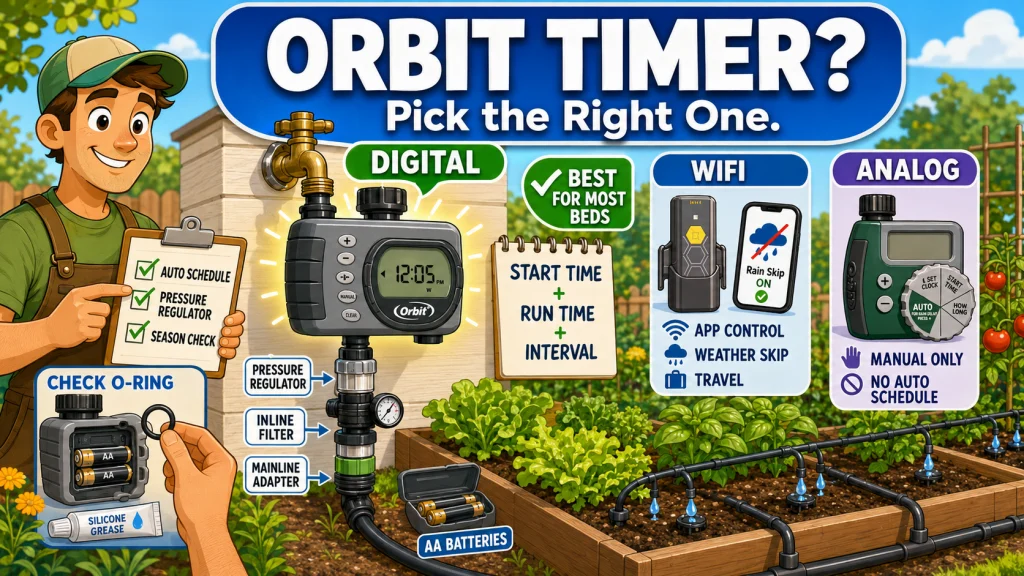
Three Timers on the Same Shelf, Three Different Use Cases
Orbit is the default timer brand for most raised bed gardeners simply because it is stocked at every major hardware store. That visibility is both convenient and a little misleading. The packaging for all three Orbit timer types is similar enough that it is easy to grab the wrong one without realizing it until you get home and try to program a schedule that the device is not capable of running.
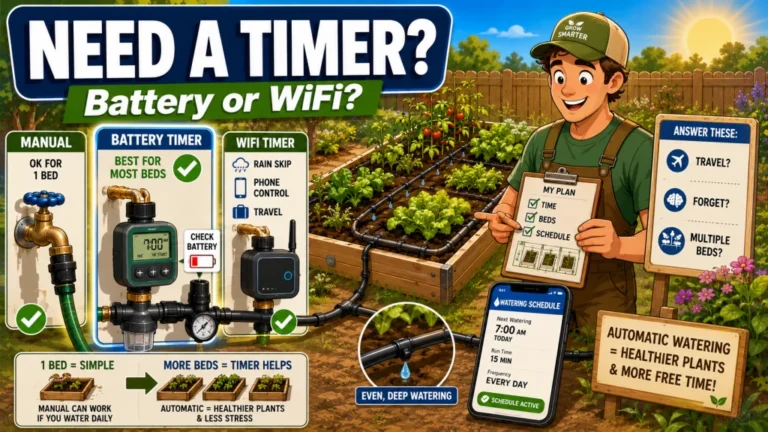
I have seen this more than once: a gardener buys the dial version expecting it to water the bed automatically while they are at work, connects everything correctly, and then stands at the hose bib waiting for the drip line to do something on its own. It will not. That is not a product defect. It is just the wrong timer type for the job. The sections below cover all three types in terms of what they actually do, which raised bed situation each one fits, and where each one falls short.
If you are still working out the full layout of your drip system before committing to a timer, the drip irrigation timer guide for raised beds covers how the timer fits into the rest of the line: where it goes relative to the pressure regulator, what goes between the hose bib and the first fitting, and how to build a watering schedule around your actual soil and crop conditions.
The Single-Outlet Digital Timer: The Right Fit for Most Raised Beds
The single-outlet digital timer in the Orbit lineup is the model most raised bed gardeners actually need. It runs on two AA batteries, does not require a network connection or smartphone, and programs a basic automated schedule in a few button presses. Run-time range covers 1 to 240 minutes per cycle, with interval options from every 6 hours up to once every 7 days. That covers the full range of raised bed drip schedules for vegetables and herbs through a growing season.
For a standard setup, the programming sequence is straightforward: set a start time, set a run duration, set the watering interval. Once that is done, the timer runs the schedule until you change it or the batteries die. For one to four raised beds on a single mainline with a shared drip layout, this is a complete automated solution. I usually recommend it as the starting point for any raised bed gardener who wants to automate watering without adding app dependency or extra cost.
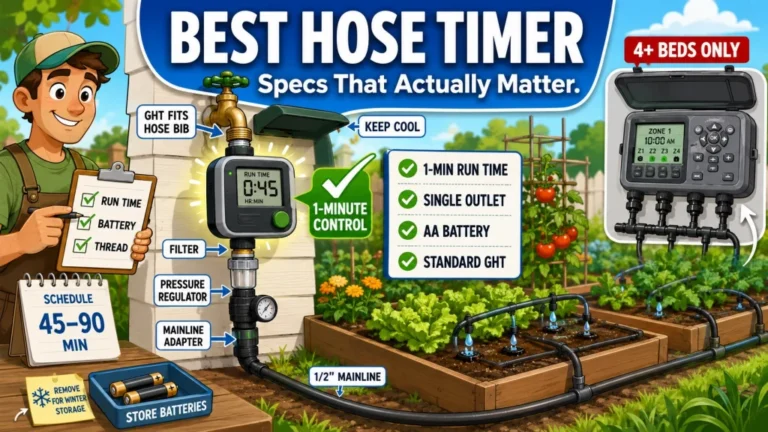
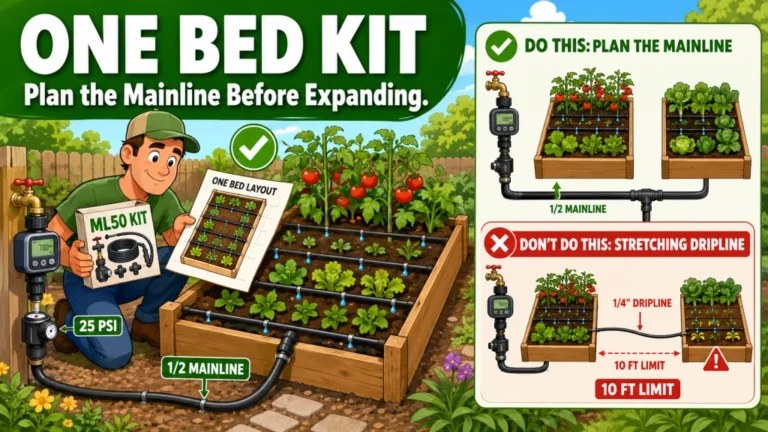
Field Note: The most common pairing mistake I see with the Orbit digital timer is connecting it directly to a hose bib with no pressure regulator before the drip line. The timer controls when water flows, not how much pressure reaches the small tubing and fittings. A standard hose bib runs 40 to 60 PSI. Most drip kits are designed to run at 15 to 25 PSI. Without a regulator in the line, the system can look fine for a few weeks and then start weeping at the weakest fitting. That is not a timer problem. A regulator before the drip tubing fixes it.
The single-outlet format works fine for beds sharing a common mainline. Where it gets limited is when you want independent schedules for different beds with different crop types. A tomato bed and a lettuce bed do not have the same water demand, especially in the heat of summer, and a single timer running both on the same interval is a compromise. Two timers, or a different timer type, is the solution if that distinction matters to your setup.
Run duration should be matched to your actual emitter flow rate and soil type, not a generic default. A 4×8 bed with 0.5 GPH emitters in loose, amended mix does not need the same run time as a 4×8 bed with 1.0 GPH emitters in a heavier soil. The timer is just a clock. The schedule still has to come from real bed conditions.

This battery-powered hose timer converts any standard faucet into an automatic single-zone watering system with programmable schedules and adjustable watering durations. The clear LCD display makes programming straightforward, and a built-in rain delay feature pauses irrigation automatically during wet weather. Designed for outdoor durability and water-resistant construction, it backs its reliability with a six-year limited warranty.
Check On AmazonIf you click this link and buy, we earn a commission at no additional cost to you.
The Orbit B-hyve Smart Hose Timer: Wi-Fi Control and Weather Sensing
Orbit also makes the B-hyve Smart Hose Timer, a Wi-Fi-connected hose-end timer that links to your home network and lets you control schedules through a smartphone app. The app interface is more intuitive than navigating physical buttons, which is a real advantage when you need to make a quick schedule change. The weather-based skip feature is the other thing that sets it apart: when rain hits, the timer can pause the next scheduled cycle automatically rather than watering an already-soaked bed.
The price difference between the standard digital model and the B-hyve typically runs 60 to 80 dollars. Whether that gap is worth it comes down to how you actually manage your garden. If you travel during the growing season and want to adjust watering remotely, or if an unusually wet week would otherwise mean manually overriding the schedule to avoid soggy roots, the app control and rain sensing earn their cost. If you check the beds daily and run a schedule that stays consistent most of the season, the standard digital timer does the same core job for considerably less.
Buying the B-hyve because it looks more capable, then setting the schedule once and never opening the app again. The weather-skip feature only works reliably with a live Wi-Fi connection, and you have added cost and complexity without using what you paid for.
Choosing the B-hyve specifically because you have a use for remote schedule adjustments, weather-based skip, or app-based programming. If neither of those applies to your situation, the single-outlet digital timer handles the same raised bed schedule for less money and without network dependency.
One thing worth understanding about the B-hyve before buying: if the Wi-Fi connection drops, the device continues running the stored schedule. The watering cycle itself does not stop. What you lose is remote control: you cannot adjust the schedule from the app while the device is offline, and weather-based skip becomes unreliable without a live connection to pull forecast data. A router change or Wi-Fi password reset also requires reconnecting the device before app control resumes. None of those are deal-breakers, but they are worth knowing so the expectation matches the reality. For a deeper look at how the B-hyve compares to a standard battery timer across a full season of raised bed use, the battery-powered vs Wi-Fi timer comparison for raised bed drip systems covers that decision in full.

This Wi-Fi enabled hose timer supports fully customizable watering schedules that can be monitored, adjusted, and activated remotely through a mobile app. Battery-powered with AA batteries, it features weatherproof housing for reliable outdoor performance. Backed by a two-year limited warranty.
Check On AmazonIf you click this link and buy, we earn a commission at no additional cost to you.
The Analog Dial Timer: What It Actually Does and Does Not Do
The third option in the Orbit lineup is a mechanical dial timer with no electronics, no batteries, and no programming. You turn the dial to a set duration, manually open the water flow, and the timer counts down and shuts off the water. That is the complete feature set. There is no scheduled start time, no automated cycle, and no way to set it to water the bed while you are away.
This is not a design flaw. It is an intentional product for a different use case. The analog timer prevents overwatering by cutting off flow after the set time, which is useful if you tend to forget a hose is running. It has essentially no failure modes because there is nothing electronic to fail. As a backup device if the digital timer loses its batteries unexpectedly, it has a role. But it is not suitable as a primary timer for a raised bed drip system that needs to run on a schedule without manual intervention.
The simplicity trade is real in both directions. There is nothing to program, nothing to charge, and nothing to connect to a network. The limitation is equally real: every watering cycle requires someone to turn the dial. For a bed that needs watering before you leave for work each morning, that is not an automated solution.
Note: If you are at the hardware store comparing the three Orbit timer types and the analog dial looks appealing for its simplicity, make sure you understand what that simplicity costs. It costs the ability to water the bed on a schedule you do not have to be present for. If that trade works for your routine, the analog timer is a genuinely durable and low-maintenance device. If it does not, the digital model is the right shelf.
The Failure Mode Most Orbit Digital Timer Owners Find Out Late
The standard Orbit digital timer has one well-documented weakness that does not appear in the first season. After one or two years of outdoor exposure, the O-ring seal on the battery compartment door can degrade and fail. When the seal breaks down, moisture gets into the battery housing and starts corroding the contacts. The timer either stops responding, starts skipping cycles, or loses its programmed schedule between watering windows. The first instinct is usually to replace the batteries. That fixes nothing if the contacts are already corroded or the seal is still letting moisture through.
This failure pattern shows up across garden forums and retailer reviews consistently enough that it is worth treating as a known maintenance item rather than a random defect. The good news is that the fix is simple and inexpensive. At the start of each season, pull the battery door off, inspect the O-ring for visible cracking, compression, or a dry texture, and apply a thin coat of silicone dielectric grease to the seal surface. If the O-ring shows any degradation, replace it. Replacement O-rings and silicone grease are available at most hardware stores for a few dollars.
Pro Tips: Do this check at the beginning of spring when you reconnect the system, not in the middle of summer when the bed has gone dry and you are tracing the cause. Check the contacts for any white or greenish residue while the door is open. If corrosion is visible, a cotton swab with isopropyl alcohol cleans the contacts before reinstalling fresh batteries. Five minutes at the start of the season prevents the most common second-year failure on these timers.
- Open the battery door at the start of each season before connecting the timer to the line
- Inspect the O-ring for cracking, flattening, or dry texture along the seal surface
- Apply a thin coat of silicone dielectric grease to the O-ring before closing the door
- Replace the O-ring if any visible degradation is present
- Check the battery contacts for white or green corrosion residue
- Clean any corrosion with isopropyl alcohol on a cotton swab before installing fresh batteries
The O-ring issue is the primary driver of mixed long-term reviews on Orbit digital timers. The timer mechanism and the valve tend to hold up well. The battery compartment seal is where outdoor durability fails, and it fails quietly until the bed stops watering on a Tuesday morning when temperatures are climbing. Building the maintenance check into the start-of-season routine removes that variable entirely.

This dielectric grease seals electrical connections against salt, moisture, dirt, and corrosion to prevent shorts, voltage leaks, and misfires. It applies easily to spark plugs, terminals, and wiring across a wide range of vehicles and equipment including cars, boats, ATVs, and mowers. Suitable for both marine electronics and general automotive maintenance.
Check On AmazonIf you click this link and buy, we earn a commission at no additional cost to you.
Matching the Orbit Timer Type to the Raised Bed Situation
Most raised bed gardeners running one to four beds on a shared mainline will get everything they need from the single-outlet digital model. Set the schedule once, maintain the O-ring annually, replace batteries before they die, and the system runs through the season without much involvement. That is the correct complexity level for most home vegetable and herb setups.
The B-hyve earns its higher price when there is a specific reason to use it: travel during peak season, a desire to skip cycles after rain without going outside, or a preference for adjusting schedules from a phone rather than cycling through physical buttons. Those are real benefits for gardeners whose routines match them. For everyone else, the added cost and network dependency do not add value that the simpler digital model does not already provide.
The analog dial timer belongs in a specific role: backup device, occasional manual watering, or the option for a gardener who genuinely prefers zero electronics and is willing to be present for every watering cycle. It is a durable product for what it is. It is not an automated drip timer.
| Timer Type | Automated Schedule | Best Raised Bed Fit | Main Limitation |
|---|---|---|---|
| Single-outlet digital | Yes | 1 to 4 beds, fixed daily or interval schedule | Single outlet, no weather sensing, O-ring maintenance required |
| B-hyve (Wi-Fi, app-controlled) | Yes, with remote adjustment and weather skip | Gardeners who travel or want weather-based skip | 60 to 80 dollars more than digital, requires reconnect after router/password change |
| Analog dial | No | Backup device, manual watering, zero-electronics preference | Requires manual turn-on every cycle, not suitable for automated schedules |
The table above summarizes the trade clearly, but the real decision usually comes down to one question: do you need the bed to water itself while you are not there? If yes, one of the two digital options is the right category. If you are present for every watering and just want the shutoff protection, the analog dial is simpler and never needs a battery.

This pressure regulator maintains an optimal 25 PSI to keep drip lines and emitters running at consistent flow, with a 20 gallon per minute capacity to support larger systems. It connects to any 3/4 inch male threaded faucet, garden hose, or component for easy setup. Built from UV and chemical-resistant materials, it offers durable, reliable performance season after season, and pairs well with a compatible Rain Bird hose-end timer for automated watering.
Check On AmazonIf you click this link and buy, we earn a commission at no additional cost to you.
Final Thoughts: Know What You Are Buying Before You Leave the Store
The Orbit name covers three timers that work in meaningfully different ways. The single-outlet digital model handles automated scheduling for most raised bed drip setups without extra cost or complexity. The B-hyve is a genuine upgrade for specific use cases and unnecessary overhead for everything else. The analog dial is not an automated timer and should not be bought as one, regardless of how simple it looks on the shelf.
The O-ring maintenance point is the thing most Orbit digital timer owners learn the hard way. Adding that check to the beginning of the season costs almost nothing and prevents the most common failure that shows up in year two. If you are weighing Orbit against the other main timer brand at the hardware store, the Rain Bird timer options for raised bed drip irrigation covers the same type of breakdown for that lineup. And if you are still piecing together the full drip system from hose bib to bed, the raised bed drip irrigation kit overview covers how the timer connects into the rest of the components before any of the individual choices matter.
FAQs
💧 Which Orbit timer type works best for raised bed drip irrigation?
The single-outlet digital model is the right fit for most raised bed setups. It automates a fixed schedule, runs on batteries, and does not require an app or network connection. For gardeners who want remote schedule adjustments or weather-based skip, the B-hyve adds those features at a higher price point.
⚙️ Can the Orbit analog dial timer run an automated drip schedule?
No. The analog dial timer shuts off water after the set duration but does not initiate a cycle on its own. Every watering cycle requires manually turning the dial and opening the flow. For automated raised bed drip irrigation, a digital timer is required.
🔋 Why does my Orbit digital timer stop working after a season or two?
The most common cause is moisture entering the battery compartment through a degraded O-ring on the battery door. Inspect the seal at the start of each season, apply silicone dielectric grease to the O-ring, and check the battery contacts for corrosion. Replacing a worn O-ring costs very little and prevents this failure before it happens.
📶 Is the Orbit B-hyve worth the extra cost for a small vegetable garden?
It depends on how you manage your beds. If you travel during the growing season and want to adjust schedules remotely, or if weather-based skip matters to you, the extra cost is reasonable. Keep in mind that the B-hyve still runs its stored schedule if Wi-Fi drops, but remote adjustments and weather sensing require an active connection. If you are home regularly and run a schedule that rarely changes, the standard digital model does the same core job for significantly less money.
🚿 Does an Orbit hose timer regulate water pressure for drip irrigation?
No. An Orbit hose timer controls when water flows, not how much pressure enters the drip line. A separate inline pressure regulator is needed to bring hose bib pressure, which typically runs 40 to 60 PSI, down to the 15 to 25 PSI range that most raised bed drip components require.
🌿 How do I set the run time on an Orbit digital timer for a raised bed?
Match the run time to your emitter flow rate and soil type rather than using a generic default. A 4×8 vegetable bed with 0.5 GPH emitters in loose amended soil typically runs 20 to 40 minutes per cycle in peak summer. A heavier soil mix or higher-flow emitters changes that number. Start on the conservative side and check soil moisture a few inches down after the first few cycles to calibrate.