The DIG ML50 is the most-reviewed raised bed drip kit at Home Depot, and for a lot of first-time buyers it does exactly what it promises: connect it to a hose bib, lay out the 1/4-inch dripline, and you have a working drip system for one standard raised bed. I have installed this kit and seen it work well and seen it confuse people badly, usually for the same reasons. This review covers what the kit actually includes, what the specs mean for a real raised bed setup, where the design holds up, and where it starts to fall apart when gardeners try to expand beyond what the kit is designed for.
What I’ve Seen With This Kit in the Field
Most DIG ML50 reviews people find online are either product pages or roundups that list specs without explaining what they mean. The dozens of questions in the Home Depot Q&A section tell a different story. Most of them circle around the same handful of problems: dry spots at the end of the line, pressure issues when gardeners try to chain kits together, and confusion about what “expandable” actually means once the kit is on the ground. I want to answer those questions here, because the product page does not.
The ML50 is a legitimate kit. It is not junk, and the price point makes sense for what you get. But there is a real difference between a kit that works for one 4×8 or 5×8 raised bed and a kit that works for three or four beds, and that difference is buried in the fine print about 1/4-inch line length limits. More on that in a moment. First, a clear picture of what is actually in the box.
What the ML50 Includes and What the Numbers Mean
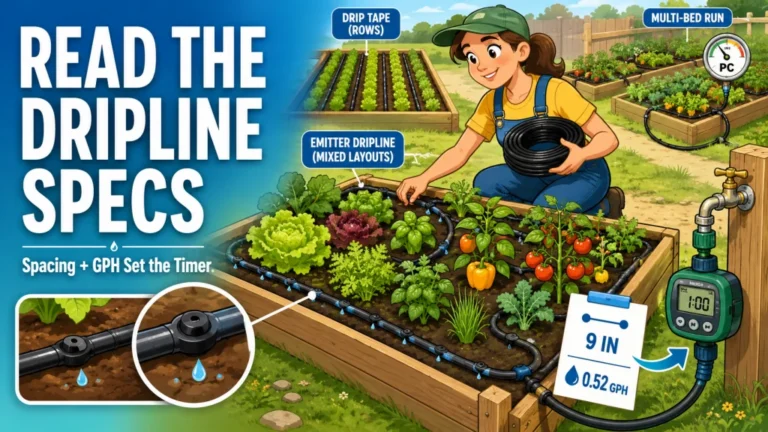
The kit ships with 50 feet of 1/4-inch dripline with emitters pre-inserted every 9 inches, 50 feet of 1/2-inch poly mainline tubing, a 3/4-inch backflow preventer, a 3/4-inch 25 PSI pressure regulator, a 3/4-inch swivel adapter with a built-in 60 mesh screen, and all the fittings needed to connect the mainline to the driplines. The rated coverage is 150 square feet, built around five parallel dripline runs each up to 10 feet long. The emitters flow at 0.52 GPH at 15 PSI or 0.65 GPH at 25 PSI, per the DIG Corp spec sheet.
That 150 square feet claim needs some translation. It fits one 8×5 bed (40 sq ft, well within the kit), and could cover a layout up to roughly 10×15 if you needed it to. For the most common raised bed size in the US, a 4×8 or 4×4, the kit gives you more coverage than the bed requires. That sounds like a problem, but it is actually useful in practice: you do not have to run all five driplines. In a single 4×8 bed, I would typically lay out two or three parallel lines spaced roughly 18 inches apart rather than trying to use all five. You cap the unused line ends and you are done. The extra tubing sits in the bag.
Key point: The 9-inch emitter spacing works well for dense vegetable plantings: lettuce, spinach, basil, and other greens planted in rows or broadcast. For tomatoes and peppers spaced farther apart, you may find the emitter density is higher than needed, which is fine as long as run time stays reasonable. The spacing is fixed at the factory, so you work around it rather than adjusting it.
The included backflow preventer is worth calling out because some kits at this price skip it or sell it as an add-on. Having it built in means you are protected against backflow contaminating your household water supply, which matters if your hose bib does not already have one. The 25 PSI pressure regulator is correctly matched to the 1/4-inch line: residential hose bib pressure typically runs between 40 and 80 PSI, and running 1/4-inch dripline at that pressure will eventually stress the fittings or pop a barbed connection. The regulator steps it down before any of that becomes a problem.
| Component | Spec | What it means for your bed |
|---|---|---|
| 1/4-inch dripline | 50 ft, emitters every 9 in | Designed around up to five short 10-ft runs for even raised bed coverage |
| Emitter flow rate | 0.52 GPH @ 15 PSI / 0.65 GPH @ 25 PSI | Low flow, good for raised bed soil, not ideal for heavy clay that needs slower penetration |
| 1/2-inch mainline | 50 ft included | Carries water from the hose bib to the bed; enough for most single-bed setups |
| Pressure regulator | 25 PSI preset | Matches the 1/4-inch line; skipping it risks fitting failures at typical hose bib pressure |
| Backflow preventer | 3/4-inch, included | Protects household supply; not always included in competing kits at this price |
| Built-in filter | 60 mesh screen in swivel adapter | Adequate for most municipal water; switch to 155 mesh if water quality is a concern |
The 60 mesh screen in the swivel adapter deserves an honest note. It is included and it does filter the water coming into the system, which is better than nothing. DIG’s own FAQ recommends upgrading to a 155 mesh filter if you have any concern about sediment or mineral content in your water supply. For most gardeners on municipal water with a single bed, the 60 mesh screen will be fine all season. If you have well water or your area has high mineral content, the finer filter is worth the few dollars it costs separately.

This heavy-duty inline filter connects via three-quarter inch female and male hose thread fittings, making it compatible with outdoor faucets, hose timers, and gravity feed tanks. A 14.9 square inch polyester screen in either 155 or 200 mesh catches debris, sand, and sediment before it reaches emitters or valves, with a large filtration surface that reduces cleaning frequency and pressure loss. Rated for up to 120 psi and 13 gallons per minute flow.
Check On AmazonIf you click this link and buy, we earn a commission at no additional cost to you.
Where the ML50 Does Its Job
For a single raised bed with one or two gardeners who want to stop hand-watering, this kit does what it claims. The components connect without specialized tools, the pressure regulator and backflow preventer are real parts rather than afterthoughts, and the 9-inch emitter spacing provides consistent coverage across a bed of greens or mixed vegetables. That is the target use case, and the kit hits it.
The 9-inch spacing is one thing I genuinely like about the ML50 for dense plantings. I have worked with kits that use 12-inch spacing and seen dry spots between plants in beds planted tightly with lettuce or spinach. At 9 inches, each emitter is close enough to the next that the moisture zones in loose raised bed mix overlap before they dry out. For tomatoes at 18-inch spacing or peppers at 24 inches, you are overserving the root zone slightly, but that is a much easier problem to manage than underserving it.
Field Note: The most common mistake I see with the ML50 is skipping the pressure regulator because the system seems to work without it. It usually does, at first. Then a barbed fitting starts weeping where the 1/4-inch line meets the 1/2-inch mainline connector, or the swivel adapter develops a slow leak at the head assembly. Residential hose bibs often run 50 to 70 PSI. The 1/4-inch fittings in this kit are designed for 25 PSI. The regulator is not optional, even if nothing leaks on day one.
The kit is also honest about what a first-time setup looks like. The instruction manual has two layout options: one for planter boxes where the mainline runs along the outside of the bed and drops driplines in over the edge, and one for in-ground row plantings where the mainline runs perpendicular to the rows. For raised beds specifically, the planter box option is cleaner and easier to maintain. I prefer running the 1/2-inch mainline along the outside of the bed frame rather than through it, which keeps the main connections accessible for seasonal disconnection and flushing.

This kit is custom designed for uniform watering in 8 by 5 foot raised vegetable and garden beds, with everything needed for setup included. It comes with up to six 1/4 inch driplines, each up to 8 feet long, delivering water directly to plant roots to minimize evaporation and ensure even coverage. No additional tools or expertise are required for installation, and the system is easily expandable as your garden grows. High-quality components are built for long-lasting, reliable performance season after season.
Check On AmazonIf you click this link and buy, we earn a commission at no additional cost to you.
Where the ML50 Falls Short
The 10-Foot Layout and Why Chaining Does Not Work
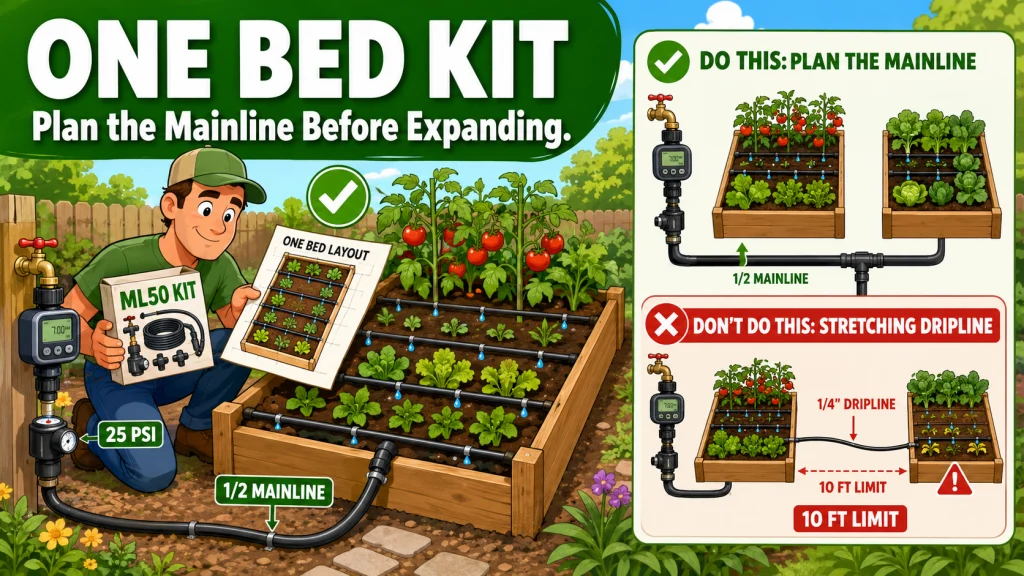
This is the issue behind the majority of questions in the Home Depot Q&A, and it is not explained clearly on the product page. The ML50 kit is designed around five dripline runs each up to 10 feet long, which is how DIG describes the kit layout. DIG’s own spec sheet does list longer technical distances for the 1/4-inch line at certain spacing configurations, but in practice, keeping each raised bed dripline run to 10 feet or under is what keeps flow even across the bed. Once you run 1/4-inch dripline much beyond that in a raised bed layout, the emitters near the far end start delivering less water than the ones near the supply connection. For a bed of mixed vegetables where every foot of row matters, that uneven delivery adds up.
Where gardeners run into trouble is when they try to chain two lines together end-to-end to reach a second bed farther away. That is not what the “expandable” language on the package means. Chaining 1/4-inch dripline end-to-end pushes flow through more tubing and more emitters than the kit is laid out for, and the beds farthest from the supply end up short on water. The solution for multiple beds is to run 1/2-inch mainline tubing from the hose bib out to each bed separately, then connect a short fresh dripline at each bed. That way each dripline starts from a properly pressurized point on the mainline rather than from the tail end of another dripline. The 1/2-inch mainline tubing is sold separately, which is the part the packaging does not make obvious.
Connecting a second length of 1/4-inch dripline to the end of the first to reach a second raised bed 15 feet away. The far line will run at reduced pressure, leaving the second bed underwatered while the first bed gets too much.
Running 1/2-inch mainline tubing from the hose bib to each bed separately, then connecting a fresh 10-foot dripline at each bed. Each dripline starts from a properly pressurized point on the mainline.
Fitting Quality and Instruction Clarity
The fittings in the ML50 are functional, but this is an area where the kit shows its price point. The barbed connections where 1/4-inch line meets the mainline connectors require a firm push to seat correctly, and a few reviewers have noted that the 1/2-inch mainline tubing is stiff enough right out of the bag to make compression fittings harder to seat than they should be. DIG’s own instructions acknowledge this by telling installers to leave the poly tubing in the sun before working with it. That is good advice and it works, but it is a real step that first-time installers skip and then blame the fittings for leaking.
The instruction manual is also a weak point. There are two separate documents in the kit: a quick-start guide for raised beds and a more detailed general installation guide. Multiple reviews note that neither document is clear enough for a first-timer who has never looked at a barbed fitting before. In my experience, this is where DIG falls behind other kits at a similar price. The components work; the documentation assumes more baseline knowledge than most first-time buyers have.
Pro Tip: Before connecting any 1/2-inch compression fittings, lay the poly tubing on a dark surface in direct sun for 10 to 15 minutes. It softens noticeably and the fittings seat without fighting you. Cold, stiff tubing is the most common cause of fittings that look connected but weep slowly at the joint.

This 100-foot roll of poly tubing works as a supply or feeder line in any low-flow drip watering system. Suitable for both surface and buried installation in any weather conditions.
Check On AmazonIf you click this link and buy, we earn a commission at no additional cost to you.
Who This Kit Is Right For (and Who Should Look Elsewhere)
The ML50 is a good fit for a first-time drip buyer with one standard raised bed, a hose bib within 50 feet of the bed, and no immediate plans to expand to multiple beds. If you have a single 4×8 or 4×4 bed planted with vegetables or herbs and you want to stop hand-watering, this kit gets the job done without asking you to understand hydraulics or buy separate components. Connect the head assembly to the faucet, run the mainline to the bed, drop in the driplines, and you are watering within an hour of opening the box.
It is not the right kit if you have more than one raised bed, beds longer than 10 feet, or any plan to expand the system later without buying additional mainline tubing separately. The kit’s expandability claim is accurate but requires more than a second kit: you need 1/2-inch mainline tubing to reach additional beds, and each new bed needs its own dripline run starting from a pressurized point on that mainline. If expansion is part of the plan, use the raised bed kit comparison before committing to a second kit. Gardeners who find this out after buying two kits and trying to chain them together are the ones writing the frustrated Q&A questions.
- Good fit: One bed, 4×4 to 8×5, vegetables or herbs, first drip setup, hose bib nearby.
- Good fit: Gardener who wants pressure regulation and a backflow preventer included without buying them separately.
- Not a good fit: Two or more raised beds without a separate mainline plan already in mind.
- Not a good fit: Beds longer than 10 feet where the layout would require long 1/4-inch runs instead of separate mainline-fed runs.
- Not a good fit: Gardeners who want individual emitter control or adjustable flow rates. The ML50 uses fixed-rate emitters at 9-inch spacing with no adjustment.
If you are looking at how the ML50 compares to other raised bed drip kits, including options with adjustable emitters or better documentation, the guide to choosing a raised bed drip irrigation kit covers the key decision points by bed count, layout, and budget without locking you into one product.
Before You Buy: Check Your Layout First
Four questions worth answering before putting the ML50 in your cart. The kit is straightforward when the setup matches what it is designed for, and most of the frustration people run into comes from a mismatch that a few minutes of planning would have caught.
- Is your bed longer than 10 feet? If any individual dripline run needs to go beyond 10 feet, plan for a mainline extension rather than a longer dripline.
- Do you have more than one raised bed? Each bed needs its own dripline connected to the mainline, not a dripline chained off the previous bed. Budget for additional 1/2-inch mainline tubing.
- How far is your hose bib from the bed? The kit includes 50 feet of 1/2-inch mainline. If the distance is longer, you will need extra tubing before the kit’s 1/4-inch dripline starts.
- What is your water source? Municipal water with the included 60 mesh screen is usually fine. Well water or high-sediment supplies will benefit from upgrading to a 155 mesh filter, sold separately.
If the answers above all check out for your setup, the ML50 does what it promises. If even one of them suggests a mismatch, it is worth knowing that before you buy rather than after you have tubing on the ground.

This robust hose-end timer works with sprinklers, drip irrigation, and soaker hoses, offering simple automatic programming with full 7 day scheduling for worry-free watering. An extra-large dial and readout screen make setup and schedule review easy, while one-touch buttons allow quick cancellation, a rain delay of up to 96 hours, or manual watering on demand. The display also shows the next scheduled cycle and time remaining on the current one.
Check On AmazonIf you click this link and buy, we earn a commission at no additional cost to you.
Final Thoughts: One Bed, One Kit, Keep It Simple
The DIG ML50 earns its reviews because it solves a real problem for gardeners with a single raised bed. The pressure regulator is the right size, the backflow preventer is included, and the 9-inch emitter spacing handles dense vegetable plantings without dry spots between rows. For that use case, the price is fair and the setup is faster than most first-timers expect.
Where it asks more of you is when you want to grow beyond one bed. The kit’s expandability is real, but it requires 1/2-inch mainline tubing run to each additional bed separately, not a dripline daisy-chained from the first. Plan that mainline layout before you start buying additional kits and most of the common problems with this system disappear before they start.
For a broader look at how the ML50 fits against other options by bed count and emitter type, the complete raised bed drip irrigation kit guide covers the full comparison.
FAQs
💧 Does the DIG ML50 work for a standard 4×8 raised bed?
Yes. A 4×8 bed is well within the ML50’s 150 square foot coverage rating. You will not need all five dripline runs for a single 4×8 bed. Two or three parallel lines spaced 18 to 24 inches apart is usually enough, depending on crop type and soil mix. Cap the unused dripline ends and leave the extra tubing in the bag.
🔧 Can I chain two ML50 kits together to cover two raised beds?
Not directly. The ML50 layout is built around short 1/4-inch dripline runs, commonly up to 10 feet per line in raised bed setups. Chaining two kits end-to-end extends the length but reduces pressure at the far end, leaving the second bed underwatered. The correct approach is to run 1/2-inch mainline tubing from the hose bib to each bed separately and connect a fresh 10-foot dripline at each bed. That mainline tubing is sold separately.
🌱 What emitter spacing does the ML50 use, and is 9 inches right for my vegetables?
The ML50 uses fixed emitters every 9 inches at 0.52 GPH at 15 PSI. The 9-inch spacing works well for dense plantings like lettuce, spinach, basil, and other greens. For widely spaced crops like tomatoes at 18 to 24 inches, the spacing is closer than necessary but not harmful as long as run time stays reasonable. The emitter spacing is fixed at the factory and cannot be adjusted.
⚠️ Do I really need to use the pressure regulator if the system seems to work without it?
Yes. Most residential hose bibs run 40 to 70 PSI. The ML50’s 1/4-inch fittings and dripline are designed for 25 PSI. The system may appear to function at higher pressure, but the fittings and line connections are under more stress than they are rated for. The most common result is a slow leak at a barbed fitting or at the head assembly, sometimes weeks after installation when pressure spikes.
🔍 Why is the 1/2-inch mainline tubing so hard to work with?
Poly tubing is stiff when cold and becomes noticeably more flexible when warm. Leave it on a dark surface in direct sun for 10 to 15 minutes before connecting compression fittings. Cold tubing is the most common reason compression fittings seem to not seat properly. It is not a defect in the tubing; it is a material property that the instructions mention but do not emphasize clearly enough.
🌿 Does the ML50 include a filter?
The swivel adapter includes a built-in 60 mesh screen, which provides basic filtration for most municipal water supplies. DIG recommends upgrading to a separate 155 mesh filter if you have well water, high mineral content, or any concern about sediment clogging the dripline emitters. The finer filter is sold separately and connects between the pressure regulator and the mainline.
❄️ Do I need to winterize the ML50 before freezing weather?
Yes, if you are in a region with freezing temperatures. Disconnect the head assembly from the hose bib, drain the mainline and driplines, and store the backflow preventer and pressure regulator indoors. Water left in the fittings and poly tubing can freeze and crack the plastic components. The dripline itself is flexible enough to survive a frost if it drains, but the rigid fittings and the regulator housing are not.