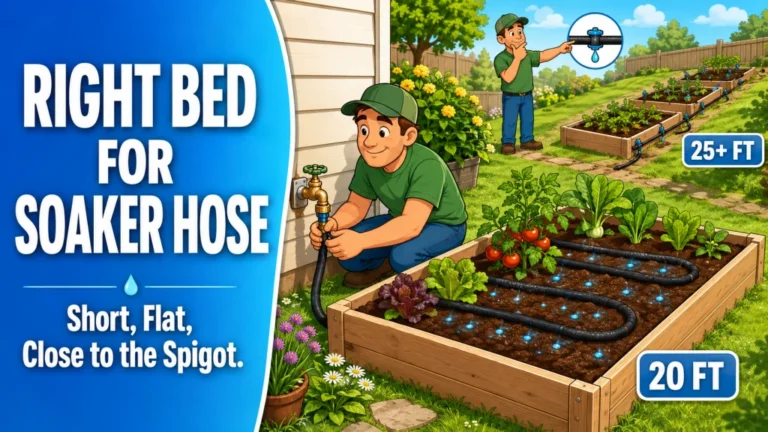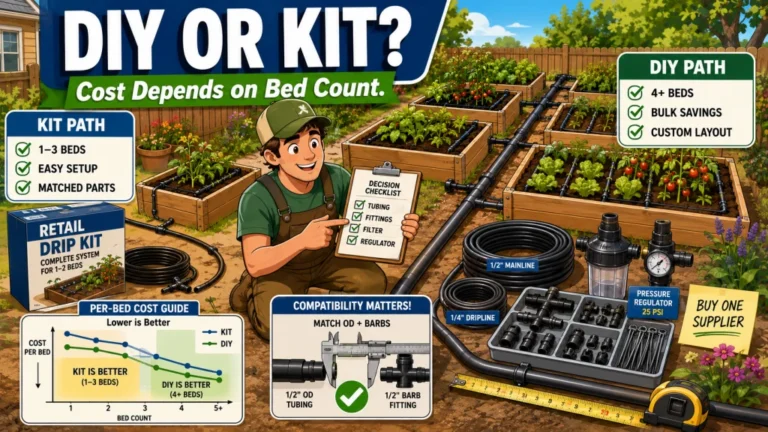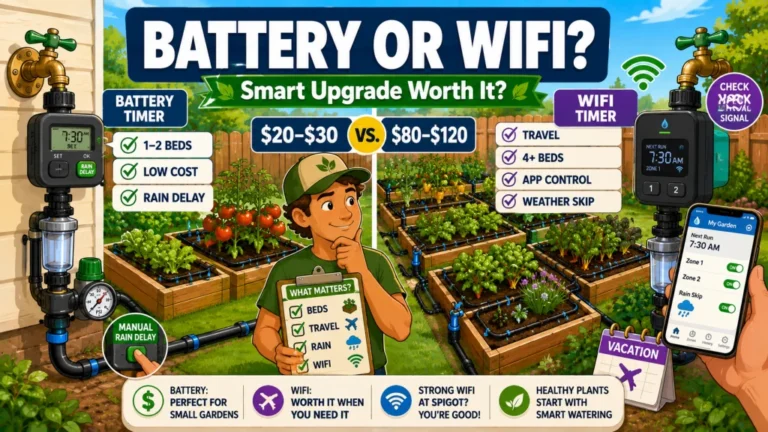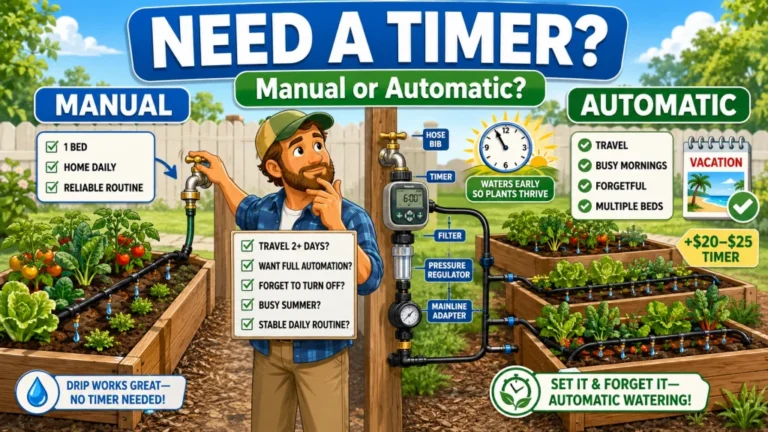
A raised bed drip system does not need the most advanced timer, it needs a reliable one, and most timer problems I hear about come from a unit that was too complicated for a two-bed vegetable garden in the first place. This guide breaks down the specs that actually matter for a hose timer running raised bed drip lines: minimum run time granularity, battery life, and connector thread, plus the one spec, multiple zones, that rarely matters unless you are running four or more beds. We will also look at where Orbit and Rain Bird fit once those specs are sorted out. What this guide will not cover is mounting the timer to your spigot or programming the actual watering schedule once it is running.
A Raised Bed Drip System Needs a Reliable Timer, Not a Sophisticated One
A raised bed drip system does not need a sophisticated timer. It needs a reliable one. Most timer problems I run into come from a unit that was over-specified for a two-bed vegetable garden, not under-specified. Whether you call it a hose timer or a timer kit add-on, the actual job is the same for a raised bed drip setup: open the valve on schedule and fail loudly instead of quietly when something goes wrong.
That reliability question comes down to a short list of real specs, and a slightly longer list of specs that get marketed hard but rarely matter for a standard raised bed setup. Working through the difference before you buy saves you money now and a second purchase six months in.
The Spec That Actually Matters: Minimum Run Time Granularity
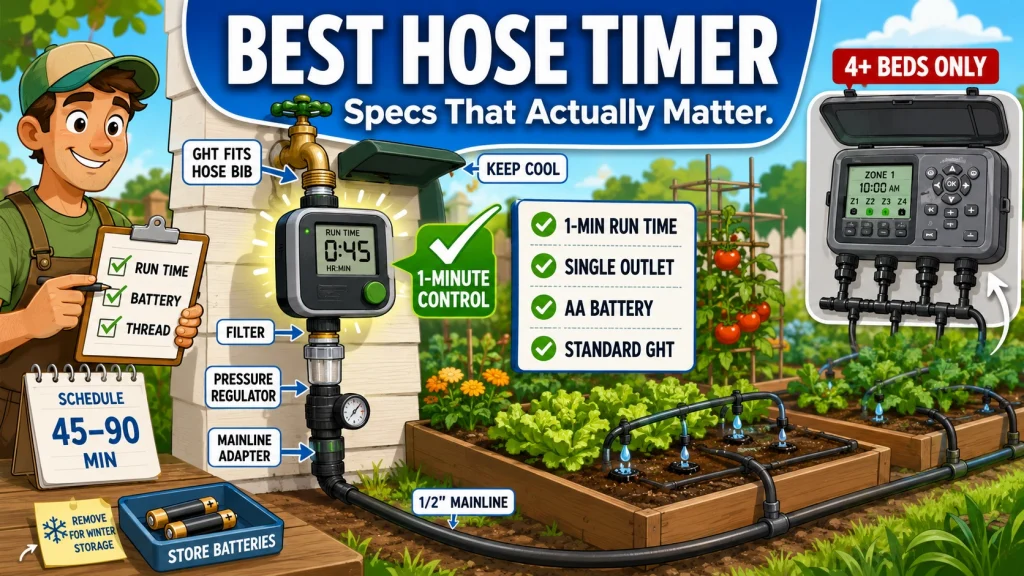
If there is one spec worth checking before you buy, it is minimum run time granularity, meaning the smallest increment the timer can be set to. A timer that only allows 30-minute minimum run times is close to useless for a raised bed drip system, since most raised bed schedules land somewhere in the 45 to 90 minute range every other day, not a flat half hour or hour block. Look for a timer with a 1-minute minimum run time instead; that level of control is what lets you actually match the schedule to your bed size, soil type, and crop mix instead of rounding to whatever increment the timer allows.
A 4-by-8 bed with tomatoes and peppers in a sandy mix might need 60 minutes every other day in midsummer, while a 4-by-4 lettuce bed in the same yard might only need 30. A timer that only steps in 30-minute increments cannot give you both schedules accurately; one bed ends up overwatered or the other underwatered, and you will not notice until the plants start showing it. This is the spec that gets buried in fine print and rarely explained in plain terms, which is exactly why it causes problems.

This battery-powered hose timer converts any standard faucet into an automatic single-zone watering system with programmable schedules and adjustable watering durations. The clear LCD display makes programming straightforward, and a built-in rain delay feature pauses irrigation automatically during wet weather. Designed for outdoor durability and water-resistant construction, it backs its reliability with a six-year limited warranty.
Check On AmazonIf you click this link and buy, we earn a commission at no additional cost to you.
The Spec You Can Mostly Skip: Multiple Zones
Multi-zone timers get marketed as the more capable option, and for a four-plus bed setup with genuinely different watering needs, that is fair. For a standard one- or two-bed raised bed drip system, a single-outlet timer handles the job completely, and paying for zones you are not using just adds programming complexity you will fight with every time you adjust the schedule.
I have set up plenty of two-bed gardens where the homeowner bought a four-zone timer because it looked like the safer, more future-proof choice, then spent the first season confused about which zone controlled which bed. Unless your setup matches one of the situations below, that complexity is not buying you anything.
- You are running four or more raised beds off the same water source with different watering needs
- Different beds get noticeably different sun exposure and need different run times on different days
- You are mixing drip tape and emitter line across beds and want separate schedules for each
- You plan to add more beds within the next season and want to avoid buying a second timer later
If none of those apply, a single-outlet timer with the right minimum run time will outperform a multi-zone model for less money and less setup frustration.
Battery Life and the Mistake That Kills a Timer Early
Most battery timers are rated for one to two seasons, and in practice, digital timers from Orbit and Rain Bird tend to run 1.5 to 2 full growing seasons on a set of AA batteries as long as they are not sitting in extreme heat. Heat is the variable that shortens battery life the most; a timer mounted in full sun on a south-facing spigot drains faster than one tucked into partial shade.
The mistake that actually kills these timers early has nothing to do with the battery rating: it is leaving the batteries in over winter. Corrosion sets in on the contacts during the cold months, and by spring the timer either will not power on or runs erratically even with fresh batteries. Pull the batteries and store the timer inside at the end of the season; it takes two minutes and avoids buying a replacement timer every year.
Field Note: The number one reason I hear about a “dead” timer in spring is corrosion from batteries left in over winter, not a defective unit. Wiping the contacts with a pencil eraser sometimes brings a corroded timer back, but pulling the batteries in fall is the easier fix.

This battery-powered hose timer converts any standard faucet into a two-outlet automatic watering system with programmable schedules and adjustable watering durations. The clear LCD display makes programming straightforward, and a built-in rain delay feature pauses irrigation automatically during wet weather. Designed for outdoor durability and water-resistant construction, it backs its reliability with a six-year limited warranty.
Check On AmazonIf you click this link and buy, we earn a commission at no additional cost to you.
Garden Hose Thread: Why Connector Compatibility Is Rarely the Problem
All standard hose timers use Garden Hose Thread (GHT), the same connection as a standard outdoor spigot, so compatibility is not usually something you need to research before buying. If your spigot already accepts a regular garden hose, a hose bib timer for raised bed drip irrigation will thread onto it the same way, no adapter required for most residential setups.
The exception is well water systems running a different thread standard, which sometimes need an adapter to accept a standard GHT timer. If your raised bed is fed from a well rather than municipal water, check the spigot thread before assuming a timer will thread straight on; it is a five-minute check that avoids a return trip to the store.
| Spec | Why It Matters for a Raised Bed | What to Look For |
|---|---|---|
| Minimum run time | Most raised bed schedules need 45 to 90 minutes, not flat 30-minute blocks | 1-minute increments |
| Zones | Adds cost and setup confusion with no benefit under 4 beds | Single outlet for 1 to 2 beds |
| Battery life | Heat shortens it, winter storage protects it | Rated for at least one full season |
| Connector thread | Almost always standard, except on some well systems | Standard GHT, confirm on well water |
That short list covers what genuinely changes the outcome on a standard raised bed setup. Everything else on a typical spec sheet is closer to marketing than to something that will affect your tomatoes.
Picking Between Orbit and Rain Bird Once the Specs Match
Once you have ruled in the right specs, a fast minimum run time, a single outlet, decent battery life, and a standard thread, the brand choice narrows down fast. Orbit and Rain Bird both make digital battery timers that meet every spec above in a similar price range, and the difference between them comes down to programming feel and how reliably each holds a saved schedule rather than anything on the spec sheet. If you are still deciding whether you even need a timer for your setup, or want to compare timer types more broadly first, whether you need a timer at all covers that decision from the start. If you have not settled on the drip kit itself yet, a raised bed drip irrigation kit is the place to start instead.
Between Orbit and Rain Bird specifically, Orbit’s hose timer in day-to-day raised bed use and Rain Bird’s hose timer in day-to-day use each get a closer look on their own if you want the brand-specific detail beyond the specs covered here. Neither one is the wrong choice once it meets the four specs above; for a one- or two-bed setup, the better buy is the one you find easiest to program and check without second-guessing the schedule.

This upgraded hose timer features two separate programmable zones, letting you set custom start times and durations for healthier, water-efficient watering. Upgraded valves reduce flow resistance by 40%, and the IP65 waterproof housing has passed 20,000 cycle testing for long-term durability. It offers auto, manual, and rain delay modes with up to 72 hours of rain delay, plus a 2.5 inch LED display showing schedules, power status, and low battery alerts. The 3/4 inch interface fits most standard faucets, and the large button, rotating design makes setup easy for users of any age.
Check On AmazonIf you click this link and buy, we earn a commission at no additional cost to you.
Final Thoughts: Buy for Reliability, Not for the Longest Spec List
The spec list on a timer box is built to make the more expensive model look like the smarter buy, and for a raised bed drip system, that is usually backwards. A 1-minute run time increment, a single outlet, a battery rated for a full season, and a standard hose thread cover what a one- or two-bed setup actually needs. Everything past that is paying for a feature set built for a bigger job than the one in front of you.
Buy the boring, reliable option, pull the batteries before winter, and the timer will be the one part of your raised bed setup you stop thinking about.

This battery-operated hose end timer allows watering durations from 1 minute to 3 hours, schedulable up to twice daily, with a large LCD display for at-a-glance schedule visibility. Manual watering can be activated for up to 72 hours without disrupting the programmed schedule, and a rain delay feature pauses watering for up to 96 hours to conserve water during rainy periods or planned yard events.
Check On AmazonIf you click this link and buy, we earn a commission at no additional cost to you.
FAQs
⏱️ What’s the most important spec when buying a hose timer for raised bed drip irrigation?
Minimum run time granularity. A timer that only steps in 30-minute increments cannot match the 45 to 90 minute schedules most raised beds actually need, so look for one with a 1-minute minimum run time.
🔢 Do I need a multi-zone timer for a raised bed?
Usually not. A single-outlet timer covers one or two beds completely; multi-zone timers only earn their cost once you are running four or more beds with genuinely different watering needs.
🔋 How long do batteries last in a raised bed drip timer?
Digital timers from brands like Orbit and Rain Bird typically run 1.5 to 2 full growing seasons on a set of AA batteries, less in extreme heat. A timer in full sun will drain faster than one in partial shade.
❄️ Should I leave batteries in my hose timer over winter?
No. Leaving batteries in over winter is the most common cause of a timer that will not power on in spring, since the cold months cause corrosion on the contacts. Pull the batteries and store the timer inside instead.
🔧 Will a drip irrigation timer fit my outdoor spigot without an adapter?
In most cases, yes. Standard hose timers use garden hose thread, the same connection as a typical spigot. The exception is well water systems on a different thread standard, which may need an adapter.
🚰 What’s the difference between a hose timer and a faucet timer for drip irrigation?
Nothing functional. Hose timer, hose bib timer, and faucet timer all describe the same battery-powered valve that threads onto your spigot and controls a raised bed drip system on a schedule.