You do not need a timer for raised bed drip irrigation to work. You need a timer for it to work without you thinking about it every day. Whether that distinction matters depends entirely on your garden situation, and the honest answer is that for some gardeners a timer adds nothing, while for others it is the only reason the system functions at all. This article lays out the specific situations where a timer is effectively required, where it adds real insurance value, and where skipping it is a completely reasonable decision.
What Drip Irrigation Actually Does Without a Timer
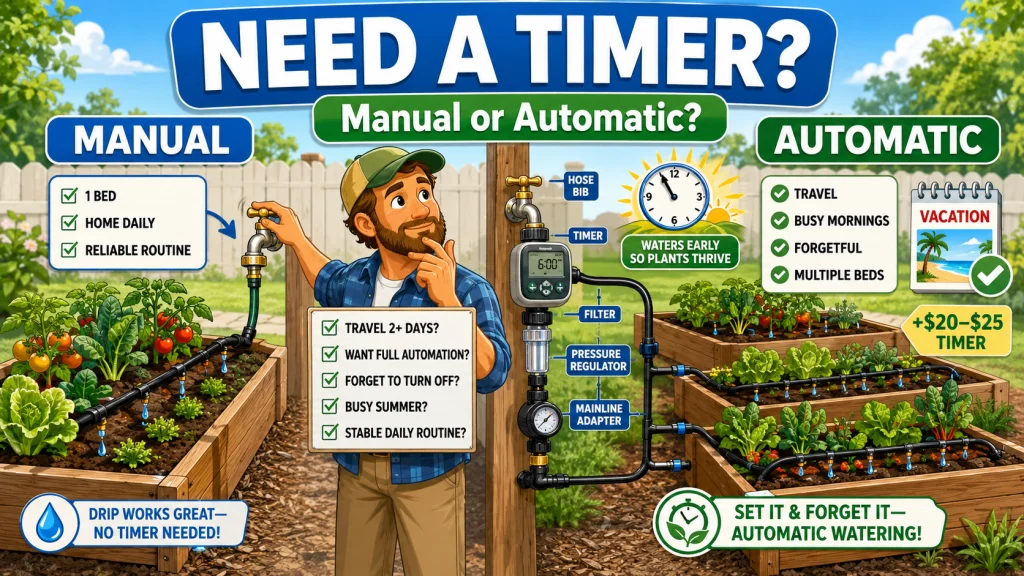
A drip system without a timer is a manual irrigation tool. You turn the faucet on in the morning, the emitters deliver water slowly and directly to the root zone for whatever length of time you decide, and you come back and turn the faucet off. That is it. The drip system itself works exactly as intended. The emitters do not care whether the water is flowing because a mechanical timer opened a valve or because you twisted a hose bib handle. The system delivers water evenly, slowly, and at the root zone either way.
For a single 4×4 or 4×8 raised bed with a basic drip kit, manual operation is a legitimate setup. You run the system for 20 to 30 minutes in the morning, shut it off, go about your day. Total hands-on time is about 2 minutes. The water gets where it needs to go. If your routine is consistent and your schedule is predictable, there is no functional gap that a timer fills.
The gap is not in what the system does. It is in what happens when you forget.
Why Most Vegetable Gardeners End Up Adding a Timer
The first time you forget to turn the drip system off, you come back to a saturated bed and a slow drip running down the path beside it. Annoying, but not a disaster. The second time, you probably overwatered a bed that was already recovering from the first incident. By the fifth time, the pattern is clear: the system is not the problem, the routine is. A timer does not improve the drip system. It removes the routine requirement entirely.
The forgetting rate is not random. It increases when the gardening season gets busy, when work gets demanding, when kids or travel interrupt the morning schedule. A drip system that runs reliably in early May when routines are fresh can become unreliable in late July when a hundred other things are competing for attention. The timer is not a luxury in that context. It is what makes the system function as designed across a full season.
Field Note: I have seen more than a few raised beds that ran fine on manual operation for the first month and then had a rough summer, not because the drip system failed, but because the watering routine did. A bed with a working drip system and an unreliable manual schedule is functionally the same as a bed with no irrigation at all on the days it gets skipped. The timer removes that variable completely.
That said, the forgetting problem is not universal. Some gardeners have morning garden routines they have maintained for years. Some work from home and check the bed twice a day as a matter of habit. For those gardeners, the timer genuinely adds nothing to the system. The decision depends on which of these five situations describes your actual gardening life.

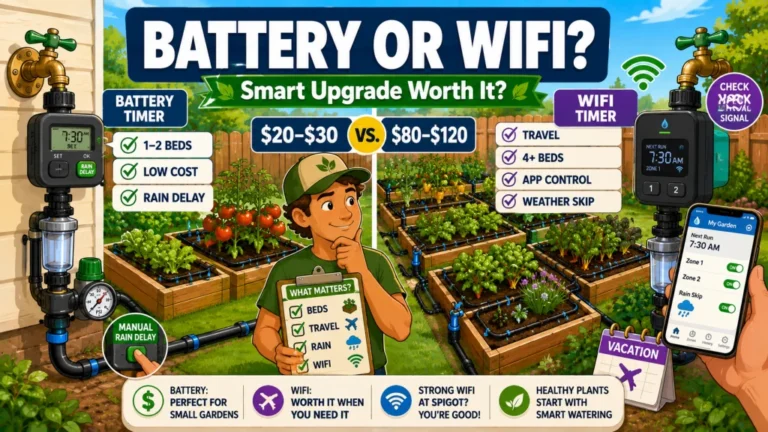
This battery-powered hose timer converts any standard faucet into an automatic single-zone watering system with programmable schedules and adjustable watering durations. The clear LCD display makes programming straightforward, and a built-in rain delay feature pauses irrigation automatically during wet weather. Designed for outdoor durability and water-resistant construction, it backs its reliability with a six-year limited warranty.
Check On AmazonIf you click this link and buy, we earn a commission at no additional cost to you.
The Five Situations and What Each One Calls For
The question of whether you need a timer is really a question about which of these situations you are in. Be honest about which one actually describes your life during the growing season, not which one sounds most flattering.
| Garden Situation | Timer Necessary? | Why |
|---|---|---|
| Travel away for 2 or more days during the season | Yes, effectively required | No good alternative exists that does not involve someone else managing the watering |
| Set up drip to eliminate daily garden management entirely | Yes, it is the point of the system | Without a timer, drip irrigation does not automate anything |
| Consistent schedule but known for forgetting to turn things off | Strongly recommended | The timer pays for itself the first time it prevents an overwatered bed |
| Busy season with variable morning schedule | Recommended | Forgetting rate increases when routines are disrupted; timer removes the dependency |
| Retired, work from home, or have a stable daily garden routine | Not necessary | Manual operation works and adds no functional gap if the routine is reliable |
Most gardeners fall into the middle three categories and benefit from a timer, but the table is an honest read, not a sales case. If the last row describes you accurately, skipping the timer is a reasonable decision and the system will work perfectly well without one.
The Travel Case
If you are away from home for more than 2 to 3 days at any point during the growing season, a timer is effectively required. A raised bed planted with tomatoes, peppers, or squash in peak summer will show stress within 48 hours without water in hot conditions. Asking a neighbor or house-sitter to manage a drip system introduces a new variable: they may not know how long to run it, may forget entirely, or may water inconsistently. A timer removes all of that. The system runs at the scheduled time and duration regardless of who is home.
Even a single vacation week mid-season justifies adding a timer. A battery-powered hose timer costs $20 to $25 and does not require any wiring or installation beyond threading it onto the hose bib and setting the schedule. That cost and effort for protecting a full season of vegetable production is not a difficult calculation for most gardeners.
The Automation-or-Nothing Gardener
Some gardeners set up drip irrigation specifically to eliminate daily watering as a task. They want to plant the bed, dial in the schedule, and not think about watering again until the system needs maintenance or the season ends. For this use case, the timer is not an add-on. It is the reason the system exists. A drip kit without a timer does not automate anything. It replaces a watering can with a faucet handle, which is a marginal improvement at best.
If this describes your goal, buy the timer at the same time you buy the kit. The two components together are what create the automated watering system you are looking for. Buying the kit first and the timer later is a common sequence, but it means the system does not do what you actually wanted it to do until the timer arrives.
The Consistent-Presence Gardener
Retired gardeners, people who work from home with established morning routines, and gardeners who have maintained a consistent daily garden check for several seasons are the cases where a timer adds the least value. If you are at the hose bib at 6:30 every morning, run the system for 25 minutes, and come back reliably to turn it off, you are already doing what the timer does. The automation is not solving a problem you have.
That said, even consistent-presence gardeners often add a timer eventually, not because their routine fails regularly but because one bad stretch of forgetting creates enough frustration to justify the $25. There is no wrong answer here. The timer does not hurt anything by being present. It just does not add as much for someone whose morning routine is already reliable.
The Cost Reality and What the Total System Actually Runs
A basic raised bed drip kit costs around $35 to $45 depending on what it includes and how many beds it covers. A battery-powered hose-end timer adds $20 to $25 to that total. The combined system runs $55 to $70 and is the cheapest fully automated vegetable watering setup available. You do not need a power outlet or any installation beyond threading fittings, and the batteries run a full season or longer before needing replacement.
For most gardeners asking this question, affordability is not the real concern. The question is whether the automation fits the actual garden routine, and whether spending the extra $20 to $25 makes sense given how they actually manage the system. The honest answer is that it makes sense for the majority of situations, but not all of them.
- One raised bed, consistent daily routine, no travel planned: manual operation is a legitimate choice.
- One raised bed, any travel planned during the season: add the timer.
- Multiple raised beds on a shared mainline: a timer manages the entire system at once and becomes more valuable as bed count increases.
- Drip system installed for vacation or extended absence coverage: the timer is not optional.
- Goal is full automation with no daily watering task: buy the timer with the kit, not after.
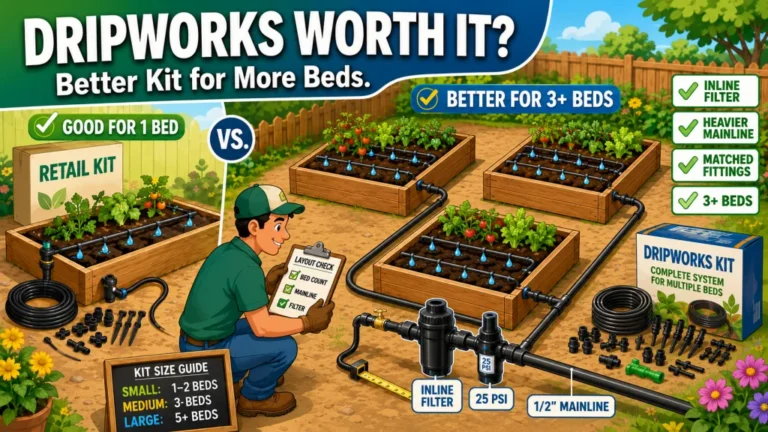
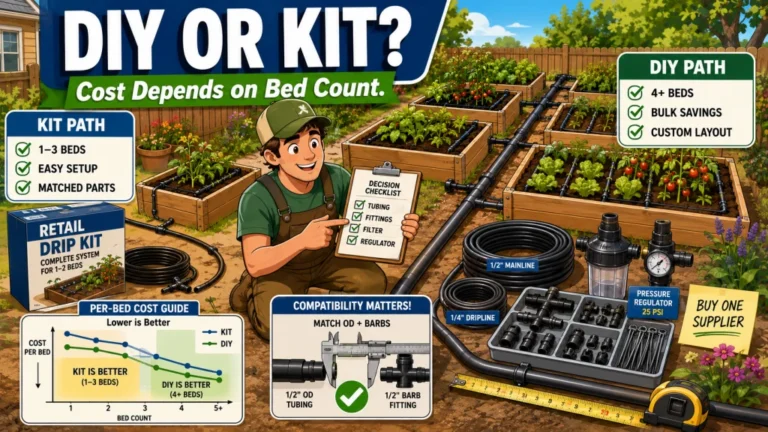
The broader decision about which kit configuration fits your bed count and layout, including whether to add a filter, pressure regulator, and timer as a head assembly, is covered in the best raised bed drip irrigation kit section, which walks through how each component in the head assembly earns its place.

This kit includes everything needed to water a raised bed up to 4 by 8 feet, with professional-grade components built for repeated seasonal use. It features 35 feet of emitter tubing with 70 built-in, pressure-compensating emitters spaced every 6 inches for even watering near the roots, plus 25 feet of easy-to-handle 1/4 inch distribution tubing. This low-volume design can save up to 80% on water while supporting healthier plants and better yields. Installation is straightforward thanks to an illustrated manual covering multiple layout options, and the system can be automated with a compatible Rain Bird hose-end timer sold separately.
Check On AmazonIf you click this link and buy, we earn a commission at no additional cost to you.
If You Decide You Want a Timer, What to Know Before Buying
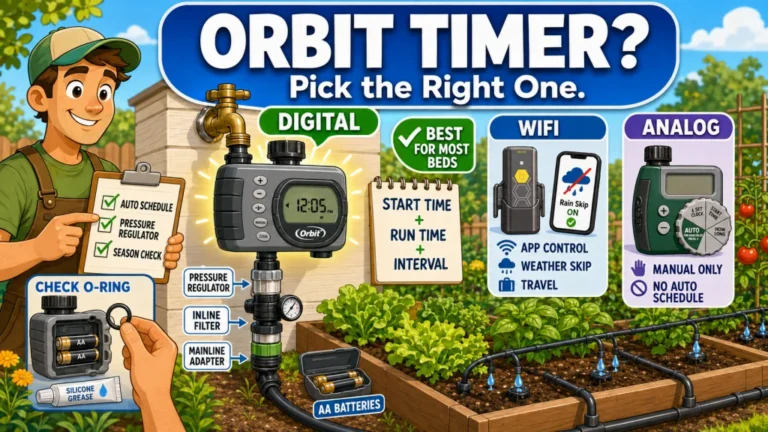
Once you have decided a timer fits your situation, the next question is which type makes sense for a raised bed drip system. For most home raised bed setups, a battery-powered single-zone hose timer is the relevant comparison. It threads onto the hose bib ahead of the filter and pressure regulator, runs on AA batteries, and sets a schedule by day frequency and duration. No wiring, no hub, no app required unless you want one.
The practical details for how a hose timer fits into a raised bed drip setup, including where it sits in the component stack and what to watch for during installation and seasonal startup, are in the drip irrigation timer guide for raised beds. If you have already decided on a timer and want to compare the specific options that work well for raised bed setups, the best hose timer for raised bed drip irrigation breakdown covers those with the raised bed use case specifically in mind.

A smart hose watering timer with an HWG040 WiFi and Ethernet gateway, app-based remote scheduling, weather-aware irrigation, flow tracking, and voice-control support for automated garden and drip watering.
Check On AmazonIf you click this link and buy, we earn a commission at no additional cost to you.
Final Thoughts: Answer the Honest Question, Then Decide
The honest question is not whether a timer is technically required for drip irrigation to function. It is not. The honest question is whether your gardening life, schedule, and season plans match the consistent manual routine that makes a timer unnecessary. For most vegetable gardeners who have a busy summer, plan any travel, or set up drip specifically to reduce daily management, the answer points clearly toward adding the timer. For gardeners with a stable daily routine and no travel, manual operation works and the $20 to $25 is genuinely optional.
Neither choice breaks the drip system. What breaks it is buying the kit expecting full automation and skipping the timer, then wondering why the bed still needs daily attention. Be clear about which of the five situations above describes your actual season, and the decision makes itself.

This robust hose-end timer works with sprinklers, drip irrigation, and soaker hoses, offering simple automatic programming with full 7 day scheduling for worry-free watering. An extra-large dial and readout screen make setup and schedule review easy, while one-touch buttons allow quick cancellation, a rain delay of up to 96 hours, or manual watering on demand. The display also shows the next scheduled cycle and time remaining on the current one.
Check On AmazonIf you click this link and buy, we earn a commission at no additional cost to you.
FAQs
💧 Do you need a timer for drip irrigation to work in a raised bed?
No. A drip system delivers water whenever the faucet is on, with or without a timer. A timer automates the on and off so you do not have to manage it manually. Whether that automation is necessary depends on your routine and schedule, not on how the drip system functions.
✈️ Do I need a drip timer if I travel during the growing season?
Yes. If you are away for more than 2 to 3 days, a timer is effectively required. A raised bed with summer vegetables will show stress within 48 hours without water in hot conditions, and there is no reliable manual alternative that does not depend on someone else managing the schedule correctly.
🌱 Can I run a raised bed drip system manually without a timer?
Yes, and it works well if your routine is consistent. Turn the faucet on in the morning, run the system for your target duration, turn it off. The drip system delivers water just as effectively as it does on a timer. The risk is what happens when you forget, and that risk increases as the season gets busier.
💰 How much does a hose timer add to the cost of a drip kit?
A basic battery-powered hose timer adds $20 to $25 to a drip kit that costs $35 to $45. The combined system runs $55 to $70 and is a fully automated vegetable watering setup that requires no wiring and no power outlet. For most gardeners, the cost question is not about affordability but about whether the automation matches the actual garden situation.
🏡 Who does not need a timer for raised bed drip irrigation?
Gardeners who have a stable daily routine, no travel plans during the season, and a consistent habit of turning the system on and off manually. If you are at the hose bib at the same time every morning and reliably follow through, the timer adds no functional value to your setup.
⏱️ What happens if I set up drip irrigation without a timer and then want to add one later?
Adding a timer later is straightforward. A battery-powered hose timer threads onto the hose bib ahead of the filter and pressure regulator. You do not need to change the rest of the system. The only reason to buy the timer at the same time as the kit is if full automation is your goal from the start, since the system does not automate anything until the timer is in place.