Most drip irrigation problems that reach plant stress could have been caught two to three weeks earlier with a 10-minute monthly walk. This raised bed drip irrigation monthly maintenance routine covers five things to check while the system is running: emitter flow, fitting condition, soil surface under the lines, timer display, and filter screen. It also covers the first response for each item that flags and how to read repeat problems as diagnostic signals rather than isolated events. The gardeners who catch problems early are the ones who walk their beds with the system on.
Why Problems Wait Until They Are Hard to Fix
The emitter that stops watering a tomato plant in late July usually gave early signals in June. It was flowing slightly less than its neighbors. The soil around it dried a little faster between cycles. The fitting that started weeping in August had a small damp spot at the connection weeks before. Plants do not show stress until the situation is already past the easy-fix stage, and at that point the repair happens around established roots in a fully planted bed. The drip irrigation maintenance schedule that prevents that scenario is not complicated: turn the system on and walk it once a month while it runs.
Daily checks create noise without signal. A correctly set raised bed drip system runs without problems for weeks at a time, and checking every day trains you to stop looking because nothing is ever wrong. Weekly checks are more useful but still more frequent than the problem cycle in most stable setups. The slow-developing issues that matter most are a partial emitter clog, a rubber washer beginning to harden, a filter screen starting to fill with debris, and a timer battery getting weak enough to miss runs. These typically take three to four weeks to progress from first signal to something noticeable. A monthly walk catches that window. Gardenary recommends turning the system on and observing a full cycle once a month as the baseline maintenance practice, and that matches what I see in residential raised bed setups as well.
New systems or systems restarted after winter are a different case. For those, a quick check at day three, day seven, and day thirty makes sense before settling into a monthly routine. Once a system has been running consistently without issues for a full month, monthly observation is the right frequency going forward.
The 10-Minute Monthly Walk
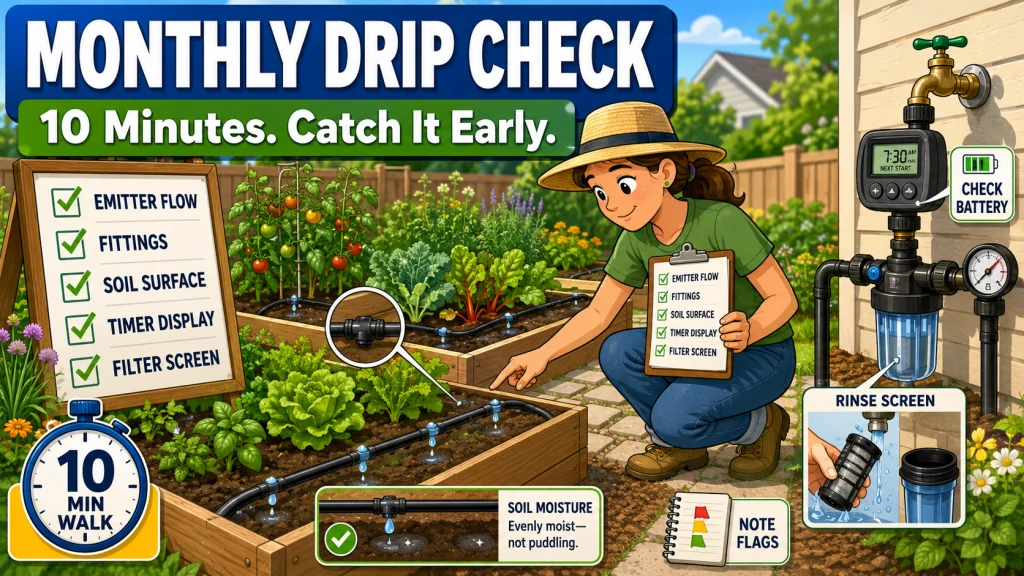
Turn the system on manually and run a full cycle while you walk. Do not check from a distance. Get close enough to see each emitter, each fitting, and the soil surface under the lines. UC Marin Master Gardeners identifies walking the circuit while the system is running as the single most effective preventive practice for drip systems. On a two- to four-bed raised bed setup, the full monthly drip system check takes roughly ten minutes.
Five things to look at on every walk:
- Every emitter: a steady drip or weep means the emitter is working as expected. Misting or spraying points to excess pressure at that point or a damaged emitter. No output at all means either a clog at the emitter itself or no pressure reaching that section of line. Check every emitter, not a sample from one end of the bed.
- Every fitting: a connection with no visible water while the system is under pressure is sealed correctly. A drip or a wet patch at a barbed tee, elbow, or threaded connection is a leak. Note the location and address it after the full walk.
- Soil surface under the emitters: a small wet area directly around an emitter is normal. A spreading puddle or surface runoff means the emitter flow rate or run time is exceeding the soil absorption rate. Dry soil directly under an emitter that should be flowing signals either a clogged emitter or reduced supply pressure upstream.
- Timer display: a running countdown means battery output is adequate. No display, a flashing readout, or a timer that does not start a scheduled run means battery replacement is needed immediately, not at the next check.
- Filter screen: remove the screen from the filter housing, rinse it under tap water, and reinstall. DripDepot confirms that periodic filter screen cleaning prevents the gradual flow restriction that develops when fine particles accumulate slowly across the mesh. This step takes two minutes and prevents a problem that affects every emitter on the line simultaneously.
After the walk, write down anything that flagged (emitter location, fitting location, display behavior) before starting fixes. A record of what flagged and when tells you far more than memory does once a pattern develops across two or three months.
First Response When Something Flags
The goal during the monthly raised bed drip irrigation inspection is not to troubleshoot in depth on the spot. It is to apply the simplest fix and then confirm it held the following week. Each of the five checklist items has a clear first response that resolves the most common version of the problem.
| What you see | Likely cause | First response |
|---|---|---|
| Emitter with no flow | Partial or full clog at the emitter | Insert a straightened paper clip gently into the emitter outlet to clear debris. Run the system and recheck. Replace the emitter if it still does not flow. |
| Emitter misting or spraying | Excess pressure at that point or damaged emitter | Confirm the pressure regulator is still in the line and functioning. If pressure is correct, replace the emitter. |
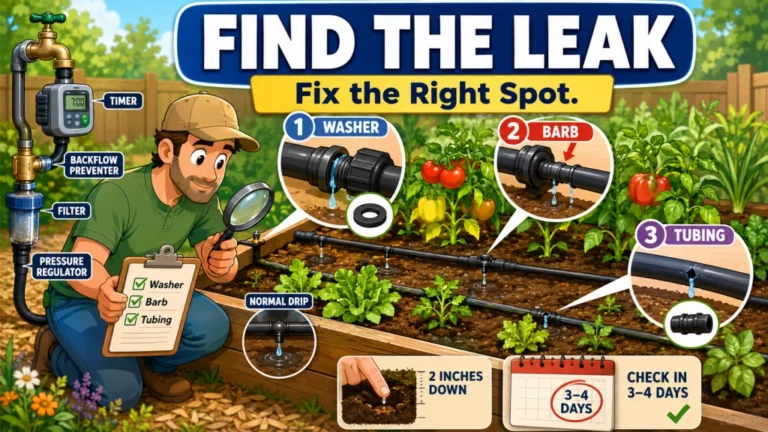
| Drip or wet spot at a fitting | Dried rubber washer or tubing pulled back from the barb | On a threaded connection, replace the rubber washer. On a barbed connection, push the tubing firmly back onto the barb or cut a fresh end on the tubing and reseat it. |
| Timer display blank or flashing | Battery low or depleted | Replace batteries immediately. Confirm the saved schedule survived the swap before walking away from the timer. |
| Filter screen caked with debris | Sediment or mineral buildup from supply water | Rinse under tap pressure. If mineral deposits do not clear, soak in white vinegar for 15 minutes, rinse again, reinstall. |
| Surface puddle or runoff under emitter | Run time too long or flow rate too high for soil absorption | Reduce run time by 15 to 20 percent and observe the next two cycles before adjusting further. |
After applying any fix, revisit that specific item within a week rather than waiting for the next monthly walk. Confirming the fix held is part of the process. If the same problem reappears within two weeks, that is a repeat problem and needs a different approach than the first response.

This pressure regulator maintains an optimal 25 PSI to keep drip lines and emitters running at consistent flow, with a 20 gallon per minute capacity to support larger systems. It connects to any 3/4 inch male threaded faucet, garden hose, or component for easy setup. Built from UV and chemical-resistant materials, it offers durable, reliable performance season after season, and pairs well with a compatible Rain Bird hose-end timer for automated watering.
Check On AmazonIf you click this link and buy, we earn a commission at no additional cost to you.
What Repeat Problems Are Actually Telling You
A single clogged emitter is a maintenance event. The same emitter re-clogging within two weeks is a signal about the water source, not the emitter. In a hard water zone, fine particles and mineral deposits move through the supply line faster than a standard filter screen can consistently catch. If the same emitter re-clogs within two weeks of being cleared, the filter is not matched to what the supply water is carrying. A finer mesh screen or a sediment pre-filter upstream of the main housing addresses the root cause.
A fitting that re-leaks after a washer replacement has a different problem. A new washer on a cracked thread or against a fitting with a hairline fracture will seal temporarily and fail again quickly. Inspect the threads directly. If they are damaged or deformed, replace the fitting rather than the washer. A washer seals a good thread. It does not repair a broken one.
A timer that needs batteries twice in one season is worth examining more carefully. Hose-end timers mounted in full direct afternoon sun deplete batteries significantly faster than timers in partial shade. A timer sitting in six hours of direct summer sun can drain batteries well ahead of the expected interval. Relocating the timer to a shadier position at the hose bib costs nothing. Diagnosing why a bed is not getting water on a hot week in August costs more.
Field Note: I have seen more than a few setups where the filter was removed for cleaning and never reinstalled. The system ran without one for several weeks, everything looked fine, and then emitters started clogging in sequence as debris moved through the unfiltered line. When the monthly check includes pulling the filter, it also confirms the filter went back in. Make it part of the reinstall habit: remove, rinse, replace, hand-tighten the housing, and move on.
Keeping a simple record makes repeat patterns visible. A notecard or a phone note with the date, what flagged, what you did, and whether the fix held is enough. Without a record, the second occurrence of the same problem in the same location feels like the first one all over again.

This inline filter protects downstream drip components from debris using a pre-installed 200 mesh stainless steel filter element rated to catch particles as small as 75 microns. The glass-filled polypropylene body handles up to 150 psi and fits any standard three-quarter inch irrigation valve via male pipe thread connections on both ends. The cap unthreads quickly for easy filter cleaning without tools.
Check On AmazonIf you click this link and buy, we earn a commission at no additional cost to you.
How Often the Filter Screen Needs Attention
Monthly cleaning is the right baseline for most raised beds on municipal water. Debris accumulates slowly enough at that water quality that a monthly rinse keeps the screen clear without requiring more attention. DripWorks recommends regular visual inspections and emitter checks as standard practice, and the filter rinse fits naturally into that routine without adding separate trips to the hose bib.
Well water and high-mineral supplies are different. The filter screen in a hard water zone can start restricting flow within four to six weeks, sometimes sooner in areas with high iron or sediment content. The signal for more frequent cleaning is not one dry emitter but a zone-wide reduction where multiple emitters are running lower than usual at the same time. If that pattern shows up, clean the filter and check the output again within two weeks. If the screen is already loading up at the two-week mark, monthly cleaning is not enough for the water source and a pre-filter is worth adding.
Final Thoughts: Most Months, Nothing Flags
The monthly check is not about finding something wrong every time. Most months, the emitters flow correctly, the fittings are dry, the timer is running, and the filter screen needs a quick rinse. That is a good outcome, and it takes about ten minutes. The months when something does flag, the early catch is the difference between a two-minute emitter clearing and a two-week mystery about why a section of the bed is staying dry with the system appearing to run normally.
For a complete picture of how the monthly check fits alongside spring startup and end-of-season tasks, the raised bed drip maintenance through the full growing season covers the whole year in one place. For a broader understanding of how the components in this routine connect to each other from the hose bib forward, the raised bed drip irrigation setup and component overview is a useful starting point before running your first monthly check.

This robust hose-end timer works with sprinklers, drip irrigation, and soaker hoses, offering simple automatic programming with full 7 day scheduling for worry-free watering. An extra-large dial and readout screen make setup and schedule review easy, while one-touch buttons allow quick cancellation, a rain delay of up to 96 hours, or manual watering on demand. The display also shows the next scheduled cycle and time remaining on the current one.
Check On AmazonIf you click this link and buy, we earn a commission at no additional cost to you.
FAQs
💧 How often should I check my raised bed drip irrigation system?
Once a month during the growing season is the right frequency for most stable raised bed setups. New systems benefit from checks at day three, day seven, and day thirty before settling into monthly. The slow-developing problems that matter most in a raised bed drip system (partial clogs, hardening washers, declining batteries, filling filter screens) typically take three to four weeks to go from early signal to something visible.
🌱 What should I look for during a raised bed drip irrigation inspection?
Run the system manually and check five things while it is under pressure: emitter flow at every emitter, fittings for drips or wet spots, soil surface under emitters for puddles or dry patches, the timer display for low battery signals, and the filter screen for debris buildup. Walk close enough to actually see each emitter rather than checking from a distance.
🔩 How do I clear a clogged drip emitter in a raised bed?
Insert a straightened paper clip gently into the emitter outlet to dislodge the blockage, then run the system and watch the emitter directly. If it flows normally, the clog is cleared. If it does not flow after clearing, replace the emitter. An emitter that re-clogs within two weeks points to a filtration issue rather than a one-off maintenance event.
🧼 How often should I clean the filter screen on a raised bed drip system?
Monthly is the right baseline for municipal water. In areas with well water, high sediment, or visible mineral buildup, the screen may need rinsing every two to three weeks. The signal for more frequent cleaning is reduced output across multiple emitters in the same zone, not a single dry emitter. Rinse under tap pressure; for mineral deposits that do not clear with rinsing, soak in white vinegar for 15 minutes.
⏱️ Should I run my drip system during the monthly check or inspect it turned off?
While it is running. Fitting leaks, emitter flow problems, timer behavior, and soil saturation patterns are only visible under pressure. A visual inspection with the system off will miss most of what a 10-minute walk while the system runs will catch. Turn the system on manually and walk the beds before the cycle ends.
🔋 How can I tell if my drip timer battery is getting low?
A blank or flashing display is the obvious sign. A less obvious sign is a timer that appears to run but misses a scheduled cycle or shortens the run without explanation. If a raised bed is drying faster than expected but the system looks functional, watch the timer over two or three consecutive scheduled runs before adjusting the schedule.