Tomatoes at full size in July need roughly twice the water per week of the herbs growing beside them. Most raised bed drip setups put both on the same zone with the same timer, which means one crop is often getting the wrong amount. This article covers how water needs differ across common raised bed vegetables, what that means for a single-zone drip setup, and what you can actually do about it without adding a second timer or rebuilding the system. For most mixed beds, the answer is adjustable emitter flow, not a different schedule.

Why One Timer Schedule Rarely Fits Every Crop in the Bed
The setup most raised bed gardeners end up with is one hose bib, one timer, one drip zone, and a bed planted with whatever looked good at the nursery in May. By July, that bed might have tomatoes on one end, peppers in the middle, and a strip of basil near the edge. The timer was set sometime in June, probably adjusted once when the tomatoes started wilting, and has been running the same schedule since. That schedule is almost certainly too much water for the basil and not quite enough for the tomatoes on the hottest days.
The core issue is that the timer delivers the same run time to every emitter on the zone. If all the emitters are the same flow rate, every plant gets the same volume of water per cycle. That works fine when you have a bed of one crop type. It starts causing problems the moment you mix plants with meaningfully different water needs. Understanding where each crop falls on the demand scale is where this starts to get manageable. For guidance on how often to run your system in general, the article on drip irrigation frequency for raised beds covers that side of the equation separately.
Crop Water Needs: Three Categories That Matter for Raised Bed Planning
Cooperative extension vegetable water use tables group most common garden crops into three demand levels. These benchmarks are for peak production season and assume reasonably consistent conditions. Your soil mix, sun exposure, and climate will shift the numbers, but the relative differences between crops hold up well enough to plan around.
| Demand Level | Common Raised Bed Crops | Approximate Weekly Water Need (Peak Season) |
|---|---|---|
| High | Tomatoes, cucumbers, squash, peppers | 1.5 to 2 inches per week |
| Medium | Beans, beets, broccoli, cabbage, onions | 1 to 1.5 inches per week |
| Low | Carrots, garlic, most culinary herbs, spring lettuce | 0.5 to 1 inch per week |
The gap between high and low demand is not small. At peak summer production, a tomato plant can need three to four times more water per week than a rosemary plant in the same bed. That spread is manageable when you plan for it. When you ignore it and let the timer run the same schedule for every plant, one end of the bed thrives while the other either dries out or drowns, depending on which crop the schedule was built for.
Soil type adds another layer. A loose, sandy raised bed mix drains faster than a compost-heavy blend, which means all crops will need more frequent watering across the board, but the category differences between crops still apply. A tomato in fast-draining mix still needs more water than basil in the same mix. The framework holds even when the baseline shifts.
What Actually Goes Wrong in a Mixed Planting
The scenario I run into most often is a 4×8 bed with tomatoes at one end and herbs or spring greens at the other, all connected to the same drip line off one timer. The gardener sets the schedule for the tomatoes because those are the plants they are most focused on in summer. A few weeks later, the basil is yellowing from saturated roots, or the parsley has gone limp despite the system running every day. Nobody connects it to the drip schedule because the tomatoes look healthy and the system is clearly working.
The problem is not only the run time. It is that every emitter on that line is delivering the same volume. If both the tomato and the basil have 1 GPH emitters, and the schedule is set to keep the tomatoes right, the basil is receiving more water than its roots can process. The fix is not a shorter run time, which would leave the tomatoes short. The fix is reducing the flow at the basil while keeping the tomatoes at full output. That is a per-plant adjustment, not a timer adjustment.
Field Note: I have seen this play out in a 4×8 bed where herbs were planted near the end of a drip line running through a full tomato setup. The herbs looked fine for the first few weeks, then started declining slowly through July. The gardener assumed it was heat stress. The emitters at the herb end were 1 GPH, same as the tomatoes, running on the same schedule. Swapping to lower-flow adjustable emitters at the herbs the following season fixed the problem completely.

A 60-piece set of staked drip irrigation emitters for 1/4-inch tubing with adjustable water flow, full 360-degree spray coverage, up to 25 GPH flow, and push-to-fit leak-resistant connections for garden beds, vegetables, lawns, and landscape watering.
Check On AmazonIf you click this link and buy, we earn a commission at no additional cost to you.
Adjustable Emitters: The Most Practical Fix for a Single Zone
Some drip kits include adjustable emitters that let you dial the flow rate at each individual plant, typically from near zero up to around 2 GPH depending on the design. This is the most direct way to manage crop water need differences in a single-zone raised bed. The timer stays the same. The run time stays the same. You reduce the flow at the low-demand plants and leave the high-demand plants at full output. One zone, one schedule, different volumes delivered where each plant actually needs them.
The way I set this up in a mixed bed is to install the emitters at full flow for tomatoes, cucumbers, and peppers first, then dial back the emitters at the herbs, garlic, or other low-demand plants to roughly half flow or lower. The goal is not precision. It is rough proportionality: the low-demand plants should receive meaningfully less per cycle than the high-demand plants. After one week at summer settings, I check the soil moisture at both ends of the bed and adjust from there.
This approach works best when the planting is relatively stable. If you rotate crops frequently, you will need to readjust emitter settings each time the mix changes. For a bed that stays the same from June through September, it is a one-time adjustment with minor tuning as conditions change.
Pro Tips: When checking whether the lower-flow emitters at your herbs are dialed in correctly, check the soil an inch or two below the surface near the root zone, not just at the top. A loose raised bed mix can look dry on the surface between cycles while the root zone is still holding adequate moisture. Surface appearance alone will lead you to overwater.

This complete kit includes 10 vortex emitters, 20 spray emitters, 50 feet of 5/16 inch mainline tubing, 50 feet of 1/4 inch drip tubing, plus couplers, splitters, end plugs, and a water connector, enough to cover up to 3 raised garden beds. It runs on 20 to 45 PSI with adjustable, detachable emitter heads that resist clogging and rotate for precise watering at each plant's roots. The UV-resistant tubing holds up year-round above or below ground, and 7.5 inch bubbler stakes anchor securely even in loose soil. A printed instruction guide and digital growing guide are included.
Check On AmazonIf you click this link and buy, we earn a commission at no additional cost to you.
When Splitting Zones Makes More Sense Than Adjusting Emitters
Adjustable emitters solve the mixed-bed problem when everything is in one bed. They are less practical when you have separate beds that are planted with completely different crop profiles. If one 4×8 bed is all tomatoes and peppers, and the bed next to it is planted with herbs and garlic, there is no reason to compromise between those two watering needs on a single zone. A 2-outlet timer gives each bed its own schedule, and you stop asking one setting to serve crops that genuinely need different treatment.
With a 2-outlet timer, the tomato bed runs at full summer frequency and duration while the herb bed runs at a shorter cycle or lower frequency. The beds are physically separate, so the zones do not interact. I would rather set this up correctly from the start than spend a season adjusting emitters on a zone that was fighting the planting layout the whole time.
Running both a dedicated tomato bed and a dedicated herb bed off the same zone at a single timer setting. The herbs get overwatered every time the tomatoes need a full summer schedule, and there is no emitter adjustment that fully resolves it when the whole bed has different needs.
Using a 2-outlet timer so each bed runs its own schedule. The tomato bed runs at the duration and frequency the crop needs in summer. The herb bed runs at reduced frequency or shorter duration. Each zone is tuned independently.
The threshold I use is this: if two separate beds have crops that fall in different demand categories and those beds are not going to be replanted with the same crops on the same schedule, a split zone is the cleaner long-term answer. If the difference is within one bed, start with adjustable emitters. If that level of control is not enough, then separate the zones.

This battery-powered hose timer converts any standard faucet into a two-outlet automatic watering system with programmable schedules and adjustable watering durations. The clear LCD display makes programming straightforward, and a built-in rain delay feature pauses irrigation automatically during wet weather. Designed for outdoor durability and water-resistant construction, it backs its reliability with a six-year limited warranty.
Check On AmazonIf you click this link and buy, we earn a commission at no additional cost to you.
The Practical Compromise Most Mixed Beds End Up Using
Not every drip kit includes adjustable emitters, and not every gardener wants to add a second outlet to the timer. In practice, most mixed raised beds get set up for the highest-demand crop and everything else is monitored around that. It is not the optimal approach, but it is a workable one if you know what to watch for and when to intervene.
When the timer is set to the highest-demand crop in the bed, lower-demand plants will be receiving more water per cycle than they strictly need. The signs usually show up as yellowing on the lower leaves of herbs, a consistently wet soil surface at the base of smaller plants between watering cycles, or a soft, waterlogged feeling around the root zone when you press a finger into the soil. If you see those signs at the herb end while the tomatoes look healthy, the system is doing what the timer told it to do. The crop is just not suited to that schedule.
- Set the timer and run time for the highest-demand crop in the bed.
- After the first week at summer settings, check the soil at the low-demand plants for signs of overwatering.
- If adjustable emitters are installed, dial back the flow at the lower-demand plants.
- If emitters are fixed-flow, consider replacing low-demand crops with ones in a similar demand category to the dominant crop.
- As a short-term option, reduce the run time slightly for the whole zone and manually supplement high-demand plants if they show stress.
The table below maps common raised bed situations to the most practical response. It is not exhaustive, but it covers what I see most often when someone is trying to figure out whether their setup needs an equipment change or just a layout adjustment.
| Setup | What to Do |
|---|---|
| One bed with tomatoes + herbs sharing a zone, adjustable emitters available | Set timer for tomatoes. Dial back emitter flow at herb plants. Check soil at both ends after one week. |
| One bed with tomatoes + herbs, fixed-flow emitters only | Set timer for tomatoes. Monitor herbs for overwatering signs. Replant herbs into a separate bed next season or replace with medium-demand crops. |
| Two separate beds: one with tomatoes, one with herbs | Use a 2-outlet timer. Each bed runs its own schedule. No compromise needed. |
| Spring lettuce beside young tomato transplants (early summer overlap) | Run the lighter lettuce schedule temporarily. Supplement tomatoes by hand. Step up to the full tomato schedule once the lettuce is pulled. |
| Bed with all crops in the same demand category (e.g., all high-demand) | One timer schedule is usually fine. No per-plant emitter adjustment needed. |
Most gardeners who grow raised beds for more than one season eventually learn to group crops by watering compatibility, not just by companion planting rules or layout preference. Putting tomatoes, cucumbers, and peppers in one bed and herbs with garlic and carrots in another makes the drip schedule straightforward instead of a constant negotiation.
How Seasonal Turnover Shifts the Schedule on Its Own
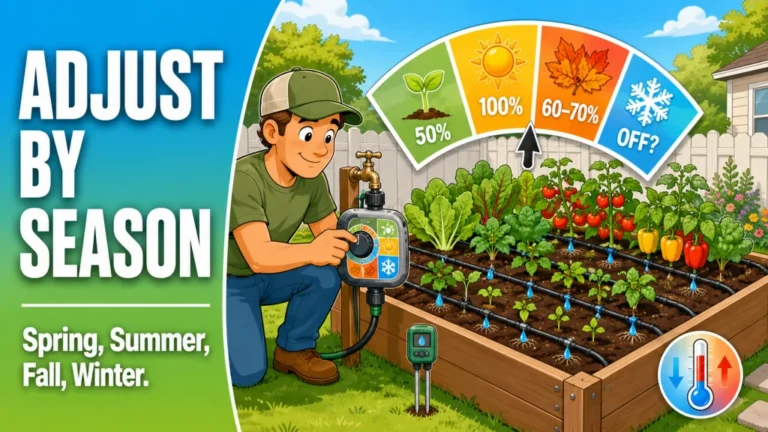
One thing that helps in practice is that raised bed plantings change over the season in ways that naturally move the water demand. Spring lettuce, which sits in the low-demand category at roughly 0.5 to 1 inch per week, typically bolts by late spring or early summer in many gardens. That is usually right around the time tomato transplants are starting to size up and push toward their summer water needs. The schedule that worked for spring lettuce in April needs to increase substantially by July, not because anything went wrong, but because the crop changed.
What I usually suggest is to check the timer settings whenever a significant replanting happens. If you pull the last of the spring lettuce and put in tomatoes in June, that is the right moment to revisit the run time and frequency, not six weeks later when you notice the tomatoes are not sizing up the way they should. The schedule should follow the planting, not stay fixed at whatever setting felt right in April.
The broader framework for structuring a full seasonal raised bed drip irrigation schedule covers how to plan across spring, summer, and fall. The crop-specific adjustments here sit on top of that seasonal structure. Getting the season right first gives you the right baseline to tune from.

This complete kit includes a dual-outlet programmable timer, 65 feet of quarter-inch tubing, 17 feet of 16mm main hose, six-way connectors, and a mix of single and double-outlet drippers with adjustable flow settings for stop, micro drip, or spray. The timer supports two independent watering zones with schedules ranging from every 1 to 7 days or every 1 to 12 hours, and runs on a built-in USB-rechargeable battery. Push-to-connect fittings require no heat or tools to install.
Check On AmazonIf you click this link and buy, we earn a commission at no additional cost to you.
Final Thoughts: Match the Flow to the Crop, Not Just the Timer to the Season
A single drip zone can serve a mixed raised bed reasonably well, but only if the per-plant flow rates reflect what each crop actually needs. Setting the timer and ignoring the emitter output at individual plants is where most mixed-bed watering problems start. Tomatoes and basil are not going to need the same volume in July, and running them on identical emitters at the same schedule will produce predictable results: one end of the bed thrives and the other suffers.
For most setups, adjustable emitters at the lower-demand plants and a timer set for the highest-demand crop covers the situation well enough. For physically separate beds with different crop profiles, a 2-outlet timer is the cleaner fix. Either way, the decision starts with knowing which crops need more and which need less. For a broader look at building out a complete drip irrigation approach for raised beds, the raised bed drip irrigation tips overview is a useful reference point.

This upgraded hose timer features two separate programmable zones, letting you set custom start times and durations for healthier, water-efficient watering. Upgraded valves reduce flow resistance by 40%, and the IP65 waterproof housing has passed 20,000 cycle testing for long-term durability. It offers auto, manual, and rain delay modes with up to 72 hours of rain delay, plus a 2.5 inch LED display showing schedules, power status, and low battery alerts. The 3/4 inch interface fits most standard faucets, and the large button, rotating design makes setup easy for users of any age.
Check On AmazonIf you click this link and buy, we earn a commission at no additional cost to you.
FAQs
🍅 Can tomatoes and herbs share the same drip irrigation zone?
They can, but not on identical emitter flow rates. Tomatoes need significantly more water per week than most herbs at peak summer production. The practical fix is adjustable emitters: reduce the flow at the herb plants while keeping the tomato emitters at full output on the same timer schedule. Without that adjustment, the timer will either overwater the herbs or leave the tomatoes short, depending on what you set it for.
💧 How much water do tomatoes need per week in a raised bed?
At full size during peak summer, tomatoes typically need 1.5 to 2 inches of water per week based on cooperative extension vegetable water use data. In a loose, fast-draining raised bed mix, they may need the higher end of that range more consistently than in denser soil. Sandy mix drains quickly and often benefits from more frequent shorter cycles rather than one long run.
🌿 What drip irrigation schedule do herbs need in a raised bed?
Most culinary herbs fall in the low-demand category, around 0.5 to 1 inch per week in peak season. Basil tolerates more moisture than woody herbs like rosemary or thyme, which prefer to dry out between watering cycles. If herbs are sharing a bed with high-demand vegetables, the most practical fix is to dial down the emitter flow at the herb plants rather than changing the timer schedule for the whole zone.
⏱️ Should lettuce and tomatoes be on the same drip schedule?
In most cases they will not be growing at the same time. Spring lettuce typically bolts around the same time summer tomatoes are transplanted, so the schedule transitions naturally. If there is a short overlap in early summer where both are in the bed, treat it as a temporary situation: keep the timer set for the lower-demand lettuce and supplement the tomatoes by hand until the lettuce is pulled. Once the lettuce is out and tomatoes take over the bed, step the timer up to the full summer schedule. Running the full tomato schedule while lettuce is still in the bed tends to push early bolting.
🔧 What is an adjustable emitter and do I need one for a mixed raised bed?
An adjustable emitter lets you set the flow rate at an individual plant, typically from near zero up to around 2 GPH depending on the model. For a mixed raised bed with crops in different water demand categories, they are the most direct solution on a single zone. You keep one timer schedule and change the output at each plant rather than trying to manage two separate zones for one bed.
🪴 Does a dedicated tomato bed need a different schedule than a dedicated herb bed?
Yes, noticeably so in summer. A bed of tomatoes and peppers will run longer or more frequently than a bed of herbs and garlic at peak season. If those beds are physically separate, a 2-outlet timer is the cleanest solution. Each outlet runs its own schedule tuned to the crop in that bed, and you stop trying to find a middle setting that undersupplies one crop or overwhelms the other.