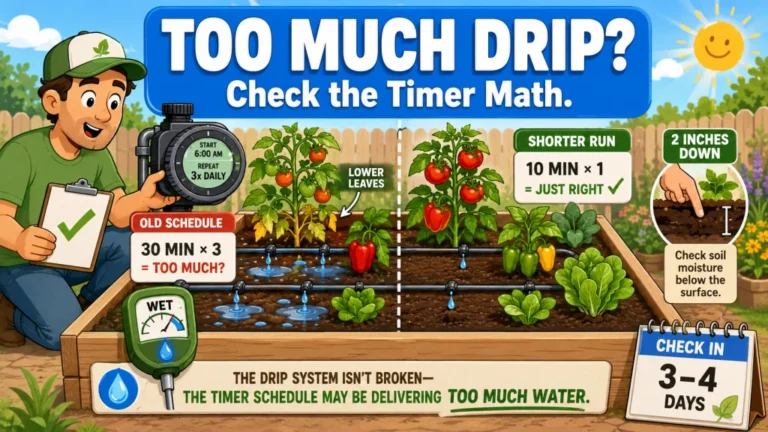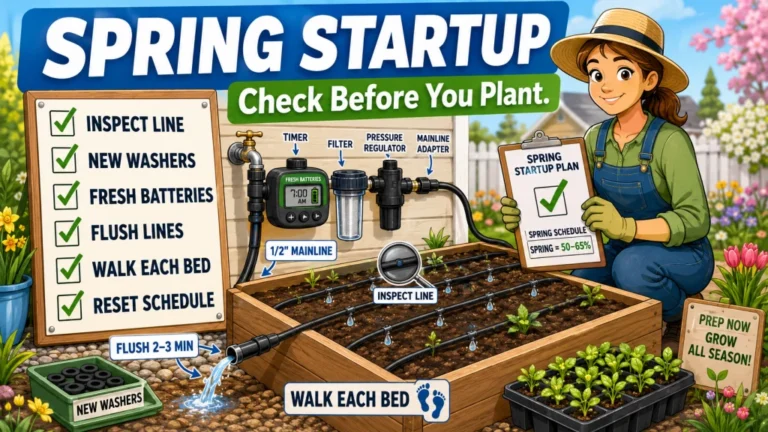
Watering frequency for a raised bed drip system is not a single number. Sandy or perlite-heavy mixes can lose all usable moisture within 18 hours during summer heat, making daily or near-daily sessions necessary. Clay-loam blends hold water for 48 to 72 hours, so the same every-other-day schedule that starves a sandy bed would keep a denser mix too wet. This article explains how to choose between daily, every-other-day, and twice-weekly schedules based on soil type and season, and gives a simple field check to confirm your frequency is actually working.

Why “Every Other Day” Is Not a Real Starting Point
Every-other-day watering shows up in raised bed guides as if it were a rule. I understand the appeal: it sounds moderate, it is easy to program on a timer, and it works often enough that nobody questions it. The problem is that raised bed soil is not uniform, and the same schedule applied across different mixes in different seasons will produce very different results. In some cases the bed dries out between sessions. In others it never fully drains before the next run begins.
Before settling on a frequency, it helps to separate two decisions that most guides bundle together. How long each session runs is a calculation based on emitter flow rate, bed size, and weekly water target. That question is addressed in the guide on how long to run drip irrigation in raised beds. Frequency is a different question entirely: how many times per week should the system run, and what actually determines that number. This article is focused on that decision alone.
Soil Drainage Is the Biggest Variable in Frequency
A sandy or perlite-heavy raised bed mix drains fast. After a 45-minute drip session, the top 6 inches may hold adequate moisture right after the run ends, but in summer heat with strong sun exposure, that moisture can be gone within 18 hours. If the bed is planted with warm-season crops like tomatoes or peppers, the roots are actively pulling water while the soil drains and the sun accelerates surface evaporation. Running every other day means 30 hours or more of dry soil between sessions during the hottest stretch of the season. Most crops will show stress before the next session starts.
Clay-loam blends behave differently enough that they almost require a separate framework. A 45-minute run into a clay-loam bed will hold usable moisture for 48 to 72 hours in mild spring or fall conditions. Watering that bed daily pushes it into a cycle where the root zone never fully drains, displacing oxygen and creating conditions that stress roots and invite fungal problems. The frequency that keeps a sandy bed alive in August would waterlog a clay-loam bed in May.
Field Note: The clearest version of this mistake I see is gardeners who set up frequency in spring using a clay-loam mix and then add perlite or switch beds mid-season without adjusting the schedule. The amended mix starts draining faster, the plants begin showing drought stress, and the gardener blames the emitters or the timer rather than the frequency.
A practical starting framework: sandy or perlite-heavy mix in summer heat needs daily or near-daily short sessions. Clay-loam in spring or fall can work on every-other-day or twice-weekly sessions. The mix type and the current season together set the frequency, not a number carried over from a generic guide.
| Soil Mix Type | Approximate Drainage Rate | Suggested Starting Frequency |
|---|---|---|
| Sandy or high-perlite mix | Moisture gone within 18 to 24 hours in summer | Daily or 5 to 6 sessions per week in peak heat |
| Balanced potting-style mix | Moisture holds 24 to 36 hours | 3 to 4 sessions per week in warm weather |
| Clay-loam or dense blend | Moisture holds 48 to 72 hours in mild weather | 2 to 3 sessions per week in spring and fall |
These ranges are starting points, not fixed rules. Crop type, bed depth, sun exposure, and ambient temperature all shift the numbers. A 4-inch-deep salad green bed in full afternoon sun will dry faster than a 12-inch-deep tomato bed with a heavy canopy, even if the soil mix is identical. Use the table to set an initial schedule, then verify with the probe check described later in this article.
Why Raised Beds Drain Faster Than In-Ground Gardens
One thing that consistently surprises gardeners coming from in-ground plots is how quickly a raised bed empties after a watering session. In-ground soil almost always has a compaction layer below the active root zone, and that layer slows drainage. Water hits the transition between loose topsoil and the compacted layer underneath and slows down, holding moisture longer in the root zone. Raised beds do not have that layer. The mix in a raised bed is loose and uniform all the way to the bottom, and water moves through the profile and out the base without anything slowing it down.
UGA Extension has documented this directly: raised beds require more frequent irrigation than in-ground gardens because of faster drainage. If you transplant watering habits from an in-ground garden into a raised bed setup without adjusting frequency, you will almost certainly underwater the raised beds. The schedule that kept in-ground tomatoes healthy every other day may leave the raised bed root zone dry and stressed between sessions.
Carrying an in-ground every-other-day schedule into a raised bed setup and assuming the same logic applies. The beds look watered. The emitters are running. But the faster drainage means the root zone is drying out faster than the old schedule accounts for.
Treat raised beds as a distinct drainage environment. Start with a higher base frequency than you used in-ground, then verify with a soil probe 12 hours after the last session. Adjust down if the soil is still saturated. Adjust up if it is dry.
The faster drainage is also the reason raised beds are less prone to long-term waterlogging than in-ground clay soil. The risk in a raised bed is more often drying out too fast than staying wet too long, especially in summer. That asymmetry should push frequency decisions toward more sessions rather than fewer in warm weather.

This kit includes everything needed to water a raised bed up to 4 by 8 feet, with professional-grade components built for repeated seasonal use. It features 35 feet of emitter tubing with 70 built-in, pressure-compensating emitters spaced every 6 inches for even watering near the roots, plus 25 feet of easy-to-handle 1/4 inch distribution tubing. This low-volume design can save up to 80% on water while supporting healthier plants and better yields. Installation is straightforward thanks to an illustrated manual covering multiple layout options, and the system can be automated with a compatible Rain Bird hose-end timer sold separately.
Check On AmazonIf you click this link and buy, we earn a commission at no additional cost to you.
Splitting the Weekly Water Target Across Sessions
Once the weekly water target is established (the total run time or gallons the bed needs per week based on emitter flow and bed size), the next decision is how to divide that total across sessions. For most raised bed vegetable gardens, 2 to 3 sessions per week is the standard frequency to start with in spring and fall. In peak summer, that number often needs to move up to 4 to 6 sessions per week depending on the soil type and temperatures.
The reason to spread sessions across the week rather than run one or two long sessions is the way raised bed soil absorbs water. A single long session can temporarily saturate the root zone, pushing out oxygen and stressing roots even if the bed is well-drained. That saturation spike, even a short one, is not ideal for vegetables growing in tight raised bed conditions. Shorter sessions spaced more frequently deliver the same total water with less per-session stress on the soil and root zone.
As a practical example: a bed needing 1 inch of water per week works better split across 3 or 4 shorter sessions than delivered in 1 long weekly run. The total water is identical. The distribution is what changes. The bed stays in a consistently moist range rather than cycling between brief saturation and multi-day drought.
- Spring and fall, balanced mix: 2 to 3 sessions per week, each session covering one-third to one-half of the weekly target
- Summer, balanced mix: 3 to 4 sessions per week as temperatures rise above 85 degrees Fahrenheit
- Summer, sandy or perlite-heavy mix: 5 to 6 sessions per week, or split into morning and early-afternoon daily runs
- Mild weather, clay-loam mix: 2 sessions per week, verify with probe before adding a third
- Seedling or transplant stage: increase frequency temporarily regardless of soil type, keeping the top 2 to 3 inches consistently moist until roots establish
These are starting ranges. The probe check at 12 hours is what confirms whether the current split is holding moisture through to the next session or leaving the bed dry in between.
What Frequency Means for How You Set Up the System
Frequency is not just a number in a timer schedule. It affects how you configure the system before you ever plant the first seedling. If a bed needs 5 or 6 short sessions per week, or split morning and afternoon runs daily, the timer needs enough start-time slots to handle that. Some basic hose-end timers allow only 1 or 2 start times per day. If you discover in July that your sandy bed needs twice-daily watering, a timer with a single daily start time becomes the limiting factor, not the emitters or tubing.
Multiple beds with different soil mixes add another layer to this. A garden with a sandy front bed and a clay-loam back bed cannot share the same zone on the same frequency without one bed getting the wrong schedule. Grouping beds by drainage rate, not just by physical location, is a step that saves a lot of troubleshooting later. A bed that drains in 18 hours and one that drains in 48 hours should not run on the same timer channel at the same frequency.
For gardeners with just one or two beds in mild conditions, a simple 2 to 3 sessions per week setup works fine with a basic timer. The complexity scales with bed count and soil mix variation. Knowing the frequency your soil type actually calls for is what lets you decide, before buying anything, whether a simple single-channel setup will cover your beds or whether you need more flexibility in how start times and zones are organized.

This robust hose-end timer works with sprinklers, drip irrigation, and soaker hoses, offering simple automatic programming with full 7 day scheduling for worry-free watering. An extra-large dial and readout screen make setup and schedule review easy, while one-touch buttons allow quick cancellation, a rain delay of up to 96 hours, or manual watering on demand. The display also shows the next scheduled cycle and time remaining on the current one.
Check On AmazonIf you click this link and buy, we earn a commission at no additional cost to you.
When Daily Watering Makes Sense
For fast-draining raised bed mixes in peak summer heat, daily watering often works better than a 3-session-per-week schedule. The logic is straightforward: if the bed is losing usable moisture in less than 24 hours, spacing sessions 48 hours apart guarantees a dry period the root zone cannot bridge. Moving to daily short sessions keeps the moisture curve flatter without requiring any single session to be long enough to risk temporary saturation.
Two short daily sessions, one in the morning and one in the early afternoon, can be a good fit for beds with sandy or perlite-heavy mix during hot weather. The morning session hydrates the root zone before peak heat. The early-afternoon session replaces what evapotranspiration removed during the hottest hours. The total water delivered per day is lower than a long every-other-day session, but the timing matches how the soil is actually losing water across the day.
The daily approach is not right for every setup. A clay-loam bed in mild spring weather running daily sessions will likely stay too wet between runs, even with short run times. The soil simply does not drain fast enough to reset before the next session starts. I have seen gardeners in zone 6b running 3 short sessions daily on clay-loam mix and wondering why the bed smells musty and the plants look stressed. More frequent is not always better. It is only better when the soil drainage rate actually calls for it.
Pro Tips: If you are unsure whether to go daily or stick to every-other-day, start with every other day and run that schedule for a full week. Check the soil at the 12-hour mark two or three times during that first week. If the probe comes back dry at 4 inches consistently, move to daily. Once a schedule is dialed in, a weekly check is enough to confirm it is still holding.
How to Check Whether Your Frequency Is Working
The most reliable check for watering frequency does not require a meter or a chart. It requires a probe stick or your finger and a consistent timing window. Twelve hours after the last watering session, push a probe or your finger 4 inches into the soil in the center of the bed, away from the emitter lines. The result tells you what the schedule is actually doing at the root zone.
Moist but not muddy at 4 inches means frequency is working. The bed is holding water long enough to bridge to the next session without staying saturated. Dry and powdery at 4 inches means the bed is losing moisture faster than the current schedule replaces it. Either increase frequency by adding one session per week or, if sessions are already long, shorten each session and add an additional run to the weekly schedule. Saturated with a sour or anaerobic smell means frequency is too high and the root zone is not getting the drainage it needs. Pull back to fewer sessions per week and let the bed cycle through a drier phase before resetting.
I recommend checking the 12-hour mark two or three times during the first week after a schedule change, then moving to a weekly check once the pattern is stable. Do not check after every single session indefinitely. Daily readings create noise: one slightly wetter or drier result on a specific day can reflect sun exposure, wind, or crop draw rather than a real frequency problem. A few checks during the adjustment week, followed by a consistent weekly check, gives a clearer picture of whether the schedule is holding.
Key point: Twelve hours post-session is a useful check because it shows whether the bed is drying out too quickly after irrigation. If the soil is already dry at 4 inches at that point, the next session is almost certainly too far away. If it is still moist, keep watching the pattern and confirm again before the next scheduled run.
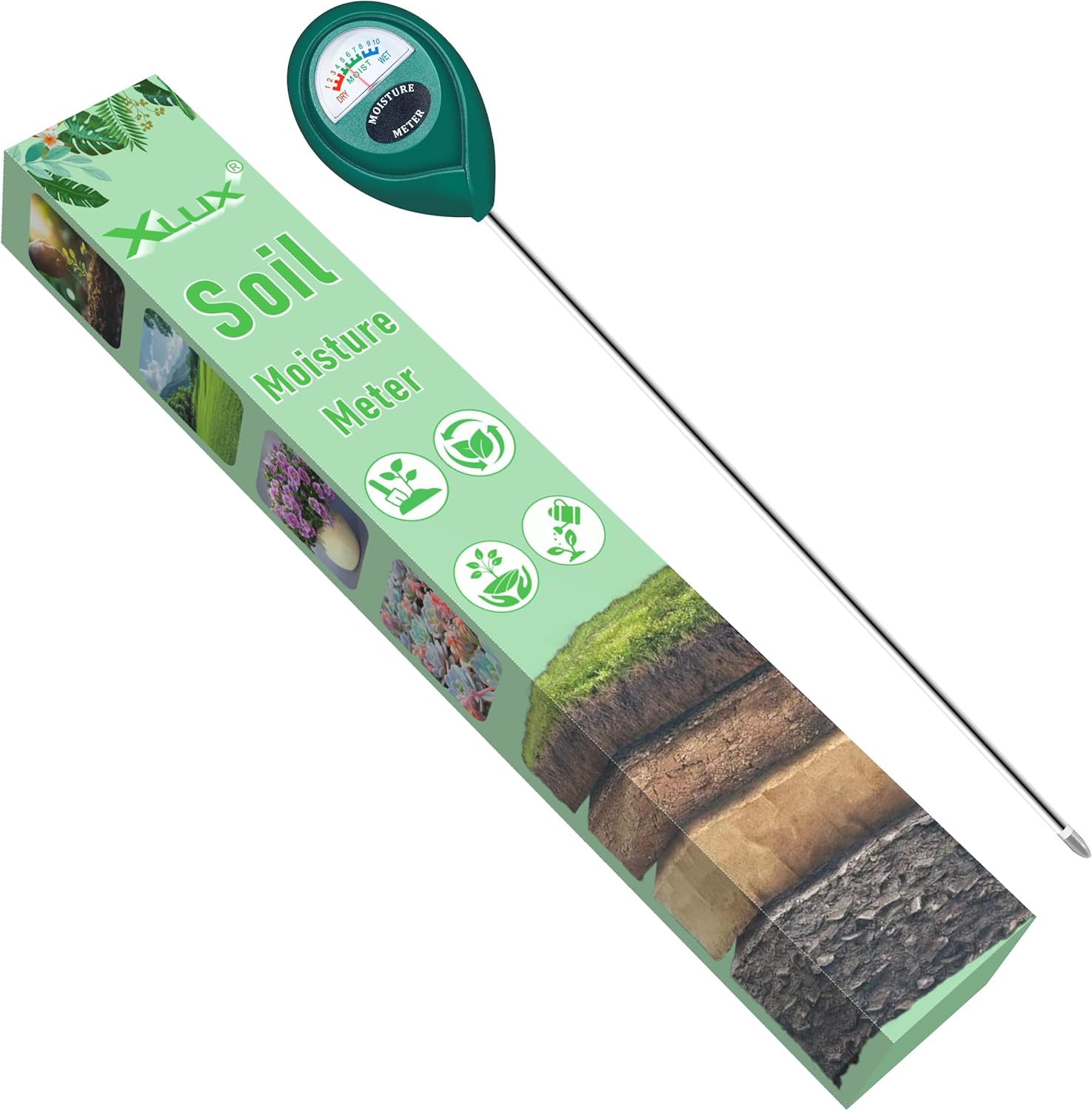
This moisture meter measures soil conditions deep inside pots and gardens with a probe 5.5 inches longer than standard styles, ideal for larger or deeper containers. Simply insert it into the soil for an immediate reading on the large, easy-to-read dial, which shows three zones across ten scales. Its single probe design causes less root disturbance than double or multiple probe meters. For best results, avoid testing hard soil or liquids, and remove the probe within 5 minutes to prevent corrosion of the metal tip.
Check On AmazonIf you click this link and buy, we earn a commission at no additional cost to you.
Final Thoughts: Frequency Is a Setting, Not a Decision You Make Once
The most common frequency mistake I see is setting a schedule in spring and leaving it unchanged through summer. A twice-weekly setup that works in May on a clay-loam bed will underwater the same bed in late July when temperatures are higher, crops are larger, and evapotranspiration rates have climbed. Frequency is a variable that needs to be checked and adjusted at least once per month through the active growing season.
Start with 2 to 3 sessions per week for most beds. Move toward daily or near-daily for sandy mixes in summer heat. Pull back to twice weekly for clay-loam beds in mild weather. The 12-hour probe check after any schedule change is the simplest way to verify whether the current frequency is actually holding moisture through to the next session. No timer setting substitutes for that confirmation.
For the full picture of how frequency fits with seasonal shifts, run time, and timer setup, the raised bed drip irrigation schedule guide covers how those variables work together across the growing year. And for a broader reference on raised bed drip system setup from pressure regulation through layout and maintenance, the raised bed drip irrigation tips guide is the place to start if you are building or troubleshooting a system from scratch.

This all-in-one drip irrigation kit is designed specifically for standard 4 by 8 foot raised beds, with options covering 2 to 10 beds depending on the tier you choose. Everything needed to connect to a standard outdoor faucet or garden hose is included, and all fittings require only hand tightening. The tubing cuts easily with household scissors, and the fully modular design lets you expand or customize the system over time.
Check On AmazonIf you click this link and buy, we earn a commission at no additional cost to you.
FAQs
💧 How often should I run drip irrigation in a raised bed?
Most raised bed vegetable gardens run best on 2 to 3 drip sessions per week in spring and fall, moving to 4 to 6 sessions per week during peak summer heat. The right frequency depends on your soil mix (sandy drains faster than clay-loam), the season, and how hot and dry your conditions are. Do the 12-hour probe check to confirm the schedule is holding moisture between sessions.
🌱 Is watering a raised bed every day too much?
Not always. For sandy or perlite-heavy mixes during summer heat, daily short sessions often outperform less-frequent longer ones. For clay-loam mixes in mild weather, daily watering is likely too much and can leave the root zone too wet. Check soil moisture 12 hours after the last session: if it is still saturated, reduce frequency.
🥵 Should I water my raised bed more often in summer?
Yes, in most cases. Higher temperatures increase evapotranspiration rates, and raised beds drain faster than in-ground gardens to begin with. A schedule that worked in May will often leave the bed too dry by July. Add one or two sessions per week as temperatures climb, and use the probe check to verify the bed is holding moisture through to the next run.
🧱 Why does my raised bed dry out faster than my in-ground garden?
Raised beds do not have the compaction layer that slows drainage in in-ground soil. Water moves freely through the loose mix and exits at the base without anything slowing it down. UGA Extension has documented this specifically: raised beds require more frequent irrigation than in-ground gardens because they drain rapidly. Increase frequency rather than lengthening each session.
🔍 How do I know if my drip frequency is correct?
Push a probe or your finger 4 inches into the soil 12 hours after the last watering session. Moist but not muddy means the frequency is right. Dry and powdery means you need to add sessions. Saturated with an off smell means you are watering too often. Check once per week after any schedule change rather than after every session.
📅 Can I water raised beds just twice a week?
Twice-weekly watering can work for clay-loam or denser mixes in mild spring or fall conditions. In peak summer, especially with sandy mixes, twice a week is usually not enough. The seasonal drip irrigation schedule guide on raised bed drip irrigation schedule by season covers how to shift frequency through the year as conditions change.