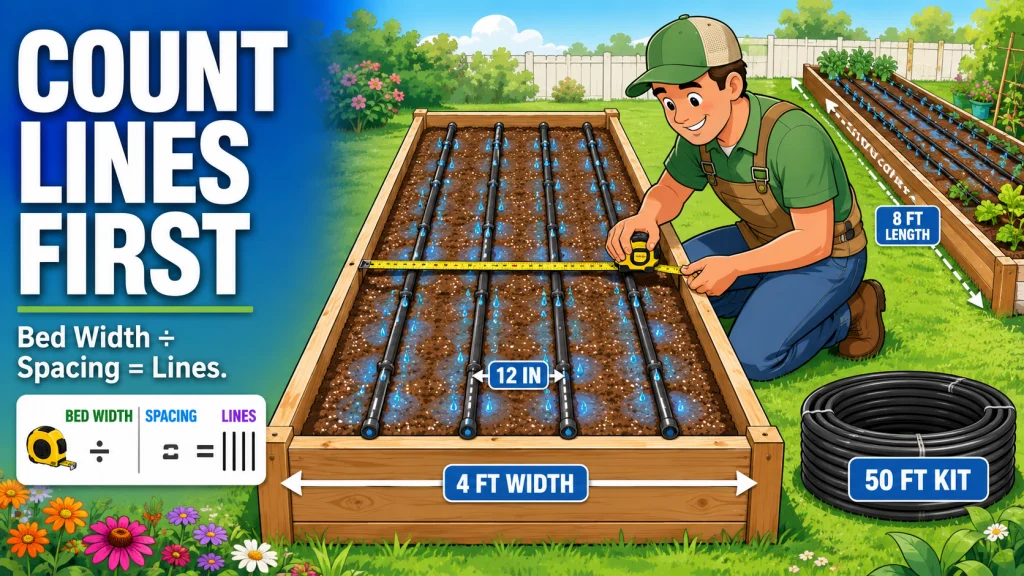
The number of drip lines a raised bed needs comes down to two things: bed width and line spacing. Divide one by the other and you have your answer. For most standard raised beds, that resolves to somewhere between 2 and 6 lines. This article breaks it down by bed size, explains what shifts the number in practice, and shows how line count affects how much dripline a kit actually has to cover before you buy.
The Formula Is Simple. What Changes It Is Not.
Divide your bed width in inches by your target line spacing in inches. The result gives you a starting line count, which you adjust slightly based on where the first and last lines sit relative to the bed edge. A 48-inch wide bed with 12-inch spacing gives 3 to 4 lines depending on edge placement. The same bed at 9-inch spacing gives 5 to 6. The division is the starting point; edge offset settles the final number.
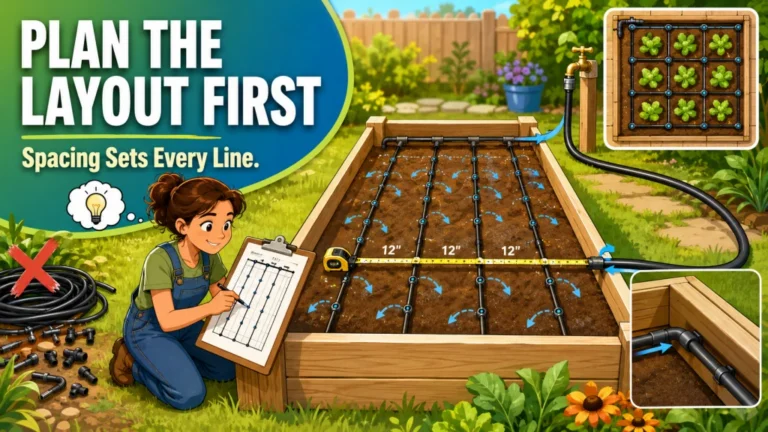
Where most gardeners get stuck is not the math. It is figuring out what line spacing to use in the first place. Spacing is driven by soil type and what you are growing. Sandy or fast-draining mix needs tighter spacing. Clay-influenced or moisture-retentive mix spreads moisture farther laterally and can work with wider spacing. Once you have the spacing figured out, the line count follows automatically. I cover that decision in detail in the drip irrigation line spacing guide for raised beds, but the short version is this: well-amended loam usually works at 12 inches; sandy soil or dense plantings call for 9 inches or closer.
The reason I bring this up first is that most raised bed setups that end up with dry spots started with the wrong spacing assumption, not the wrong line count. Getting the spacing right is what makes the line count useful.
Line Count by Standard Bed Size
Most raised beds in US home gardens fall into three standard widths: 2 feet, 3 feet, and 4 feet. Beds wider than 4 feet are uncommon because you lose the ability to reach the center from the side. Here is how line count breaks down across those widths at the two most common spacings.
| Bed Width | Lines at 12-Inch Spacing | Lines at 9-Inch Spacing | Common Use Case |
|---|---|---|---|
| 2 ft (24 inches) | 2 lines | 3 lines | Lettuce, herbs, spinach, shallow-rooted crops |
| 3 ft (36 inches) | 3 lines | 4 lines | Mixed plantings, medium planting density |
| 4 ft (48 inches) | 3 to 4 lines | 5 to 6 lines | Tomatoes, peppers, dense square foot gardens |
A 2-foot wide bed is narrow enough that 2 lines at 12-inch spacing covers most of the root zone for shallow-rooted crops. In well-amended mix, lateral moisture spread from a drip emitter reaches roughly 6 inches in each direction, so two lines placed toward each long edge cover the width without a gap in the middle. If the soil drains fast or you are packing in dense greens, a third centered line at 9-inch spacing makes sense. It is not complicated, just a function of how wide the wet zone needs to be.
The 3-foot bed sits in the middle. Three lines at 12-inch spacing handles standard mixed plantings in decent soil. Tighten to 4 lines at 9-inch spacing when you are growing densely or the mix runs sandy. The 4-foot bed is where most of the conflicting advice lives, and I will address that specifically in the next section.
One Thing Bed Length Does Not Change
Bed length has no effect on line count. A 4×4 bed and a 4×8 bed both need the same number of parallel lines running across the 4-foot width. What changes with a longer bed is how much total dripline you use per run, not how many lines you lay. This distinction matters when you are calculating how much line a kit can cover, which I get into later in this article.

This kit includes everything needed to water a raised bed up to 4 by 8 feet, with professional-grade components built for repeated seasonal use. It features 35 feet of emitter tubing with 70 built-in, pressure-compensating emitters spaced every 6 inches for even watering near the roots, plus 25 feet of easy-to-handle 1/4 inch distribution tubing. This low-volume design can save up to 80% on water while supporting healthier plants and better yields. Installation is straightforward thanks to an illustrated manual covering multiple layout options, and the system can be automated with a compatible Rain Bird hose-end timer sold separately.
Check On AmazonIf you click this link and buy, we earn a commission at no additional cost to you.
What Shifts the Number in Practice
Line count is not fixed for a given bed size. Three factors move it: soil type, planting density, and whether the bed is unusually narrow. Each one changes the effective spacing you need, which changes how many lines fit across the bed.
- Soil type: Clay-influenced or moisture-retentive mix holds moisture and spreads it laterally more than sandy soil. Good loam can often work with 12-inch spacing, keeping the line count on the lower end. Sandy or fast-draining mix dries out between lines faster, which pushes spacing tighter and adds a line or two.
- Planting density: Square foot gardening packs plants into every inch of bed space and expects even moisture across the whole surface. Dense plantings push spacing to 9 inches or tighter, adding lines. Wide-spaced crops like tomatoes or peppers can often work with fewer lines placed closer to each plant row rather than evenly distributed.
- Narrow beds under 2 feet: A 12-inch wide bed really only needs a single line run down the center. Occasionally a second line helps if the soil drains fast, but one centered line is usually enough. Two lines in a bed that narrow tend to create wet edges and a damp center with no real coverage advantage.
Field Note: The narrow-bed mistake I run into most often is two lines spaced too far apart, leaving a dry strip down the center while both edges stay damp. In a 12-inch wide bed, one line centered on the root zone does the job. Adding a second line just introduces more fittings and more potential leak points without improving coverage.
Soil type and crop type together are what really drive the decision. A 4-foot bed in well-amended loam growing tomatoes does not need the same line count as a 4-foot bed in sandy mix growing densely planted lettuce, even though the bed dimensions are identical. The layout should reflect what is actually happening in the soil, not just what the bed measures.

This ready-to-use kit includes 50 feet of quarter-inch dripline pre-assembled with a three-quarter inch female hose thread adapter, ten galvanized steel stakes, and an end plug, requiring zero assembly before use. Built-in half-gallon-per-hour emitters are spaced every 12 inches along the line, and a turbulent flow design helps flush out sediment to reduce clogging. The system connects to any standard water source in three steps and is fully compatible with other Raindrip components for easy expansion.
Check On AmazonIf you click this link and buy, we earn a commission at no additional cost to you.
Why Different Sources Give Different Numbers for the Same Bed
If you have done any research on drip lines for a 4×8 raised bed, you have probably run into two different answers: 3 lines or 4. DripDepot and Homestead and Chill have both published guidance on 4-foot wide beds and land on different numbers. The reason is not that one of them is wrong. They are recommending for different planting styles and different soil conditions.
DripDepot’s recommendation of 3 lines per 4-foot wide bed is built around square foot gardening in well-amended soil, using 12-inch spacing. In that setup, 3 evenly spaced lines across 48 inches provides solid coverage across the root zone. Homestead and Chill documented 4 lines at 9-inch spacing in their 4×8 beds for densely planted crops. The extra line and tighter spacing address higher planting density and faster soil drainage. Both recommendations are correct for the conditions they were designed for.
This is the part that most line-count answers miss: the right number for a 4×8 bed is not one number. It is one number for a given combination of soil type, planting density, and edge placement. Once those variables are clear, the line count is just arithmetic.
The hidden variable is where the first and last lines sit. Some layouts do not place a dripline right against each bed edge. They run the lines across the active planting zone, leaving a few inches of edge buffer on each side. That is how a 4-foot bed can show 3 lines at 12-inch spacing in one layout and 4 lines in another. The spacing number matters, but so does the edge offset. Neither source is wrong; they are just drawing the lines from different starting points.
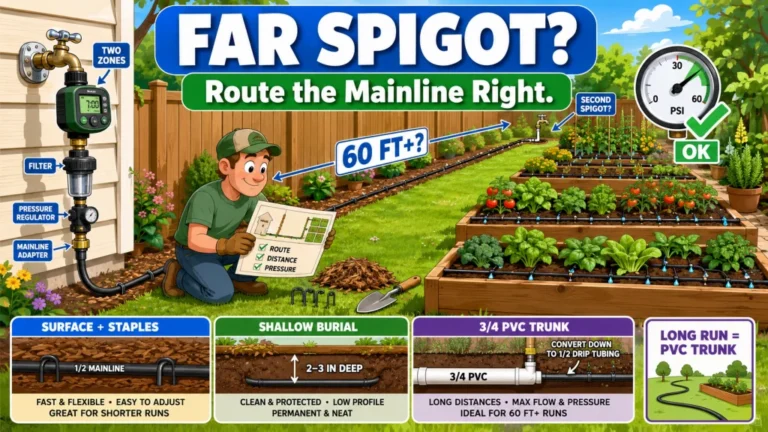
If you want to see how line placement connects to the rest of the drip system from mainline routing to emitter selection, the raised bed drip irrigation layout overview walks through how those decisions fit together before the first fitting goes on.

This 100-foot roll of quarter-inch dripline comes with half-gallon-per-hour emitters pre-installed every 6 inches, eliminating the need to purchase or install separate drippers. The tight emitter spacing makes it well suited for row crops, raised beds, and container gardens, with a maximum recommended run length of 19 feet per line. More durable than drip tape or soaker hose, it can even be buried for subsurface use. The kit includes 5 barbed quarter-inch couplings and 10 goof plugs to get you started.
Check On AmazonIf you click this link and buy, we earn a commission at no additional cost to you.
How Line Count Affects How Much Dripline You Need
Knowing the line count before you buy is not just about getting the layout right. It is about knowing whether you have enough dripline to finish the bed, or whether you will run short partway through the install. A lot of starter kits for raised beds include around 50 feet of dripline. Here is how that gets consumed at different line counts on a single 4×8 bed:
- 4 lines x 8 feet each = 32 feet. Leaves about 18 feet for a second small bed or for running mainline to the bed.
- 5 lines x 8 feet each = 40 feet. Still within one kit, but not much room for anything else.
- 6 lines x 8 feet each = 48 feet. Nearly the entire kit for one bed, with almost nothing left over.
Those numbers change quickly when you add a second bed. Two 4×8 beds at 4 lines each uses 64 feet of dripline total. One 50-foot kit will not cover both. Three beds at the same layout uses 96 feet. Running this math before placing an order takes two minutes and prevents the situation where you are standing in the garden with half a bed left to connect and no line to do it with.
If you are setting up more than two beds or connecting multiple beds to a single timer and mainline, the full process is laid out in the raised bed drip irrigation setup overview, including how to plan the mainline run and size the system for multiple beds without losing pressure at the far end.

This all-in-one drip irrigation kit is designed specifically for standard 4 by 8 foot raised beds, with options covering 2 to 10 beds depending on the tier you choose. Everything needed to connect to a standard outdoor faucet or garden hose is included, and all fittings require only hand tightening. The tubing cuts easily with household scissors, and the fully modular design lets you expand or customize the system over time.
Check On AmazonIf you click this link and buy, we earn a commission at no additional cost to you.
Final Thoughts: Start With Spacing, Then Count the Lines
Line count is the second step, not the first. Settle on the right spacing for your soil and crops, divide the bed width by that spacing, and adjust by one line depending on edge placement. For most 4-foot wide beds in well-amended mix, that puts you at 3 to 4 lines around 12-inch spacing. Tighten to 9 inches if the soil drains fast or the planting is dense.
The one thing I would do before buying any line or kit is run the consumption math. Multiply line count by bed length, account for all the beds you are covering, and check that number against what the kit supplies. It is a short calculation, and it is the difference between having enough line and making a return trip to the hardware store before the season starts.
FAQs
💧 How many drip lines do I need for a 4×8 raised bed?
For many 4-foot wide beds, 3 to 4 parallel lines at about 12-inch spacing is the practical starting range, depending on edge placement and planting density. If the soil drains fast or you are planting densely, 5 to 6 lines at 9-inch spacing gives more even coverage. Bed length does not change the line count, only how much total dripline the run uses.
📐 What is the formula for calculating drip lines per raised bed?
Divide the bed width in inches by the line spacing in inches, then adjust for edge placement. A 48-inch wide bed at about 12-inch spacing usually lands at 3 to 4 lines depending on where the first and last lines sit. A 36-inch wide bed at 12-inch spacing usually lands around 3 lines. Nail down the right spacing for your soil type first, then apply the formula.
🌱 How many drip lines for a 4×4 raised bed?
Same as any 4-foot wide bed: 3 to 4 lines at about 12-inch spacing, or 5 to 6 lines at 9-inch spacing. A 4×4 bed is shorter than a 4×8, so the total dripline consumed per run is half as much, but the number of lines across the width stays the same.
🌿 Does a 2-foot wide raised bed need more than 2 drip lines?
Usually not. Two lines at 12-inch spacing handles most shallow-rooted crops in a 24-inch wide bed. If the soil drains quickly or you are growing dense greens, a third centered line can help. In well-amended mix, two lines is typically enough.
🧱 Does bed length change how many drip lines I need?
No. Line count is determined by bed width, not length. A 4×4 and a 4×12 bed need the same number of parallel lines across the 4-foot width. What changes with a longer bed is the total dripline consumed per run, which affects how much line a kit can cover.
🌊 Why do some sources say 3 lines and others say 4 for the same raised bed?
Because they are recommending for different planting styles and soil conditions. Three lines at 12-inch spacing suits square foot gardening in well-amended loam. Four or more lines at 9-inch spacing fits denser plantings or faster-draining soil. Both numbers are correct for their respective setups.
🛒 How do I calculate how much dripline a raised bed uses?
Multiply the number of lines by the bed length. A 4×8 bed with 4 lines uses 32 feet of dripline. With 6 lines, it uses 48 feet. Run this calculation for every bed you are covering to find out whether one kit is enough or whether you need additional line.
🥬 Should tomatoes and lettuce have different drip line counts in the same bed?
If they are in separate beds, yes, the layouts can and should differ. Lettuce planted densely benefits from tighter spacing and more lines. Tomatoes spaced 18 to 24 inches apart can work with fewer lines placed closer to each plant row. Mixing them in the same bed usually means designing for the denser crop and accepting slightly more line than the tomatoes strictly need.