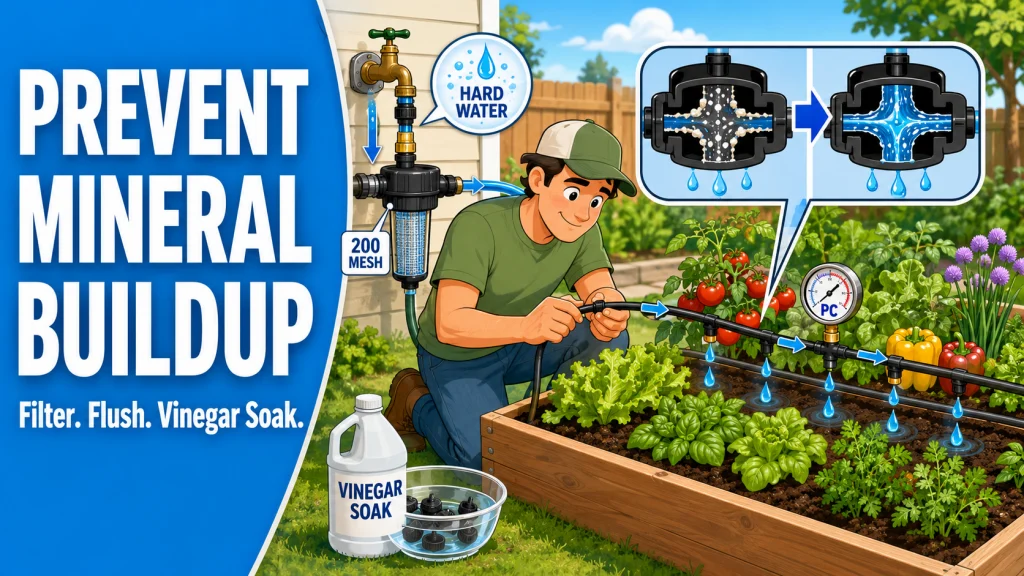
Hard water is the most overlooked reason raised bed drip systems start underperforming after the first or second season. Calcium and magnesium dissolved in the water supply precipitate as scale inside the emitter flow path, and the passage in a standard emitter is narrow enough that even modest buildup changes the output noticeably. This article covers how hard water affects a raised bed drip system, how quickly clogging develops at different hardness levels, which component types resist it better, and the maintenance steps that prevent most mineral-scale problems before they cost you a season of inconsistent watering.
The Second-Season Failure Most Gardeners Misdiagnose
The most common second-season drip failure I see on residential installs is an emitter clogged with calcium scale. The system ran fine the first year. In the second season, sections of the bed stay dry even though the timer is running. The gardener increases run time, the problem improves slightly, and by midsummer the same corners are dry again. The usual assumption is a faulty timer, a kinked line, or a bad emitter. In hard water regions, the real explanation is usually mineral buildup that has been accumulating since the first day the system ran.
This is specifically a mineral-scale problem, not the same as sediment clogging from a dirty water source or root intrusion into older emitter lines. Those are different failure modes with different fixes. What hard water does is chemical: dissolved calcium and magnesium in the supply water precipitate as solid scale deposits when the water slows down and pressure drops inside the emitter passage. Over a season or two, that scale narrows the flow path until the emitter cannot deliver its rated GPH, or stops flowing entirely.
Field Note: I have pulled emitters from second-year installs in Arizona and seen the internal flow path almost completely blocked with white calcium crust. The tubing looked fine, the filter had never been cleaned, and the homeowner had been adjusting the timer for six months trying to fix a watering problem that was actually a chemistry problem. A clean filter and an annual vinegar soak on the emitter line would have prevented all of it.
What Hard Water Actually Does Inside a Drip Emitter
Hard water carries dissolved calcium and magnesium ions that are invisible in the water and cause no obvious problem at the hose bib. The issue is what happens at the emitter. A typical 0.5 GPH emitter moves water through a flow path that is fractions of a millimeter wide, usually a labyrinth channel or a small disc orifice designed to regulate output at a specific pressure. When water slows and pressure drops at that passage, calcium carbonate and magnesium compounds precipitate out of solution and deposit on the flow path walls.
The buildup is gradual. Early in the season the emitter delivers close to its rated flow. By late season in hard water conditions, the flow path is narrower and the output has dropped. By the second season, some emitters in the system are effectively underdelivering while others are still running correctly, which creates the dry-spot-and-wet-spot pattern that looks like a distribution problem rather than a chemistry problem. The fix for a partially clogged emitter and the fix for a misrouted dripline are completely different, so diagnosing the actual cause before adjusting anything is worth the extra ten minutes.
Warning: Do not increase timer run time as the first response to dry spots in an established drip system. If the system ran correctly in its first season and is now inconsistent, check the emitters and the filter before adjusting the schedule. A clogged emitter does not water better with more run time; it waters less and creates overwatering pressure on the emitters that are still flowing freely.
How Fast Clogging Develops: Water Hardness and What to Expect
The speed at which mineral scale builds up depends primarily on the hardness of the water supply, usually measured in milligrams per liter as calcium carbonate (mg/L as CaCO3) or in grains per gallon. Municipal water quality reports publish this number, and most utilities make annual reports available online. If your water supply is above 200 mg/L as CaCO3, mineral-scale clogging in an unfiltered drip system is not a matter of if but when, and in the American Southwest, parts of the Midwest, and many western states, that threshold is commonly exceeded.
| Water Hardness | Regions Commonly Affected | Expected Clogging Timeline Without Filter | Minimum Recommended Response |
|---|---|---|---|
| Below 120 mg/L as CaCO3 (soft) | Pacific Northwest, parts of Southeast | 3 or more seasons before noticeable flow reduction | Basic inline filter, annual flush |
| 120 to 200 mg/L as CaCO3 (moderately hard) | Parts of Midwest, Mid-Atlantic | 2 to 3 seasons without maintenance before flow reduction | 150-mesh filter, flush at end of season, vinegar soak every 2 to 3 seasons |
| Above 200 mg/L as CaCO3 (hard) | Southwest (AZ, NV, CA inland), parts of TX, CO, UT | Within one growing season without a filter | 200-mesh filter, self-flushing emitter dripline, annual vinegar soak |
The table above uses hardness thresholds that appear in extension service guidance on drip system maintenance. The timelines are based on typical residential drip system runs in those hardness ranges, not guaranteed failure points. A system that runs 30 minutes daily will accumulate scale faster than one running 20 minutes every two days at the same water hardness, because total water volume through the emitters drives mineral deposition. The harder the water and the longer the seasonal run time, the faster the clog cycle runs.
The Filter: First and Non-Negotiable Defense
An inline filter at the hose bib connection is the single most important component in a hard water drip setup, and it is also the most commonly skipped. Most quality raised bed drip kits include one, but confirming it is actually present before buying any kit is worth doing. A kit without a filter is not a good hard water choice, regardless of what the packaging says about compatibility.
For hard water conditions, the filter mesh matters. A 150-mesh filter catches particles 100 microns and larger, which handles most suspended sediment but allows dissolved minerals to pass through freely. The dissolved minerals still precipitate inside the emitter; the filter delays clogging from sediment but does not address mineral scale. A 200-mesh filter is finer and catches more suspended material, but neither mesh size prevents the chemical precipitation that causes mineral scale. The filter’s role in a hard water system is to remove suspended particles that would otherwise compound the clogging problem on top of the mineral buildup. It handles one problem, not both.
Check the filter at the start and end of each season. A filter that is partially clogged reduces system pressure, which changes the flow rate at every emitter on the line. In hard water setups, I usually find the filter needs cleaning at least once mid-season in the first few years until the gardener gets a sense of how fast their specific water supply loads the screen.

This kit includes everything needed to water a raised bed up to 4 by 8 feet, with professional-grade components built for repeated seasonal use. It features 35 feet of emitter tubing with 70 built-in, pressure-compensating emitters spaced every 6 inches for even watering near the roots, plus 25 feet of easy-to-handle 1/4 inch distribution tubing. This low-volume design can save up to 80% on water while supporting healthier plants and better yields. Installation is straightforward thanks to an illustrated manual covering multiple layout options, and the system can be automated with a compatible Rain Bird hose-end timer sold separately.
Check On AmazonIf you click this link and buy, we earn a commission at no additional cost to you.
Emitter Type: Why Self-Flushing Diaphragms Matter in Hard Water
Not all emitters respond to hard water the same way. Simple orifice emitters, which are a fixed opening with no moving internal parts, rely entirely on the narrowness of the flow path to regulate output. That narrow path is also where mineral scale deposits most readily. Once scale narrows the orifice, the emitter underdelivers, and the only fix is cleaning or replacement.
Pressure-compensating emitters with self-flushing diaphragms work differently. When pressure drops at shutdown, the flexible diaphragm inside the emitter opens briefly and allows a small backflush of water through the flow path. That flushing action dislodges early-stage mineral deposits before they harden into fixed scale. It does not eliminate the chemistry problem, but it significantly slows the clogging cycle compared to a simple orifice emitter in the same water conditions.
In hard water regions, self-flushing emitter dripline is worth the premium over standard emitter line. The difference in cost per foot is modest; the difference in maintenance frequency and emitter replacement rate over four or five seasons is not. If you are buying a kit for a raised bed in Arizona, Nevada, or inland California, the emitter type specification on the packaging is worth checking before price becomes the deciding factor. The article on drip emitter line for raised beds covers emitter types, spacing, and flow rate specs in more detail if you are still working through the component decision.

This combination unit pairs a 200 mesh, 75 micron stainless steel filter with a 30 PSI pressure regulator in a single piece, reducing the number of parts needed and speeding up installation. It protects downstream drip components from clogging and works with all types and brands of 3/4 inch irrigation valves. The cap unthreads easily for quick cleaning, and the glass-filled polypropylene body and 3/4 inch male pipe threads are rated for 150 psi, ensuring long-lasting, reliable performance.
Check On AmazonIf you click this link and buy, we earn a commission at no additional cost to you.
Which System Types Hold Up Best in Hard Water
The system type you choose before installation has a meaningful effect on how quickly hard water clogging becomes a problem. Not all raised bed drip components are equally vulnerable, and understanding the difference can save a second or third season of troubleshooting.
Soaker hose performs worst in hard water. The pores that release water are distributed along the full length of the hose and are small enough that mineral deposits block them relatively quickly. Once a section of soaker hose is clogged with scale, the affected area cannot be cleaned the same way an emitter can. The hose either gets replaced or that section stops contributing to bed coverage. In moderately hard water, soaker hose degradation from mineral buildup shows up within two seasons. In hard water regions, often within one.
Drip tape is more resistant than soaker hose but more vulnerable than quality emitter dripline with self-flushing emitters. Drip tape emitters are pre-installed at fixed intervals with a relatively simple internal structure, which makes them susceptible to mineral accumulation without a self-flushing mechanism. In hard water conditions, drip tape used without regular vinegar maintenance can reach its practical replacement point faster than many home gardeners expect. For a direct comparison of how soaker hose and drip tape perform across different raised bed conditions, the article on drip tape vs soaker hose for raised beds covers those tradeoffs in more detail.
Quality emitter dripline with pressure-compensating, self-flushing emitters holds up best among the three. It is not immune to hard water, but the combination of self-flushing action, thicker tubing wall, and a filter upstream gives it the longest reliable service life in high-mineral-content water. For hard water installs, this is the system type to start with rather than upgrade to after two seasons of clogging problems.
Installing soaker hose or basic drip tape in a hard water region, then increasing timer run time season by season as flow drops, attributing dry spots to weather or soil changes rather than mineral clogging.
Starting with emitter dripline with self-flushing PC emitters, a 200-mesh filter at the spigot, and a vinegar maintenance routine. The system costs slightly more upfront and runs reliably for multiple seasons without a mid-season clogging diagnosis.

This drip tubing works like a soaker hose but without the clogging or maintenance, thanks to pressure-compensating emitters that water evenly from one end of the line to the other. Built-in 0.8 gallon per hour emitters are spaced 12 inches apart with dual outlets positioned 180 degrees apart for even coverage. The tubing measures 0.25 inches outside diameter and connects with 1/4 inch barbed fittings, operating across a wide pressure range of 8.5 to 60 psi. Its micro-porous construction creates a tight, reliable connection that holds up over time.
Check On AmazonIf you click this link and buy, we earn a commission at no additional cost to you.
The Maintenance Routine That Prevents Most Hard Water Problems
Hard water drip system maintenance has two levels: what you do at the end of every season, and what you do every two to three seasons for deeper mineral removal. Neither is complicated, but skipping the annual steps is what turns a manageable maintenance issue into a full emitter replacement in year three.
At the end of each growing season, flush the mainline before closing the system. Open the end caps on each drip line and run the system for a few minutes to push any accumulated sediment and loose mineral deposits out of the tubing. This step removes the material that the filter did not catch and that settled in the line during the season. Clean the inline filter screen at the same time. In hard water regions, this end-of-season flush is not optional; it is the step that sets up the following season for reliable performance.
Every two to three seasons, or sooner if you notice flow reduction before the expected window, a white vinegar soak dissolves calcium carbonate deposits that the flush cannot remove. Disconnect the drip lines from the mainline, cap one end, fill the lines with undiluted white vinegar, and let them soak for several hours. The acetic acid in vinegar reacts with calcium carbonate scale and dissolves it without damaging the polyethylene tubing or emitter components. Flush with clean water after the soak before reconnecting. In hard water regions above 200 mg/L as CaCO3, an annual vinegar soak is a reasonable baseline; every two seasons is the minimum for moderately hard water.
- Start of season: inspect and clean the inline filter screen; check emitter output on each line before planting.
- Mid-season: check the filter screen if pressure seems low; look for dry spots that indicate blocked emitters, not a timer issue.
- End of season: open end caps and flush all drip lines; clean the filter; store lines indoors if possible to reduce UV and temperature cycling.
- Every 2 to 3 seasons: white vinegar soak on drip lines; inspect emitters for visible scale; replace individual emitters that cannot be restored by soaking.
The vinegar soak is the step most gardeners skip because it is not in most kit instruction sheets. It is also the step that extends emitter dripline life by two or three seasons in hard water conditions and prevents the frustrating mid-season performance drop that sends most gardeners to the hardware store for a new kit.

This inline filter protects downstream drip components from debris using a pre-installed 200 mesh stainless steel filter element rated to catch particles as small as 75 microns. The glass-filled polypropylene body handles up to 150 psi and fits any standard three-quarter inch irrigation valve via male pipe thread connections on both ends. The cap unthreads quickly for easy filter cleaning without tools.
Check On AmazonIf you click this link and buy, we earn a commission at no additional cost to you.
Final Thoughts: Know Your Water Before You Choose a System
Hard water does not make drip irrigation impractical for raised beds. It makes the system choice and the maintenance routine more specific. A gardener in a soft water region can install a basic kit with a standard filter and run it for several seasons without thinking much about mineral scale. A gardener in Phoenix or Las Vegas is working with water chemistry that will clog a simple orifice emitter within one season if there is no filter and no maintenance plan.
Check your local water hardness before buying a kit. If it is above 120 mg/L as CaCO3, plan for a filter and an end-of-season flush as minimum annual maintenance. Above 200 mg/L as CaCO3, self-flushing PC emitters and a vinegar soak every season are the difference between a system that lasts and one that degrades quietly until the bed stops watering correctly. The upfront cost difference between a basic kit and a hard water setup is small compared to the cost of diagnosing and replacing a clogged system in year two. For a broader look at how all the raised bed drip options compare, the best raised bed drip irrigation kit overview covers the full range and what to look for before buying.
FAQs
💧 Does hard water clog drip irrigation emitters in raised beds?
Yes. Calcium and magnesium dissolved in hard water precipitate as scale inside the emitter flow path during normal operation. The passage in a standard emitter is fractions of a millimeter wide, so even modest scale buildup reduces flow noticeably. In regions above 200 mg/L as CaCO3, flow reduction from mineral scale can appear within one growing season without a filter and a maintenance routine.
🔍 How do I know if my water is hard enough to cause drip emitter clogging?
Check your municipal water utility’s annual water quality report, which is usually available on the utility’s website. Look for hardness in milligrams per liter as calcium carbonate (mg/L as CaCO3) or in grains per gallon. Above 120 mg/L as CaCO3, some mineral maintenance is advisable. Above 200 mg/L as CaCO3, a filter and self-flushing emitters are worth the investment before the first season, not after the second.
🌱 What type of drip system holds up best in hard water?
Emitter dripline with pressure-compensating, self-flushing emitters performs best in hard water among the common raised bed options. The self-flushing diaphragm dislodges early-stage mineral deposits at each shutdown cycle, which slows the clogging process significantly compared to simple orifice emitters. Soaker hose and basic drip tape are more vulnerable to hard water mineral buildup and require more frequent replacement in high-hardness regions.
🧼 How do I clean hard water mineral buildup from drip emitters?
A white vinegar soak is the standard approach. Disconnect the drip lines from the mainline, cap one end, fill the lines with undiluted white vinegar, and let them soak for several hours. The acetic acid dissolves calcium carbonate scale without damaging polyethylene tubing or emitter components. Flush thoroughly with clean water before reconnecting. Emitters with severe blockage that do not respond to soaking should be replaced individually instead of replacing the full line.
📅 How often should I maintain my drip system if I have hard water?
At minimum: clean the inline filter and flush the drip lines at the end of every season. In moderately hard water (120 to 200 mg/L as CaCO3), add a vinegar soak every two to three seasons. In hard water above 200 mg/L as CaCO3, plan for an annual vinegar soak and inspect emitter output at the start of each new season before planting. Skipping the end-of-season flush is what turns a manageable mineral issue into a full emitter replacement problem.
⚠️ Will a drip irrigation filter prevent hard water clogging?
A filter removes suspended particles before they reach the emitters, which reduces sediment clogging and slows overall emitter degradation. It does not prevent mineral scale from dissolved calcium and magnesium, since those pass through any mesh filter in solution and precipitate inside the emitter passage after the water slows down. A filter is necessary but not sufficient for hard water conditions; it works best as part of a routine that also includes periodic flushing and vinegar maintenance.