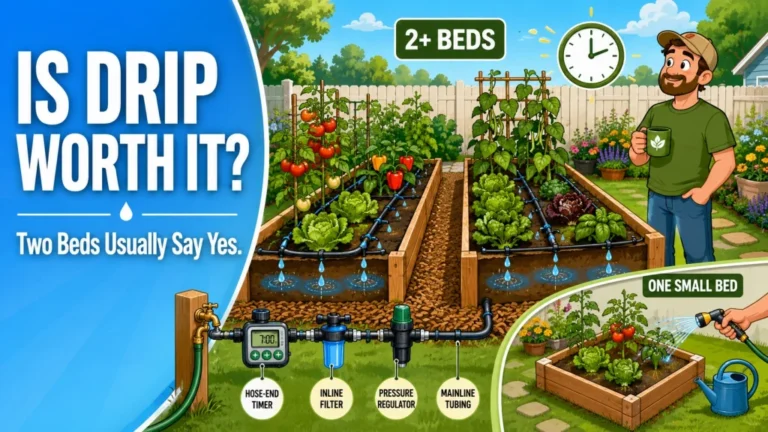
Bootstrap Farmer is not the brand most raised bed gardeners find first. It shows up in recommendations when someone asks what professional growers and experienced gardeners actually use, and the answer keeps coming back the same. This review covers what the Bootstrap Farmer raised bed drip irrigation kit includes, where its agricultural-grade construction makes a real difference, and where a standard retail kit is still the more practical choice. The decision mostly comes down to how long you plan to run the system and whether you have had retail kit fittings fail on you before.
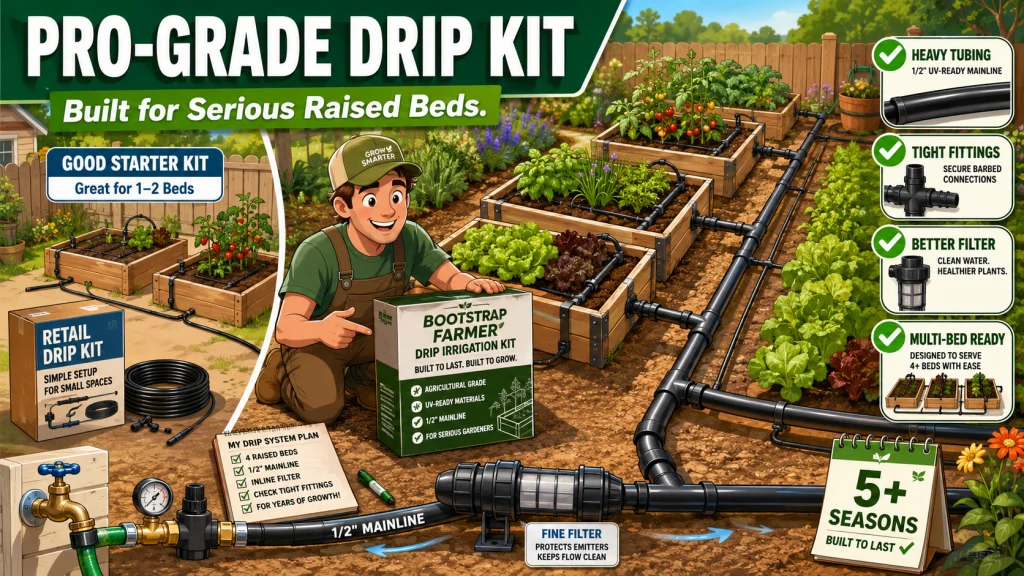
Not on the Shelf at Home Depot, but in Every Serious Recommendation Thread
Bootstrap Farmer does not sell through big-box retailers. You will not find the brand in the drip irrigation aisle next to DIG and Rain Bird. What you will find is the name showing up repeatedly in raised bed gardening forums and community threads whenever someone asks which drip kit actually holds up over multiple seasons. That kind of word-of-mouth from experienced gardeners is worth paying attention to, because it usually comes from people who have already burned through a retail kit or two and started asking harder questions about materials.
The brand started as a direct-to-consumer supplier for small farms and market gardeners, which explains a lot about what makes it different. Their original customer was someone running multiple beds in a production context, not a home gardener picking a kit off a peg hook. That origin shapes the tubing wall thickness, the fitting tolerances, the filter spec, and the way the kit is assembled. Those differences are what the raised bed gardening community keeps pointing back to when Bootstrap Farmer comes up.
What Bootstrap Farmer Is and Where It Comes From
Bootstrap Farmer is a direct-to-consumer irrigation and growing supply company built around serving small farms and market garden operations. Their raised bed drip kit uses agricultural-grade polyethylene tubing and fittings that meet the same specification standards as commercial drip systems, not the thinner-wall materials found in retail kits sized for a casual backyard install. That distinction sounds minor until you hold both products in your hands. The difference in tubing stiffness and fitting fit is obvious.
The company sells primarily through their own website and Amazon, which keeps pricing competitive without a retailer markup. They also sell individual components separately, which matters if you want to expand the system to more beds later or replace a specific fitting without buying an entirely new kit. That kind of component availability is something standard retail kits almost never offer, and it is one of the practical advantages that shows up over a long-running install.
What the Kit Includes
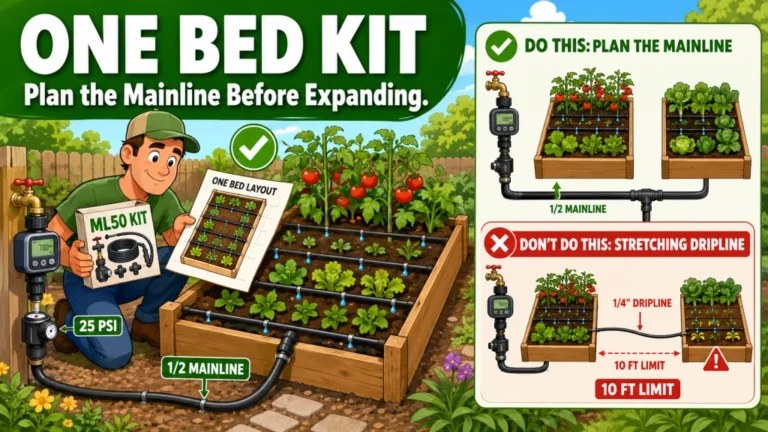
The Bootstrap Farmer raised bed drip kit is built around 1/2-inch mainline tubing, 1/4-inch emitter dripline, a pressure regulator, a filter, and the fittings needed to connect multiple 4×8 beds from a single hose bib. The layout concept is similar to what you get with a retail kit, but the components are built to a heavier spec across the board. That starts with the tubing and carries through to the filter.
The mainline tubing wall thickness is the most immediate difference. Retail kit mainline is thinner, which is workable for the first season or two, especially if the line runs under mulch or is pulled and stored each winter. Bootstrap Farmer’s tubing is heavier-walled and formulated for direct UV exposure, meaning it holds up on runs that stay exposed across a raised bed frame in full sun without the surface cracking that shows up in retail tubing after a couple of seasons.
- 1/2-inch mainline tubing: Agricultural-grade polyethylene with heavier wall thickness than retail kit equivalents
- 1/4-inch emitter dripline: Pre-installed emitters designed for raised bed row spacing, paired with the mainline
- Pressure regulator: Included and matched to the system’s flow requirements, not an afterthought add-on
- Filter: Stronger filtration focus than typical budget kit filters, aimed at sediment and particulate issues
- Fittings: Tighter tolerances than big-box retail connectors, reducing seep-at-connection failures in the first and subsequent seasons
| Component | Spec |
|---|---|
| Mainline tubing | 50 ft of 1/2-inch polyethylene |
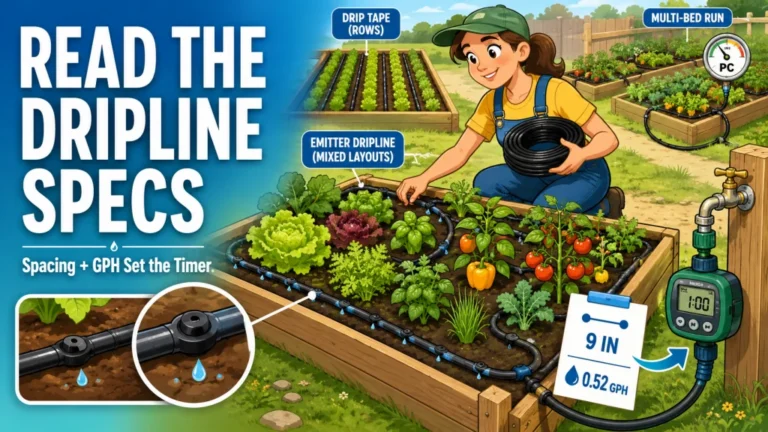
| Emitter dripline | 50 ft of 1/4-inch line, emitters every 9 inches |
| Pressure regulator | 25 PSI |
| Coverage | Up to 150 sq ft |
| Best matched to | Multi-bed setups or long-term raised bed installs |
The filter is worth calling out on its own. Most retail kit filters are adequate for clean municipal water but fall short when water carries fine sediment, mineral deposits, or particulate from a tank or shallow well. Bootstrap Farmer positions its filter as a stronger filtration setup than what standard budget kits include, aimed directly at the emitter clogging that raised bed gardeners with problem water deal with regularly. For gardeners with clean city water and no history of emitter clogging, the difference matters less. For everyone else, getting a stronger filtration setup from the start addresses the right problem before it shows up.
Field Note: The fitting tolerance difference is something I notice most at end-of-season teardown and spring reinstall. Retail kit barbed fittings often loosen after one winter cycle, especially if the line was left partially pressurized or pulled repeatedly during the growing season. Bootstrap Farmer fittings hold tighter over multiple seasonal cycles of removal and reinstall, which matters when you are pulling and storing lines before a freeze and reconnecting them in spring without having to re-seat every connection.

This multi-function kit connects 1/2 inch drip tubing to any 3/4 inch male threaded faucet or garden hose, helping ensure your drip irrigation system runs properly. It includes a backflow preventer, a 25 PSI pressure regulator, and a 150 mesh filter, along with a compression fitting that creates a leak-proof seal to 1/2 inch tubing. Built from UV and chemical-resistant materials for long-lasting durability, the kit can also be paired with a compatible Rain Bird hose-end timer for automated watering.
Check On AmazonIf you click this link and buy, we earn a commission at no additional cost to you.
Where Bootstrap Farmer Has a Real Edge Over Retail Kits
There are three areas where Bootstrap Farmer consistently outperforms standard retail options: UV durability on exposed runs, fitting reliability over multiple seasons, and filtration for problem water. Each one maps to a failure pattern that shows up regularly in retail kit installs once the system has been running for a season or two.
UV Durability on Exposed Lines
Retail kit mainline tubing handles UV exposure reasonably well in the first season and often into the second. By year three on a line running exposed along the top of a raised bed frame with no mulch cover, retail tubing starts showing surface cracking and the material becomes brittle at connection points under temperature swings. Bootstrap Farmer’s tubing formulation was designed for open-field agricultural use where exposed runs are the norm. For a raised bed gardener running lines along the outside of a bed frame rather than burying them under mulch, this is a meaningful difference in how long the system holds up before needing tubing replacement.
Fitting Tolerances and Connection Reliability
The most common first-season complaint with retail kit installs is a slow seep at a barbed fitting connection. Not a full leak, just a drip that develops where the emitter line meets the mainline or where an end cap seats against the tubing. Retail kits use barbed fittings with tolerances that work when the tubing is new and pliable, but those same fittings loosen as the tubing ages or after the connection is disturbed during weeding or plant work. In a 4×8 tomato bed where you are working around the plants regularly, that disturbance adds up. Bootstrap Farmer’s tighter fitting tolerances reduce those seep-at-connection failures from the start and hold better over repeated seasonal removal and reinstall cycles.
Filtration for Problem Water Supplies
If you are on a well, draw from a tank, or have noticed mineral buildup or sediment collecting in your emitters, the filter spec matters more than kit marketing usually makes clear. Bootstrap Farmer’s filter is positioned for stronger filtration than what standard budget kits include, which gives you better protection when fine sediment slips through a lighter screen and into the emitter lines. I have seen retail kit installs where the emitters were running clean for the first season and starting to clog in year two because the filter was letting fine particulate through. Getting better filtration up front is the easier fix.

This inline filter protects downstream drip components from debris using a pre-installed 200 mesh stainless steel filter element rated to catch particles as small as 75 microns. The glass-filled polypropylene body handles up to 150 psi and fits any standard three-quarter inch irrigation valve via male pipe thread connections on both ends. The cap unthreads quickly for easy filter cleaning without tools.
Check On AmazonIf you click this link and buy, we earn a commission at no additional cost to you.
Where Standard Retail Kits Still Hold Up
The DIG ML50 and Rain Bird GARDENKIT both retail for roughly 40 to 45 dollars at Home Depot and perform reliably for two to three seasons with basic maintenance. That is not a consolation prize. For a gardener running one or two raised beds and trying drip irrigation for the first time, a retail kit is the right starting point. The price is low enough that a failed fitting or a clogged emitter in year two is a learning experience, not a significant loss. Bootstrap Farmer is the right next step for someone who already knows the system works and wants to build something that holds up for five or more seasons.
The retail case is also stronger when the install is short-term or seasonal. If you are setting up drip irrigation to handle watering during a vacation, or you are in a rental and do not want to commit to a permanent-feeling system, the difference between a retail kit and Bootstrap Farmer does not pay off in any practical timeframe. I have set up retail kits in exactly that situation and they did exactly what was needed.
| Factor | Bootstrap Farmer | DIG ML50 / Rain Bird GARDENKIT |
|---|---|---|
| Tubing wall thickness | Agricultural-grade, noticeably heavier | Standard retail wall, adequate for 2 to 3 seasons |
| UV longevity (exposed line) | Holds up without mulch cover | Surface cracking on exposed runs after year 2 to 3 |
| Fitting tolerances | Tighter, fewer seep-at-connection failures | Functional but looser, more first-season seepage common |
| Filtration setup | Stronger filtration focus for problem water | Adequate for clean municipal supply |
| Approximate price | Higher (direct or Amazon) | 40 to 45 dollars at Home Depot |
| Available in retail stores | No | Yes |
| Best fit | Five-plus-year install, 4 or more beds, problem water | First install, 1 to 2 beds, seasonal or short-term use |
The comparison above reflects the decision most raised bed gardeners actually face. Both kit types work. The question is which one matches the investment timeline you are planning around. If you want to see how these kits stack up across a wider range of bed counts and setup types, the raised bed drip irrigation kit comparison by setup size covers that in more detail. If you want a closer look at the retail alternative before deciding, the DIG ML50 raised bed drip kit review covers what that option delivers at the 40-dollar price point.

This kit is custom designed for uniform watering in 8 by 5 foot raised vegetable and garden beds, with everything needed for setup included. It comes with up to six 1/4 inch driplines, each up to 8 feet long, delivering water directly to plant roots to minimize evaporation and ensure even coverage. No additional tools or expertise are required for installation, and the system is easily expandable as your garden grows. High-quality components are built for long-lasting, reliable performance season after season.
Check On AmazonIf you click this link and buy, we earn a commission at no additional cost to you.
Who Bootstrap Farmer Is Right For, and Who Should Start Elsewhere
The Bootstrap Farmer raised bed drip kit makes the clearest sense for gardeners planning a five-or-more-year drip installation, running four or more raised beds from a single supply line, or dealing with water quality issues that have caused repeat emitter clogging on retail kits. It also makes sense for gardeners who have already run a retail kit through two or three seasons and experienced the fitting seepage or UV surface cracking that shows up at that stage. The premium is real, and so is the difference in longevity.
If you are putting in drip irrigation for the first time with one or two raised beds and clean municipal water, a retail kit gets you into the system at a lower upfront cost. You will learn how the layout works, how the pressure regulator and filter interact, and what emitter spacing makes sense for your crops. That knowledge makes the step up to a higher-quality system more deliberate when the time comes. Bootstrap Farmer is not designed to convince someone to try drip irrigation for the first time. It is designed for a gardener who already knows drip irrigation works for their setup and wants to build something that does not need significant repair or replacement in year three. If you are still working through which type of raised bed drip kit fits your bed count and water source from the beginning, the best drip irrigation kits for raised beds covers the full range across kit types and price points.
Key point: Bootstrap Farmer earns its premium for five-or-more-season installs, four or more beds, or problem water that has already clogged retail kit emitters. For a first install with one or two beds and clean municipal supply, a retail kit is the more practical starting point.

This kit includes everything needed to water a raised bed up to 4 by 8 feet, with professional-grade components built for repeated seasonal use. It features 35 feet of emitter tubing with 70 built-in, pressure-compensating emitters spaced every 6 inches for even watering near the roots, plus 25 feet of easy-to-handle 1/4 inch distribution tubing. This low-volume design can save up to 80% on water while supporting healthier plants and better yields. Installation is straightforward thanks to an illustrated manual covering multiple layout options, and the system can be automated with a compatible Rain Bird hose-end timer sold separately.
Check On AmazonIf you click this link and buy, we earn a commission at no additional cost to you.
Final Thoughts: The Right Kit Depends on How Long You Are Planning to Run It
Bootstrap Farmer earned its reputation in raised bed gardening communities for the same reason it earned its reputation with small farm operators: the materials hold up where lighter-spec kit materials do not. The heavier tubing wall, tighter fitting tolerances, and stronger filtration are real differences, not marketing language. They show up in year two and year three, at exactly the point when gardeners start asking why the system that looked fine in season one is now dripping at every other connection.
The right call depends on what you are building. Four or more beds with a five-or-more-year timeline makes Bootstrap Farmer the straightforward choice. One or two beds with a first-time install and clean city water makes a standard kit the more sensible starting point. Step up when the scale makes it the obvious move.
FAQs
🌱 Is Bootstrap Farmer drip irrigation actually better than DIG or Rain Bird for raised beds?
Better depends on your setup and timeline. Bootstrap Farmer uses heavier tubing and tighter fittings that outlast retail kits in UV-exposed installs over five or more seasons. For a first install with one or two beds and clean municipal water, DIG and Rain Bird are reliable and cost significantly less. The Bootstrap Farmer advantage shows up most in multi-bed installs planned to run long-term.
💧 Does the Bootstrap Farmer kit include a pressure regulator and filter?
Yes, both are included. The filter is built for stronger filtration than what comes with standard budget kits, which matters if your water supply carries fine sediment or mineral particulate that causes emitter clogging over time. The pressure regulator runs at 25 PSI and is matched to the system rather than being a generic afterthought.
🔩 Why do barbed fittings leak on retail drip kits more than on Bootstrap Farmer?
Retail kit barbed fittings pair with thinner-wall tubing and carry slightly looser tolerances from the start. The connection loosens over time, especially after seasonal removal and reinstall cycles or after being bumped during garden work. Bootstrap Farmer’s fitting tolerances are tighter, and the heavier-wall tubing holds the barb more consistently over multiple seasons.
☀️ Can Bootstrap Farmer tubing run exposed without mulch cover?
It handles UV exposure noticeably better than retail kit tubing. The formulation was developed for open-field agricultural use where exposed runs are normal practice. Retail kit tubing tends to show surface cracking on exposed lines after two to three seasons. Bootstrap Farmer tubing holds up considerably longer under the same direct sun conditions.
🧪 Should I use Bootstrap Farmer if I have well water or recurring emitter clogs?
Yes, this is one of the clearest use cases for the upgrade. Bootstrap Farmer’s filter setup is better suited to problem water than the lighter filtration usually included with budget retail kits. If you have had emitters clog regularly on a retail kit and you are on well water, a tank supply, or hard mineral water, the better filtration addresses the most likely source of the problem before it starts repeating.
🏡 Is Bootstrap Farmer overkill for a home vegetable garden?
For a single 4×4 or 4×8 bed with a first-time drip install and clean municipal water, it is more kit than most gardeners need at that stage. For someone running four or more raised beds with a five-or-more-season timeline, it is not overkill. It is the right spec for the scale and the time investment being planned.