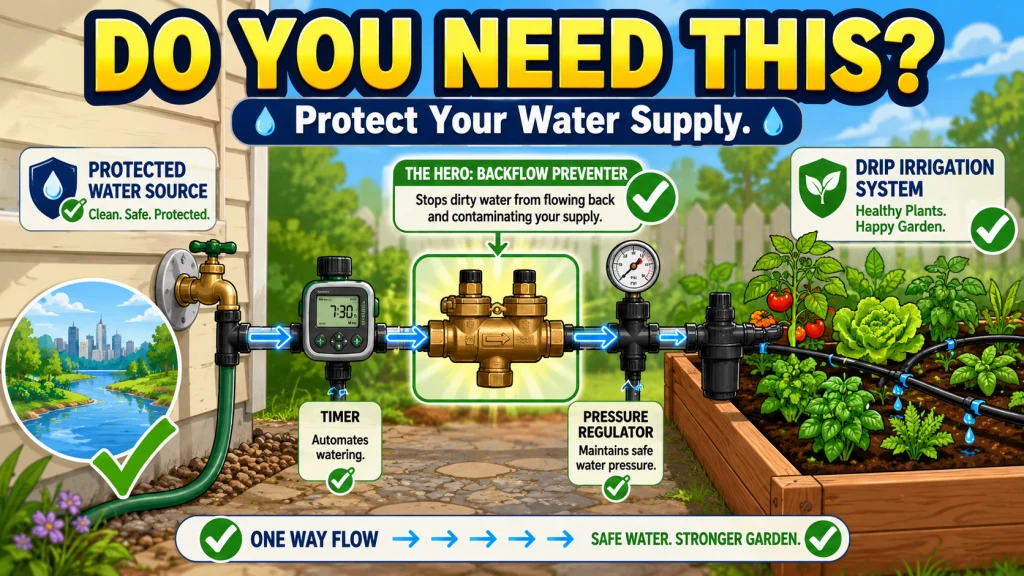
A backflow preventer on a raised bed drip system does one specific thing: it stops water from flowing backward out of your drip lines and into your home’s drinking water supply. In most US jurisdictions that protection is not optional. It is a code requirement on any outdoor irrigation connection to a potable water line, including a standard garden hose bib. This covers what backflow actually is, why a vegetable garden raises the risk compared to a clean landscape bed, what the legal situation looks like in most areas, and where the component goes in the assembly order.
What Backflow Is and Why a Vegetable Garden Makes It Matter
Water in a residential supply system flows in one direction under normal conditions. Pressure from the main keeps it moving from the street into the house. What most people do not think about is what happens when that pressure drops. During a water main break, a firefighting draw on a nearby hydrant, or a sudden pressure surge in the distribution system, the pressure balance can reverse temporarily. When it does, water that was sitting in your drip lines can be pulled backward into the supply line and from there into the house plumbing.
In a raised bed vegetable garden, that standing water in the drip lines is not clean. It has been sitting in contact with garden soil, organic matter, and whatever you have applied to the bed. If you use any kind of fertilizer injection through the drip system, the risk goes up further. Backflow from a drip system in direct contact with soil and plant material introduces microbial contamination into a potable water supply in a way that a simple filter at the hose bib does not prevent. A filter catches particles. A backflow preventer stops the reverse flow before it starts.
I want to be clear about what I am not saying here. Backflow from a residential drip system is not a daily hazard. The conditions that cause it, a significant pressure drop in the main, do not happen on a normal watering day. But they do happen, and the vegetable garden is a higher-contamination source than most people picture when they think of outdoor water use.
Field Note: The question I get most often when explaining backflow preventers to homeowners is some version of “but the water just drips out, how could it go backwards?” The answer is that drip lines hold standing water when the system is off. The emitters are small and the tubing retains water between runs. That sitting water is what gets pulled backward if the main pressure drops while the lines are connected.
The Legal Requirement Most Homeowners Do Not Expect
Most US municipalities require backflow prevention on any connection between an irrigation system and a potable water supply. That requirement typically applies to residential hose bibs the same way it applies to in-ground irrigation systems. The specific device required and the enforcement level vary by city and state, but assuming no requirement exists in your area is the wrong starting assumption.
The practical reality for a raised bed drip gardener is that a simple hose-thread vacuum breaker, which costs a few dollars and threads directly onto the hose bib before the rest of the head assembly, satisfies the requirement in most jurisdictions. Some areas with stricter plumbing codes require a dedicated atmospheric vacuum breaker or a more substantial device. The only way to know which applies to you is to check with your local public works department or water utility before installation. Most utilities have a short FAQ or code reference on their website that covers residential irrigation.
What I find in the field is that the majority of homeowners with raised bed drip systems install everything except the backflow preventer, usually because the kit instructions list it as a separate purchase or the local code requirement was never surfaced when they were buying components. The installation works fine either way during normal operation. The question is whether it is legal in your jurisdiction and how much harder it becomes to defend the setup if a contamination issue ever comes up.
Key point: Do not assume no requirement applies. Check with your local public works department or water utility before completing a permanent hose bib drip connection. The backflow preventer requirement for residential irrigation is more common than most DIY drip guides acknowledge.

This brass vacuum breaker protects potable water lines by preventing fluid backflow or siphoning from irrigation systems. A self-draining mechanism automatically clears water from the valve on shutoff, and a break-off screw allows permanent installation. The heavy-duty brass body is corrosion-resistant for long-term outdoor reliability.
Check On AmazonIf you click this link and buy, we earn a commission at no additional cost to you.
When a Backflow Preventer May Be Optional or Different
The legal and contamination case for a backflow preventer is tied to one specific condition: the drip system connects to a potable water supply. For the majority of home gardeners using a standard hose bib attached to the house water line, that condition is met and the requirement applies. But not every raised bed drip setup uses that water source.
If your system runs from a closed rain barrel that is not connected back to the home’s water supply, the code and contamination calculus changes. The water in the barrel is not potable and the connection does not create a cross-contamination path to the drinking water line, so the standard hose-bib backflow requirement may not apply in the same way. That does not mean no precautions are needed, but the driver is different. Check with your local authority before assuming either direction.
Private wells are another case that shifts the question. A well-fed raised bed system can still create a cross-connection risk if the well, pressure tank, and house water share the same plumbing. Whether a backflow preventer is required and what type depends on how the well system is plumbed and what the applicable code authority says about it. If you are not sure how your well connects to the outdoor hose bibs, that is the first thing to confirm before buying components.
The short version: if the drip system connects to the same supply that feeds indoor drinking water, plan on a backflow preventer. If the system runs from a truly isolated non-potable source, confirm your situation before assuming the same rules apply. For most gardeners with a standard city water connection, the simpler rule holds.

This multi-function kit connects 1/2 inch drip tubing to any 3/4 inch male threaded faucet or garden hose, helping ensure your drip irrigation system runs properly. It includes a backflow preventer, a 25 PSI pressure regulator, and a 150 mesh filter, along with a compression fitting that creates a leak-proof seal to 1/2 inch tubing. Built from UV and chemical-resistant materials for long-lasting durability, the kit can also be paired with a compatible Rain Bird hose-end timer for automated watering.
Check On AmazonIf you click this link and buy, we earn a commission at no additional cost to you.
Three Backflow Preventer Options for a Raised Bed Setup
For most hose-bib raised bed setups, the backflow prevention options are simple and inexpensive compared to what larger irrigation systems require. Most small vegetable garden systems do not involve the same buried vaults or tested reduced-pressure assemblies common in larger installations, unless local code specifically requires that level of protection. The three options below cover the practical range most home raised bed gardeners will encounter.
Simple Hose-Thread Vacuum Breaker
This is the most common device in residential drip kits and the one most homeowners end up with. It threads directly onto the hose bib and uses an atmospheric vent to break the siphon if supply pressure drops. Under normal flow, water pressure keeps the device sealed. If pressure falls enough to create a backsiphonage risk, the vent opens to admit air and stops contaminated water from being drawn backward into the supply line. It is inexpensive, widely available, and satisfies code in most residential jurisdictions. In a typical 4-by-8 raised bed setup with one or two drip zones on a single hose bib, this is what belongs at the top of the head assembly.
Atmospheric Vacuum Breaker
An atmospheric vacuum breaker is a more robust version of the same concept. Some jurisdictions with stricter plumbing codes require this type specifically for any outdoor connection, even at the hose bib level. It operates on the same principle as the simple vacuum breaker but is built to a higher spec and is independently rated. If your local code requires a specific device type, the atmospheric vacuum breaker is the residential step up from the basic hose-thread version. A few irrigation supply retailers sell these as standalone units that thread into the same position in the head assembly.
4-in-1 Faucet Adapter
A 4-in-1 faucet adapter combines a backflow preventer, a filter, a pressure regulator, and a hose-thread connection into one compact unit that attaches directly to the hose bib. For a gardener setting up a single raised bed or two, this simplifies the assembly considerably. The tradeoff is that you cannot independently swap out a failed pressure regulator or clean just the filter mesh without replacing the whole unit. For a small setup running one or two beds, the convenience usually outweighs that limitation. For a larger setup with multiple beds or different pressure zones, individual components give more control.
| Option | Best For | Trade-off |
|---|---|---|
| Simple hose-thread vacuum breaker | Most residential raised bed setups; satisfies code in most areas | May not meet stricter local code requirements |
| Atmospheric vacuum breaker | Areas with stricter plumbing codes; higher-spec installations | Costs more; check local code before buying |
| 4-in-1 faucet adapter | Single or two-bed setups; gardeners who want a simpler assembly | Cannot service components individually |
Which option fits your setup comes down to two things: what your local code actually requires, and how many beds you are running from a single bib. If you have four or more beds with separate pressure zones, individual components at each position in the head assembly give you more flexibility when something needs cleaning or replacing mid-season.

This backflow preventer connects via three-quarter inch female hose thread to any standard hose bib or faucet, with a three-quarter inch male hose thread outlet for attaching timers, pressure regulators, supply tubing adapters, or garden hoses. It prevents impure water from reversing into the clean water supply and includes a removable filter washer to block particles that could clog downstream emitters.
Check On AmazonIf you click this link and buy, we earn a commission at no additional cost to you.
The Practical Risk If You Skip It
In a normal residential raised bed setup with no fertilizer injection, the practical contamination risk from skipping a backflow preventer is low during routine watering. The system runs on a timer, water flows out through the emitters, and the lines sit idle between cycles. Nothing unusual happens most of the time.
The risk becomes real under a specific set of conditions. All of the following have to line up for backflow contamination to occur:
- The drip system is connected to the hose bib with water still in the lines
- The municipal water main experiences a significant pressure drop, which happens during water main breaks, large firefighting draws on nearby hydrants, or surge events in the distribution system
- The drip lines are in contact with soil, organic material, or fertilizer residue at the time of the pressure event
- There is no other backflow prevention device between the drip system and the potable supply
None of those conditions are extreme, and they do not all require a dramatic event. A water main break a few blocks away during watering season while your emitter lines are sitting in wet garden soil is not a rare combination in many parts of the country. The contamination risk per household may be low, but the mechanism is real and the public health reason for the code requirement is not arbitrary.
The other practical issue with skipping it is the legal one. If a code inspection or a utility audit finds a drip connection to a potable hose bib without backflow prevention, the requirement to fix it typically falls on the homeowner. That is a minor inconvenience when the system is easy to access, and a more involved one if the lines are already buried or integrated into a garden bed that has been planted for a season.
Where the Backflow Preventer Goes in the Assembly
Placement in the head assembly is straightforward but worth being specific about, because some kit diagrams show it in the wrong position. The backflow preventer goes between the timer and the filter, never after the filter or after the pressure regulator.
The correct order from hose bib outward is: timer first, then backflow preventer, then filter, then pressure regulator, then the adapter to mainline tubing. The backflow preventer needs to sit as close to the supply side as possible to protect the full length of the connection. Placing it after the filter or after the pressure regulator leaves a section of the head assembly outside the protection zone, which defeats the purpose. Placing it after the timer but before everything else gives maximum coverage without interfering with how the timer, filter, or regulator function.
Note: Some 4-in-1 faucet adapters incorporate the backflow device inside the unit in a fixed order that you cannot rearrange. That is fine because the unit is designed to sit directly on the hose bib, which puts the backflow function at the correct position in the assembly by default.
The full assembly explanation, including how each component fits in sequence and which thread standards to watch for when connecting them, is in the raised bed drip irrigation head assembly. The backflow preventer placement covered here is one piece of that order, but understanding how the filter, regulator, and adapter connect after it helps you buy the right fittings before you start.

This pre-assembled kit combines a backflow preventer, 150 mesh filter, and Senninger 25 psi pressure regulator into a single ready-to-use unit that connects any standard three-quarter inch faucet, hose bib, or spigot to a half-inch drip system in seconds. The leak-proof tubing connector fits any half-inch tubing with an inner diameter between 0.520 and 0.620 inches, including Rain Bird and Dig brands. If using a timer, this assembly installs directly after it.
Check On AmazonIf you click this link and buy, we earn a commission at no additional cost to you.
Final Thoughts: Match the Device to the Source Before the Assembly Goes In
The backflow preventer is the one component in a raised bed drip head assembly that requires a short check before buying, not just before installing. The device type, the placement, and whether one is required at all depend on your water source and your local code, not on the drip kit instructions alone. Most kits either include a basic vacuum breaker or list it as a separate add-on without explaining why it matters or what your area specifically requires.
Three things worth confirming before the assembly goes together: what your water source is (city supply, well, or rain barrel), what your local utility or code authority requires for residential irrigation connections, and whether a single combined adapter or separate components makes sense for your bed count. Get those right and the rest of the assembly falls into a clear order.
For the broader picture of how each component in a raised bed drip system fits together, from the hose bib to the emitters, the raised bed drip irrigation setup covers the full process. And if you are still working through which components your setup needs before committing to a layout, the raised bed drip irrigation components is the right starting point.
FAQs
🚿 Do I need a backflow preventer for raised bed drip irrigation?
In most US jurisdictions, yes. A backflow preventer is required by code on any outdoor irrigation connection to a potable water supply, including residential hose bibs. The specific device required varies by municipality. Check with your local public works department or water utility to confirm what your area requires before installation.
💧 What does a backflow preventer actually do in a drip system?
It stops water from flowing backward from your drip lines into the home water supply when main line pressure drops. In a vegetable garden, drip lines in contact with soil and organic matter hold contaminated water between cycles. Without a backflow preventer, a pressure event in the main can draw that water into the potable supply.
🌱 What is the difference between a vacuum breaker and a backflow preventer?
A vacuum breaker is a type of backflow preventer. The term “backflow preventer” covers the category of devices that stop reverse water flow. A vacuum breaker specifically works by venting to atmosphere when pressure drops, which breaks the siphon before backflow can occur. For residential raised bed drip use, a hose-thread vacuum breaker is the most common device installed.
📍 Where does the backflow preventer go in the drip head assembly?
Between the timer and the filter, as close to the hose bib as possible. The correct order from the bib outward is: timer, backflow preventer, filter, pressure regulator, then the mainline adapter. Placing the backflow preventer after the filter or regulator leaves part of the assembly outside the protection zone.
⚠️ What happens if I skip the backflow preventer on a raised bed drip system?
The practical contamination risk during normal operation is low but not zero. The real issue is the legal one: most jurisdictions require it on any residential irrigation connection, and a code audit can require you to add it after the fact. In a vegetable garden with soil and fertilizer contact, skipping it also leaves the water supply unprotected if main pressure drops during a storm event or a nearby main break.
🔧 Can a 4-in-1 faucet adapter replace a separate backflow preventer?
For most residential raised bed setups, yes. A 4-in-1 adapter includes a backflow device along with a filter, pressure regulator, and hose connection in one unit. It attaches directly to the hose bib and places the backflow function at the correct position in the assembly. Check that it meets your local code requirement before purchasing, since some jurisdictions specify the device type.