1/2-inch mainline can run about 200 feet from the spigot under most residential pressure conditions before the emitters at the far end start receiving meaningfully less water than the ones near the start. This guide explains why distance causes that drop in the first place, roughly how much pressure you lose per 100 feet, and what your options are once your beds sit far enough away that 200 feet is not enough. The short version: friction inside the tubing eats pressure with every foot of travel, and once that loss gets too large, the fix is either splitting into zones, adding a second spigot, or upsizing part of the run to PVC.
Why Distance Reduces Pressure in a Drip Irrigation Mainline
Water moving through tubing experiences friction loss, and that friction loss is the main reason mainline distance matters for raised bed drip irrigation. Every foot the water travels through 1/2-inch tubing costs a small amount of pressure, and that loss adds up steadily rather than happening all at once at some specific distance. There is no single point where the system suddenly fails. There is a slow bleed of pressure that eventually becomes large enough to show up as weak emitters at the far end of the run.
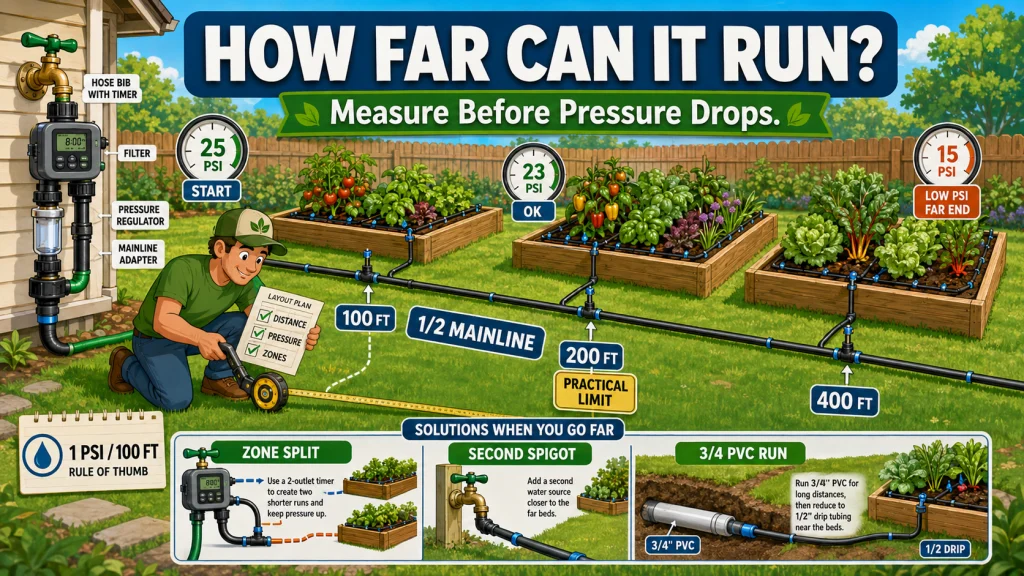
At standard residential flow rates, 1/2-inch tubing loses roughly 1 PSI per 100 feet of mainline under load. That number sounds small until you walk it out across a longer yard, and real layouts can lose more once you add fittings, tees, elevation changes, and several beds drawing water at the same time. At 200 feet, a system starting at 25 PSI right after the pressure regulator often arrives at the far bed somewhere around 23 PSI, which is still well within the range most drip components need to perform normally. At 400 feet, especially with higher flow demand or marginal starting pressure, the far end can drop low enough to noticeably slow down emitters and drip tape compared to the beds closer to the spigot.
This is also why two yards with the same number of beds can behave completely differently. A garden with beds clustered within 50 feet of the spigot barely notices friction loss at all, while a garden with the same bed count spread across 300 feet of yard is already fighting a pressure problem before a single emitter clogs or a single filter gets dirty.
The 200-Foot Rule and Where It Comes From
Homestead and Chill has confirmed that 90 to 100 feet of 1/2-inch mainline works well for a 5-bed setup, and they specify that systems running past 200 feet benefit from splitting into separate zones rather than pushing one continuous mainline further. That 200-foot figure is the closest thing to an agreed practical limit for raised bed drip irrigation mainline, even though it is more of a planning guideline than a hard physical wall.
| Mainline length | Approximate pressure at the far end (starting at 25 PSI) |
|---|---|
| 100 feet | Around 24 PSI, no meaningful issue |
| 200 feet | Around 23 PSI, still generally acceptable |
| 400 feet | Can drop low enough to cause a noticeable performance loss, especially with higher flow demand |
DripDepot does not publish a single hard maximum for mainline length, but their guidance does recommend pressure-compensating emitters specifically for systems where pressure variation across the layout is expected. That recommendation lines up with the idea that distance-related pressure loss is a real factor worth designing around, which supports the friction loss numbers above rather than contradicting them.
Field Note: the mistake I see most with this rule is treating 200 feet as a strict cutoff instead of a planning threshold. A 220-foot run with low plant count and a generous starting pressure may still perform fine. A 150-foot run feeding a heavy crop load with marginal starting pressure can already show uneven watering well before that number.
When 200 Feet Is Not Enough
Once your layout genuinely needs more distance than the practical mainline limit comfortably allows, there are three realistic paths forward, and which one fits depends on your yard and how permanent you want the solution to be.
- Splitting the system into two zones from a single 2-outlet timer, so each zone only has to push water across half the total distance instead of the full run.
- Running a second mainline from a second outdoor spigot if your yard has one available, which sidesteps the distance problem entirely by shortening the path each line has to travel.
- Upsizing the mainline itself from 1/2-inch to 3/4-inch PVC for the long stretch, then converting down to 1/2-inch drip tubing once the water reaches each bed.
Zone splitting is usually the simplest fix if your beds are already grouped in a way that makes sense to divide, and it doubles as a solution for beds with different watering schedules at the same time. A second spigot is the most situational option since it depends entirely on what your house’s plumbing already gives you access to. The PVC approach is the most permanent and the most effective at reducing the actual physics of the problem, which is worth understanding on its own.

This upgraded hose timer features two separate programmable zones, letting you set custom start times and durations for healthier, water-efficient watering. Upgraded valves reduce flow resistance by 40%, and the IP65 waterproof housing has passed 20,000 cycle testing for long-term durability. It offers auto, manual, and rain delay modes with up to 72 hours of rain delay, plus a 2.5 inch LED display showing schedules, power status, and low battery alerts. The 3/4 inch interface fits most standard faucets, and the large button, rotating design makes setup easy for users of any age.
Check On AmazonIf you click this link and buy, we earn a commission at no additional cost to you.
The 3/4-Inch PVC Hybrid Approach
Homestead and Chill’s own setup uses exactly this hybrid method: 3/4-inch PVC pipe runs from the spigot out to each bed location, and only at the bed itself does the line convert down to 1/2-inch drip tubing for the header and driplines. The reasoning is straightforward once you connect it back to the friction loss numbers above. Larger diameter pipe carries the same volume of water with significantly less friction loss per foot than narrow drip tubing, so the long-distance portion of the run loses far less pressure than it would traveling the same distance through 1/2-inch mainline.
This approach trades simplicity for permanence. Running PVC means trenching, proper joints, and a layout that is not meant to move once it is in the ground, which is a bigger commitment than swapping in a second timer outlet. In exchange, it greatly reduces the pressure drop problem over long distances rather than just working around it, which makes it the right call for a yard where the spigot-to-bed distance is fixed and unlikely to change for years.
If your beds might still move, or you are not ready to commit to a permanent layout, this is the one option on the list worth holding off on until the rest of your garden plan settles.

This pack of 12 one-piece PVC adapters connects half-inch drip irrigation tubing to any three-quarter inch female pipe threaded water source, valve, or sprinkler head without tools, clamps, or glue. The male pipe thread inlet and half-inch poly barb outlet are constructed from UV-resistant, high-impact material for reliable performance in both above-ground and buried drip systems.
Check On AmazonIf you click this link and buy, we earn a commission at no additional cost to you.
Pressure-Compensating Emitters as a Partial Fix
Pressure-compensating emitters maintain roughly consistent output across a range of about 10 to 30 PSI, which makes them useful once you already have a long run and are not in a position to redo the mainline. They do not fix the underlying pressure drop the way upsizing to PVC does. What they do is keep the emitters at the far end of a long run functioning closer to normal even when the pressure reaching them has already dropped into the lower part of that range.
Think of pressure-compensating emitters as damage control rather than a cure. They are worth using on any bed that sits near the far end of a long mainline, especially if a full zone split or PVC upgrade is not realistic right now, but they will not rescue a system where pressure has already fallen well below the 10 PSI floor they need to work properly.

This complete kit covers up to three standard 4 by 8 foot raised beds and includes 50 feet of half-inch mainline tubing, 50 feet of quarter-inch micro tubing, 100 feet of quarter-inch soaker dripline with 12-inch emitter spacing, and over 80 fittings, plugs, and stakes. A 30 psi pressure regulator, inline filter, Easy-Loc hose start connector, two figure-8 end closures, and a key punch tool are also included for a fully self-contained setup. No special tools or adhesives are needed for installation.
Check On AmazonIf you click this link and buy, we earn a commission at no additional cost to you.
Final Thoughts: Measure the Distance Before You Commit to a Layout
The 200-foot guideline only matters because friction loss is real and predictable, not because it is some arbitrary number someone picked. Knowing roughly how much pressure you are losing per 100 feet lets you decide early whether your yard needs a single mainline, a zone split, or a more permanent PVC run, instead of finding out the hard way when the last bed in the sequence starts underperforming.
If you have not worked out how your beds will connect to the mainline in the first place, the broader overview of how to connect drip irrigation to raised beds covers that connection layout before distance becomes the deciding factor. For yards with several beds where zone splitting is the likely answer, the fuller breakdown on drip irrigation for multiple raised beds goes into how that grouping works in practice, and the wider planning context sits in the raised bed drip irrigation setup guide.

These green-coded emitters deliver a consistent 2 gallons per hour regardless of pressure fluctuations, making them well suited for sandy soil conditions. They attach to the end of quarter-inch feeder line or punch directly into half-inch supply tubing, and a turbulent flow design helps flush out sediment to reduce clogging over time. Ideal for individual shrubs, trees, and container plants.
Check On AmazonIf you click this link and buy, we earn a commission at no additional cost to you.
FAQs
📏 How far can drip irrigation mainline run for raised beds?
1/2-inch mainline generally holds acceptable pressure up to around 200 feet under typical residential pressure. Beyond that, the far end of the run starts losing enough pressure to notice in emitter and drip tape performance.
💧 How much pressure does drip irrigation lose over distance?
At standard residential flow rates, 1/2-inch tubing loses roughly 1 PSI per 100 feet under load. A 200-foot run typically drops a couple of PSI, while a much longer run can lose enough pressure to weaken the far end once real layout losses are included.
🔧 What can I do if my raised beds are too far from the spigot for one mainline?
Split the system into two zones from a 2-outlet timer, run a second mainline from a second outdoor spigot if one is available, or upsize the long stretch to 3/4-inch PVC before converting to drip tubing at each bed.
🧱 Why does upsizing to PVC help with pressure drop?
Larger diameter pipe carries the same flow with less friction loss per foot than narrow drip tubing. Running 3/4-inch PVC for the long stretch and converting to drip tubing at each bed reduces pressure loss over long distances.
⚙️ Do pressure-compensating emitters fix mainline pressure drop?
Not directly. They maintain consistent output across roughly 10 to 30 PSI, which helps emitters at the far end of a long run keep working closer to normal, but they do not eliminate the pressure loss itself.
🚿 Does a longer mainline always mean a weaker drip system?
Not automatically. A long run with low plant count and strong starting pressure may still perform fine past 200 feet, while a shorter run with a heavy crop load and marginal starting pressure can show problems sooner.